

Since the launch of its mainnet on March 27, 2025, Walrus has steadily emerged as one of the most closely watched infrastructure projects in the decentralized data space. Rather than chasing short-term hype, Walrus has focused on building credibility through funding, real integrations, and partnerships that demonstrate practical demand for decentralized storage.
One of the strongest signals of confidence came from its funding trajectory. The Walrus Foundation successfully raised $140 million in a private token sale, reflecting strong institutional belief in decentralized data availability as a long-term narrative. This level of backing places Walrus among a small group of infrastructure projects with the capital needed to scale globally, incentivize node operators, and support long-term ecosystem development.
Beyond funding, Walrus has focused on proving real-world utility through strategic partnerships. In the NFT sector, Walrus partnered with Pudgy Penguins, one of the most recognizable consumer-facing NFT brands, to support decentralized media storage. NFT ecosystems depend heavily on reliable and permanent data availability, making this collaboration a strong validation of Walrus’ storage model.
Walrus has also expanded aggressively into the AI data landscape. Integrations with platforms such as Space and Time and OpenGradient highlight its role as a scalable data layer for AI training and analytics. As AI models increasingly rely on large, verifiable datasets, Walrus positions itself at the intersection of Web3 and machine intelligence, where data integrity and availability are critical.
From a market perspective, WAL has already experienced a full cycle of price discovery. The token reached an all-time high of approximately $0.87 USD in May 2025, driven by mainnet excitement and early adoption narratives. Like many infrastructure tokens, WAL later retraced as the broader market cooled and speculative interest rotated elsewhere. Today, WAL trades around $0.15 USD, a level that many view as reflecting infrastructure valuation rather than hype-driven momentum.
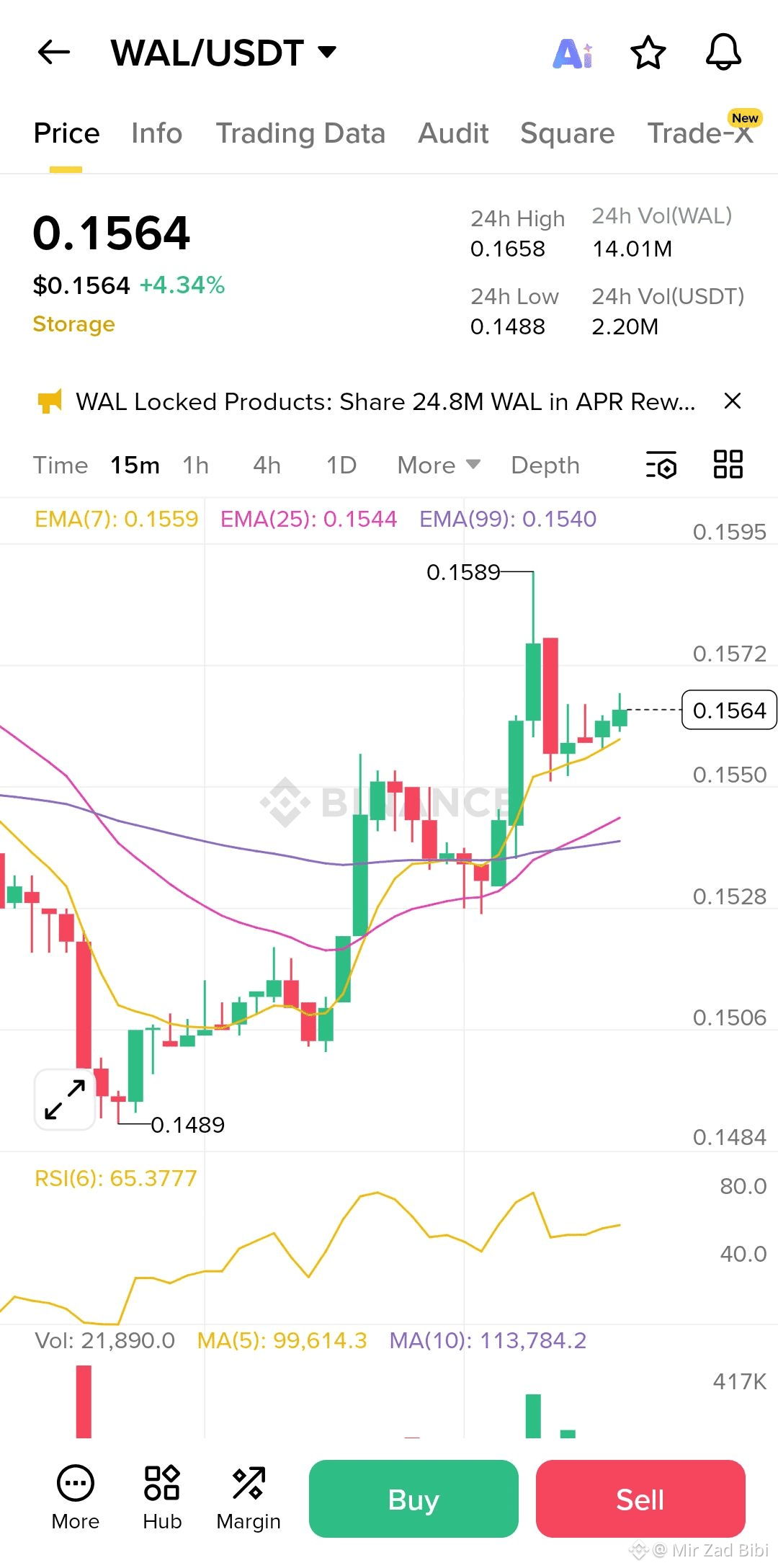
Despite the price pullback, onchain and market activity remain healthy. WAL maintains a 24-hour trading volume exceeding $19 million, signaling sustained liquidity and ongoing market participation. The token is available across major trading venues and can be accessed directly through tools like the Binance Web3 Wallet, making it easily accessible to both retail users and onchain-native participants.
What makes Walrus particularly compelling is how its market position aligns with long-term demand trends. AI training, decentralized gaming, NFT media, and DeFi applications are all becoming more data-intensive. At the same time, reliance on centralized cloud infrastructure increasingly conflicts with the principles of decentralization, censorship resistance, and trust minimization. Walrus directly addresses this gap by offering scalable, verifiable, and decentralized data storage designed for production use.
Rather than positioning itself as a speculative narrative, Walrus is building quietly as foundational infrastructure. Its partnerships demonstrate real usage, its funding provides long-term runway, and its token economics tie value to actual network demand. As decentralized applications mature and data becomes the most valuable resource in Web3, protocols that secure and distribute that data will sit at the core of the ecosystem.
Walrus is not trying to win attention through noise. It is positioning itself to be indispensable. If decentralized data becomes as critical as decentralized execution, Walrus and the WAL token may increasingly be viewed not as optional exposure, but as core infrastructure for the next generation of Web3 and AI-native applications.

