

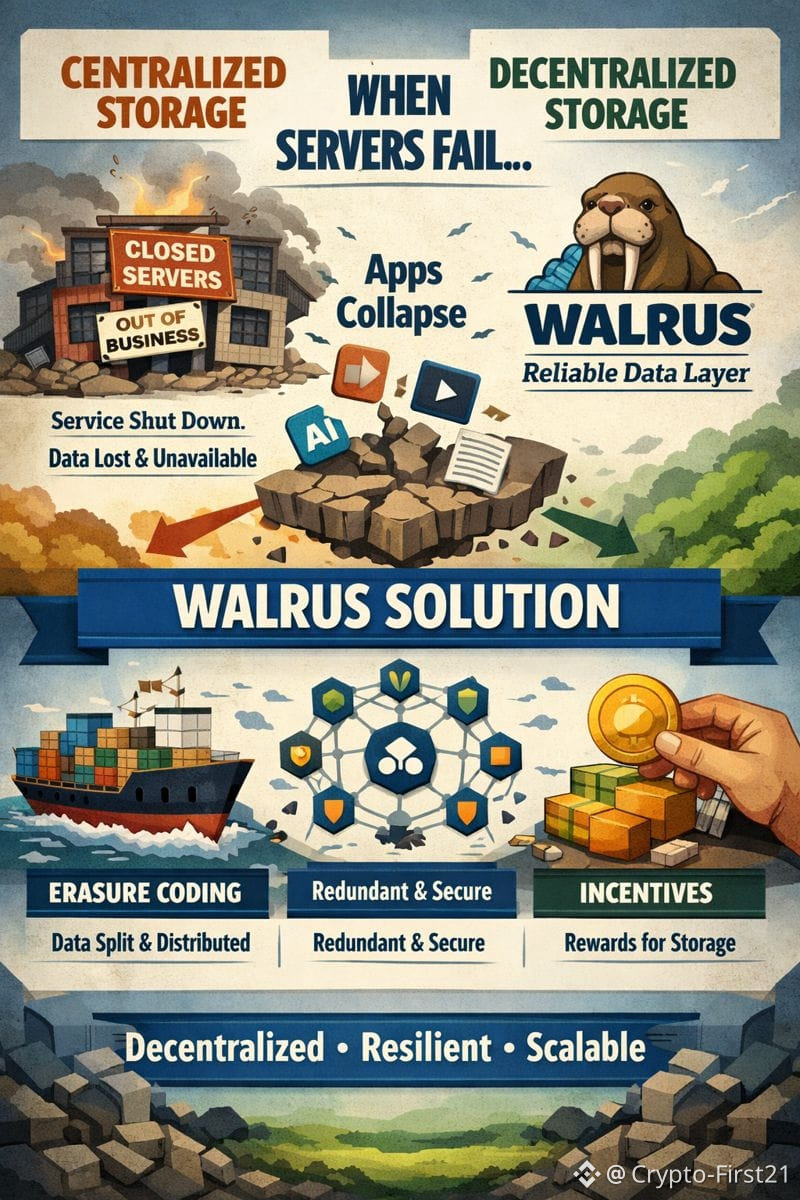
I first started paying attention to decentralized storage not because it was a whitepaper, but because of a very ordinary problem. I was trying to get at old data from a service that was no longer around. The files weren't "lost" in the dramatic sense. The company had simply shut down, the servers were gone, and the data vanished with it. That moment has lingered with me since then. It reminded me that most of the digital infrastructure today depends on a few entities deciding to keep operating. And when they stop, everything built on top quietly collapses.
This is the lens through which I look at Walrus and why its token exists.
That's from a trader-investor's point of view. Walrus has nothing to do with speculative narratives or short-term excitement; it is about a structural gap in Web3. We have decentralized money, we have decentralized execution through smart contracts, but the data those systems rely on-large files, application state, media, AI datasets-still largely lives on centralized servers or fragile, incentive-poor networks. Walrus was built to put that right.
At its core, Walrus is decentralized storage infrastructure designed for reliability at scale. The problem it solves is easy to explain, but not so easy to implement: What is a good way to store lots of data, do it in a decentralized fashion, make sure it is available over a period of time, and make sure that people are incentive to store it?
In order to understand the importance that follows, one just has to conceptualize blockchains in relation to accounting. Blockchains are excellent for managing ownership and state transitions, but abysmal for storing media assets. It is like trying to store furniture in a filing cabinet when one puts videos, models, or data directly onto a blockchain. It is expensive, inefficient, and just plain unnecessary. Storage has its own level.
Traditional cloud storage deals with this problem by making everything centralized. Trust Amazon, Google, or another company to store your files, back them up, and make them available, you’re supposed to. That’s great—but what happens when it isn’t. Walrus is necessary because decentralized tech can’t afford to go back to relying upon those centralized storage solutions.
What differentiate Walrus is the fact that it aims for reliability in terms of design, not trust in the network. Rather than keeping copies of data on each node, Walrus uses something called “erasure coding.” This means that data is chunked into lots of pieces and encoded so that it can still be decoded if some of the pieces are lost. This is much like how data centers prevent loss of data from failed disks, but for independent nodes in a network.
A good example is shipping cargo using many routes in contrast to a single highway. Even if some routes are closed, the cargo still succeeds. This is because Walrus does not think every node will act well. Instead, it expects failure.
For an investor, this is a significant aspect because it impacts the cost and scalability of the system directly. Replicating data fully is costly and secure. Replicating too little is insecure and cheap. Walrus is at a point where the integrity of the data is mathematically enforced and not socially promised. This makes a predictable system, and that is what investors want in infrastructure.
A token named Walrus operates to manage this process. Its purpose is not abstract. Storage participants require incentives to contribute their resources and keep them available. Storage providers must be rewarded for donating storage and keeping it up and running. Storage users need a system that charges them based on real-world usage. The token is what mediates between these two groups.
When a user archives data, he or she has to pay a fee in terms of the Walrus token price. These fees will be shared with storage nodes that are capable on the basis of performance and availability. Storage nodes which fail may be penalized. Thus, there is a feedback mechanism: desirable storage is incentivized, while undesirable is penalized. In due course, it grows to ensure speculability is avoided.
Walrus enters a market where there is a shift in demand pertaining to data. AI models are fed massive amounts of data. Data generated by games on the blockchain cannot reside on a traditional blockchain. Corporations experimenting within a blockchain infrastructure require similar access to data, such as Web2. Decentralized storage ideas have grown in significance because they have practical applications when under stress.
But one has to remain grounded. Walrus does not provide a solution for every problem. A decentralized storage network is a hardware-heavy business. It doesn’t only require nodes to have hardware but also bandwidth. The reward structure for tokens has to be attractive enough for that to happen. In case there isn’t much demand for storage, it may impact economics. A flawed structure for decision-making may destroy trust in a network. This is not something that should be in a footnote.
There’s adoption risk too, of course. If the development community likes what it knows, it’ll use it. Walrus has to compete on merit, not just on philosophy. Reliability, tools, price, Walrus has to compete in all these areas too. Infrastructure wins not when it’s interesting, but when it’s dull and reliable.
From a trader’s perspective, this means Walrus is to be assessed against a set of standards not considered for narrative tokens. Here, its value proposition is tied to its usage and not attention. Taking into consideration factors such as the volume of stored data, number of active nodes, percentage uptime, and usability in applications is far more important than social media sentiment.
What fascinates me about Walrus is that it's not trying to offer a solution that replaces cloud storage in, say, a year. It doesn’t. Its relevance is in providing an option that matches the decentralization of the systems structurally. Blockchains, in their quest to handle practical applications over long periods of time, require storage levels that don’t vanish when the strategy of the organization changes or when the server goes down.
In this regard, being like Walrus and being a startup that is growing and trying to expand its reach is not its characteristic; rather, it’s like a public utility that is being developed slowly. Utilities are not those that people cannot wait to use or are very fascinating, but without them, societies fail. In this regard, being a long-term investor, this perspective can be very important.
It is my opinion, while tentative, that Walrus is a project whose time has come because decentralized networks require a reliable data layer, and it is by no means a problem that will be resolved in the near future. The existence of a cryptocurrency is to ensure a sustainable data layer. It is a project with risks but no promises.
But to this crypto systems thinker, not crypto story listener, Walrus represents a serious effort to solve a real problem: not loudly, not quickly, but in the way lasting infrastructure is usually built.

