
Walrus was born from a quiet problem most people learned to live with. In early Web3, storage existed in a strange gray area. Data stayed available as long as everything went right. Nodes stayed online. Providers stayed interested. Links didn’t break. No one said it out loud, but everyone understood the rule: storage was “best-effort.” If something vanished, it was unfortunate, but rarely treated as a real failure. Walrus exists because that old assumption finally broke.

For years, best-effort storage shaped how builders thought. Developers learned not to trust memory too much. Apps were built with the idea that parts of them might disappear. Big features felt risky. Long-term plans felt fragile. Data could be referenced, but never fully relied on. Web3 moved forward, but it did so while quietly accepting loss as normal.
That mindset only worked when expectations were low.
As Web3 grew up, the cracks became impossible to ignore. Financial systems needed records they could depend on. Games needed worlds that didn’t reset or decay. Identity needed history that mattered. Governance needed archives that couldn’t quietly vanish. At this stage, availability stopped being a nice bonus and became a basic requirement. Walrus represents the moment Web3 stopped hoping data would survive and started designing systems where survival is the point.
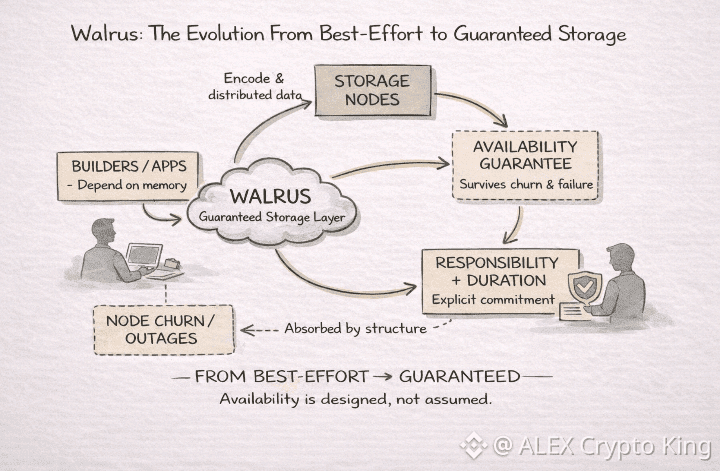
Guaranteed storage doesn’t mean pretending failure won’t happen. Walrus takes the opposite view. It assumes failure is normal. Nodes will leave. Incentives will shift. Networks will weaken. Instead of treating these as rare edge cases, Walrus builds around them from day one.
Data on Walrus is spread across many independent participants. No single node decides whether information lives or dies. Availability doesn’t depend on one provider staying honest, motivated, or online. It depends on structure. When parts of the system fail, the system absorbs that shock and keeps memory intact. Loss becomes something the network handles, not something users silently accept.
This is the real difference between best-effort and guaranteed storage. Best-effort asks, “Will this probably stay available?” Walrus asks a harder question: “What must be true for this to stay available even when things go wrong?” And then it designs directly for that answer.
Guarantees also require honesty. In many systems, no one really knows how long data is meant to last or who is responsible for it. Walrus removes that uncertainty. Storage is intentional. Duration is defined. Responsibility is clear. Data doesn’t survive by accident, and it doesn’t disappear quietly. When something exists, it exists because the system is committed to keeping it there.
The economics follow the same logic. Best-effort storage often relies on upfront payment and long-term hope. Walrus aligns incentives with time. Storage providers are rewarded for keeping data available for as long as it is meant to exist. Responsibility doesn’t end after upload. It continues for the full life of the data. The $WAL token becomes part of this promise, tied to real demand and real accountability rather than short-lived speculation.
That shift changes behavior across the ecosystem. Builders stop designing for decay and start designing for durability. Users stop treating on-chain data as temporary. Systems begin to accumulate history instead of losing it. Trust grows not because someone made louder promises, but because the system itself enforces them.
The move from best-effort to guaranteed storage isn’t about hype. It’s about raising standards. Early Web3 could afford uncertainty. The next phase cannot. Infrastructure that forgets will eventually weaken everything built on top of it.
Walrus understands that decentralized systems are only as strong as their memory. And memory must survive real conditions, not ideal ones. By treating data availability as a core responsibility instead of a hopeful outcome, Walrus helps Web3 grow from something experimental into something dependable.
This is how Web3 stops relying on luck and starts relying on design. Walrus is built for that transition and for the future that comes after it.