
Data storage is essential to our day-to-day existence. We rely on storage solutions to maintain the security and accessibility of our data, from private images to crucial corporate documents. However, there are a lot of drawbacks to conventional storage techniques, particularly when it comes to decentralization, scalability, and security.
In order to overcome these constraints, the Walrus Protocol provides a decentralized, scalable, and affordable way to store large binary objects, or "blobs." This protocol ensures users have complete control over their data by utilizing blockchain technology to provide safe, effective, and dependable data storage.
However, what distinguishes the Walrus Protocol from alternative storage options? Let's examine its technical architecture, salient characteristics, and useful applications in order to provide an answer. The Walrus Protocol is thoroughly explained in this article, along with its special features and practical applications.
An overview of the Walrus protocol
The Walrus Protocol, created by Mysten Labs and introduced in 2024, is a decentralized data availability and storage solution based on the Sui blockchain that is presently only in testing. It is especially made to manage big binary files, like PDFs, videos, and images, in a safe, effective, and economical way.
Walrus disperses data throughout a network of nodes, in contrast to conventional cloud storage services that depend on centralized servers. Users can access their files at any time and from any location thanks to this decentralized approach, which also improves security and lowers the risk of data loss.
The requirement for complete data replication across all validators presents difficulties for traditional blockchain storage, leading to high redundancy, restricted scalability, and inefficiency, particularly for large files. Walrus uses erasure coding to get around these obstacles. By dividing data into smaller pieces while preserving redundancy, this method enables recovery even in the event that some nodes are down.
Walrus reduces storage overhead while maintaining data availability and integrity by utilizing a decentralized network of storage nodes. The protocol manages payment transactions, coordination, and proof of data availability in a seamless manner with the Sui blockchain. Because of this combination, Walrus is a reliable, scalable, and affordable solution that can be used for a variety of applications, which we will discuss in more detail later.
Walrus Protocol's Technical Architecture The Walrus Protocol is intended to guarantee dependable and safe file storage, even in the event of hostile assaults or network outages. Three essential elements make up its architecture: Users are people or programs that save and retrieve files, much as library patrons who check out or return books. Computers that store file fragments that are dispersed strategically to provide for redundancy and recovery are known as storage nodes. Sui Blockchain: The system's central coordinator, which arranges file storage, handles transactions, and guarantees effective functioning. It functions similarly to a library's management software.
The Operation of File Storage
The system uses erasure coding, which splits a file into smaller parts known as "slivers," when a user uploads a file. Walrus saves modified data fragments coupled with extra "repair data," which enables reconstruction even if sections are destroyed, as contrast to a traditional library where volumes are kept in their entirety. In order to prevent any one node from holding the entire file, these slivers are then dispersed over other storage nodes. Each sliver's location is monitored by the Sui Blockchain, which also handles payments to storage nodes for their services. When a user requests a file, the system collects enough pieces from several nodes to reassemble the original file, even if some of the fragments are corrupted or absent.
Safety and Dependability
The Walrus Protocol employs Merkle trees to confirm data integrity in order to improve security. Additionally, it includes fault-tolerant features that enable file recovery even in the event that up to two-thirds of storage nodes are hacked or inaccessible. The Walrus Protocol removes single points of failure by distributing files among several nodes and use blockchain for coordination. This decentralized strategy greatly increases the system's resistance to intrusions and data loss.
Important Walrus Protocol Features
Notable characteristics of the Walrus Protocol set it apart from other storage systems, such as: Click or hit Enter to display the full-size image.
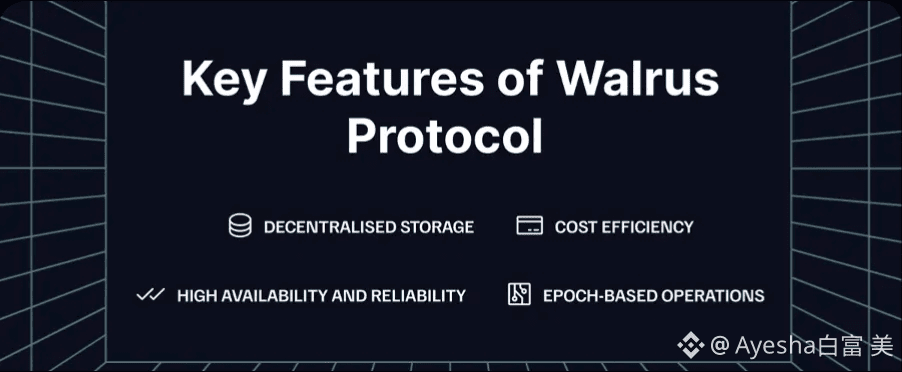
1. Decentralized Storage: Walrus does away with the need for a single central server by distributing data among several storage nodes. Data security and availability are improved by this decentralization.
2. Cost-effectiveness: Walrus lowers storage expenses by using cutting-edge methods like erasure coding. It divides files into smaller bits and stores these fragments across various nodes rather than copying complete files. This technique minimizes storage expense while guaranteeing that data can be reconstructed even in the event that some nodes fail.
3. High Reliability and Availability: Walrus Protocol guarantees that user data is always available, even under dire circumstances. By replicating data across a selection of nodes, it improves availability, dependability, and censorship resistance.
4. Epoch-Based Operations: The network functions within predetermined time intervals known as epochs. A committee of storage nodes is in charge of managing and storing data during each epoch. The network's continued efficiency and the clear division of duties among nodes are guaranteed by this structure.
Use Cases and Real-World Applications of the Walrus Protocol
Numerous sectors, including media, decentralized apps, and NFT marketplaces, employ the Walrus Protocol. Here are a few real-world use examples and useful applications that show the influence of the Walrus Protocol.
Decrypt: One noteworthy application of the Walrus Protocol is the Web3 media firm Decrypt's adoption of it. Decrypt intends to use Walrus to upload and store its content, showcasing the protocol's capacity to effectively manage massive amounts of media data. This use case demonstrates Walrus's ability to assist media companies in need of decentralized content storage solutions.
Walrus Sites: Walrus Sites is a protocol application that makes it possible to build decentralized frontends. This functionality enables developers to create scalable and reliable storage solutions for decentralized applications (dApps). Walrus Sites offer a complete solution for decentralized web application development since they can be connected to Sui objects, such NFTs, and take advantage of Sui's programmability for backend functionality.
Tusky:
The Walrus Protocol's integration with Tusky, a decentralized content storage platform that prioritizes privacy, is a crucial implementation. Tusky makes it easier to upload files for NFTs, website assets, and other digital content by serving as a smooth gateway to Walrus. This demonstrates Walrus's ability to offer users and companies looking for dependable data management safe, effective, and scalable decentralized storage options. TradePort The Walrus Protocol's connection with TradePort, a multichain NFT marketplace, is another useful use.
TradePort:
This intends to store metadata for all NFT projects within its Move-based ecosystem by utilizing Walrus's strong storage capabilities. TradePort highlights the protocol's dependability in supporting NFT infrastructure by using Walrus to assure safe and effective storage for both its current NFT collections and new projects launched through its platform.
Possible Uses for Walrus Protocol in the Future
Other situations in which Walrus Protocol can be used include:
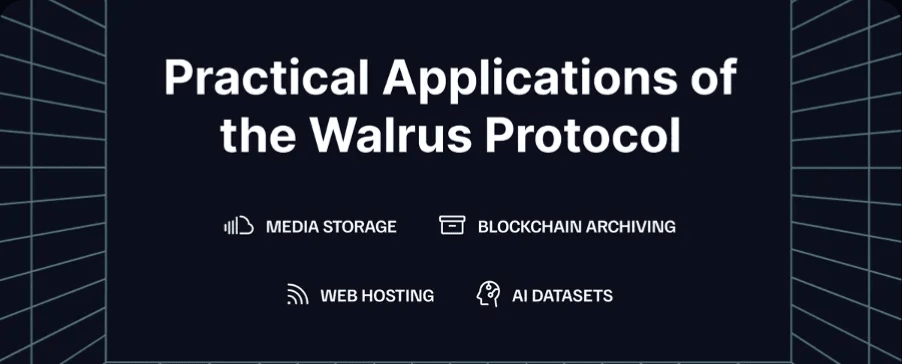
Media Storage: Users are able to store items that are too big for conventional blockchain systems, such as videos and pictures. This guarantees effective, decentralized storage without the high expenses or restrictions of on-chain substitutes.
Blockchain Archiving: The protocol enables ledger data from several blockchains to be archived.
AI Datasets: Because the Walrus Protocol enables training datasets and live-streaming data, AI applications can also profit from it. It improves the performance and dependability of machine learning models that need enormous volumes of data for training by offering a decentralized and scalable storage solution.
Web hosting: Without depending on centralized servers, users can host decentralized websites that are viewable from any browser.
Tokenomics in the Walrus Protocol
The Walrus Protocol's ecosystem is powered by its native token, WAL. The protocol's main currency, WAL, let users to pay for file storage and rewards network maintainers. WAL can be broken down into smaller units called FROST to handle smaller transactions; one WAL is equivalent to one billion FROST.
Staking is one of WAL's primary features. Any registered storage node that users stake with can have an impact on that node's voting weight. Additionally, staked WAL tokens help create the epoch committee, which is in charge of managing network operations for a predetermined amount of time. Similar to paying for cloud storage services, WAL tokens are also used to pay for data storage on the Walrus network in addition to staking. Participants, including storage node operators and stakers, earn WAL token awards for their contributions at the conclusion of each epoch, encouraging active participation in the network.
WAL offers governance privileges in addition to prizes and compensation. A decentralized, community-driven approach to the protocol's evolution is ensured by token holders' ability to vote on significant issues pertaining to network improvements and settings. In addition to increasing accessibility and storage efficiency, this method motivates users to actively support and maintain the network.
Important Walrus Protocol Milestones and Accomplishments
Walrus Protocol has accomplished a number of noteworthy milestones since its inception, demonstrating its expansion and influence in the Web3 industry.
Launched on August 13, 2024, the "Breaking the Ice" Devnet Hackathon was one of its most successful projects. Developers of different skill levels were invited to create creative solutions on the Walrus platform at this event, investigating a variety of use cases like media storage interfaces and decentralized applications. Each team that made the short list received $500, and the community actively participated in the shortlisting process. Developers were able to obtain notoriety and respect within the Walrus ecosystem by sharing a $30,000 prize fund with the ultimate winners. Over 200 developers participated in the hackathon, and ten exceptional creations that made use of Walrus' decentralized storage network were acknowledged. Among the winners were.
Web3 matchmaking platform Sui Meet Cyferio is a computing platform that prioritizes privacy. A decentralized AI network called Sui-ai-agents
Walrus Share: A program for sharing files
SecretLink: An encrypted, safe storage option
Doomsday Protocol: A strategic card game powered by AI .
DriftBottle, de-docker-hub, SuiS3, and SuiPet Projects demonstrating Walrus' infrastructure's adaptability
Before the official announcement, a user on social platform highlighted several other promising projects, including:
Before the official announcement, a user on X (formerly Twitter) highlighted several other promising projects, including:
Cable — an encrypted messaging app
Suitizen — an on-chain identity initiative
Jar Jar File Storage — a decentralised file storage solution
Blob Vault — a secure file encryption platform
Walrus Wayback — a website archiving tool
Suitok — a platform for video creators
These initiatives demonstrate the potential of decentralized technology inside the Walrus ecosystem while displaying the inventiveness and technical prowess of the Web3 community. On September 17, 2024, Walrus opened its public Testnet as a result of the hackathon's success. A data explorer created by Staketab, API endpoints for deletable blobs, and a tokenomics ecosystem for WAL with staking and rewards were among the major features provided during this phase. To improve user interaction within the network, Mysten Labs also created a staking app.
Alongside these technological developments, Walrus introduced SnowReads, a decentralized digital library, to broaden its ecosystem. Using Walrus' decentralized storage for effective and dependable archiving, this platform offers free access to a sizable collection of scholarly articles in disciplines including economics, computer science, and physics.
Encouraging Community Engagement
Walrus has also actively engaged its community through various initiatives, including a meme contest launched on January 22, 2025, with a total prize pool of 955 SUI. At the time of the announcement, one SUI token was valued at $4, according to CoinMarketCap. The contest aimed to encourage creativity and humour while strengthening community participation.
Strategic Partnerships Driving Growth
Beyond these milestones, Walrus has forged strategic partnerships to expand its reach and utility. One of its key partners is Sui, which supports scalable smart contracts for seamless computing. On December 6, 2024, Walrus announced another major partnership with Creditcoin and Spacecoin, aimed at launching a groundbreaking DeFi project to enhance financial services and internet access in underserved regions worldwide.
More recently, on January 28, 2025, TradePort, a multichain NFT marketplace, partnered with Walrus to leverage its decentralised storage for NFT metadata within TradePort’s Move-based ecosystem.
Speaking on the partnership, Daniel Fritsche, Co-Founder of TradePort, stated.
"Object-based NFTs rise far above what the NFTs of the 2022 boom were able to achieve. Thanks to their innate structure, Sui and other Move chains enable dynamic and composable NFTs. Combined with programmable storage, NFT metadata becomes dynamic and responsive, unlocking new use cases.”
In conclusion Walrus Protocol represents a novel shift in decentralized storage by providing a scalable, cost-effective, and efficient substitute for conventional blockchain-based systems. Through the use of erasure coding, decentralized node storage, and a connection to the Sui blockchain, it ensures high availability, reduced replication costs, and security. It is anticipated that the protocol would become an essential part of decentralized data storage, hence facilitating web3 apps and blockchain ecosystems.

