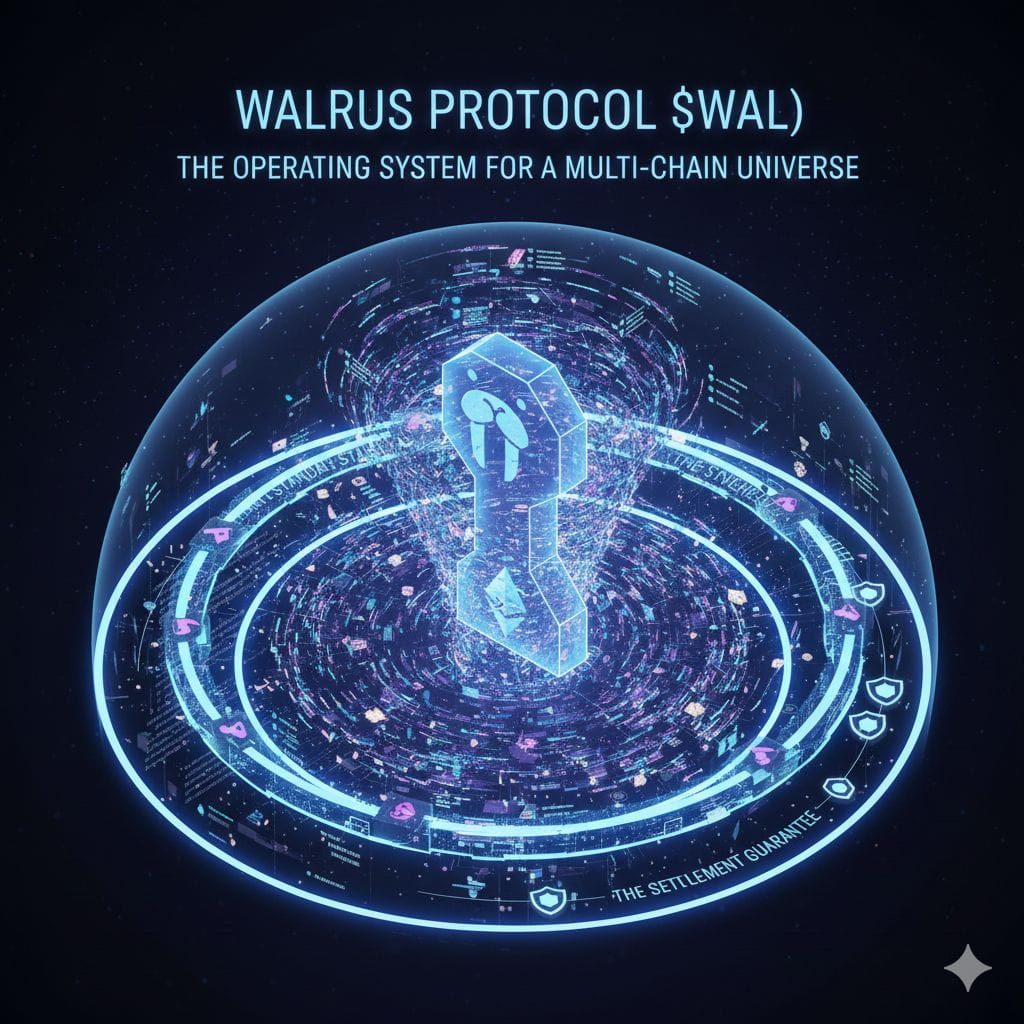
The Existential Problem of FragmentationThe multi-chain thesis has won, but at a severe cost to user experience. An asset's utility is now bounded by its native chain. To escape this, users must become experts in:
Bridge security and trust assumption Destination chain gas economics Liquidity depth across isolated decentralized exchanges The timing and ordering of cross-chain transactions
This is not scalable. It relegates sophisticated DeFi to a niche audience and presents an impenetrable barrier to institutional capital, which demands reliability and best execution above all.
Walrus: Not an App, But an Walrus Protocol distinguishes itself by aiming to be decentralized infrastructure, not another consumer-facing dApp. Its core innovation is creating a market for intent fulfillment
The Three-Layer Value Stac The Intent Standard: Walrus provides the format and settlement layer for a user's declarative statement (an intent). This is akin to establishing a new protocol like HTTP for the intent econom
The Solver Marketplace: A permissionless network of competing agents (solvers) who must stake $WAL to participate. Their profit motive drives them to discover the most efficient, cost-effective path to fulfill a user's intent. This creates a dynamically optimizing routing layer for the entire multi-chain ecosyste
The Settlement Guarantee: Walrus acts as the trustless settlement hub, ensuring solvers are paid only upon provably correct execution and that users either get their desired outcome or revert without.
In this system, not a peripheral governance token. It is the central economic coordination mechanism
Collateral & Security: Solver staking in wal
ensures good behavior and protects the network from spam or malicious bids. The size of the staked pool becomes a measure of network securit
Fee Capture & Value Accrual: While users may pay in any asset, fee settlement and solver rewards are expected to be denominated in $WAL. This creates a direct, non-inflationary value accrual model tied to network usage volum
Governance of the Mesh: Token holders will decide on critical parameters: which chains to integrate, solver bond sizes, fee structures, and protocol upgrades—governing the very plumbing of cross-chain finan.
The "Uniswap Moment" for Intents: The first killer Application-Specific Intent (ASI) built on Walrus—perhaps a one-click, cross-chain leverage engine or a decentralized wealth manager—could trigger a flood of developer and user adoptio
Institutional Adoption as a Best-Execution Venue: Asset managers seeking optimal yield or trade execution across all liquidity venues would find a protocol like Walrus indispensable. This is a multi-trillion dollar addressable marke
Wallet & Front-End Integration: If major wallet providers (MetaMask, Rabby) integrate Walrus as their default cross-chain execution backend, it achieves instant, ubiquitous distributi.
The Liquidity Bootstrap Problem: This is a classic "cold start" issue. The solver network needs volume to be profitable, but users need a reliable, competitive solver network to provide volume. Early incentives and bootstrap funding are critica
Solver Centralization Risk: If solver algorithms become too complex or capital-intensive, a small number of well-funded players could dominate the market, turning a decentralized network into an oligopoly and reintucing points of failur
Existential Competition: Every major DEX aggregator (1inch, Matcha) and cross-chain bridge (LayerZero, Axelar) is actively working on intent-like features. Walrus must out-innovate and out-execute well-funded incumbents with established user base
Smart Contract & Cross-Chain Risk: The protocol's security is only as strong as the weakest chain it connects to and the integrity of its own complex, cross-chain smart contract syste
@walrusprotocol represents one of the most ambitious and necessary visions in the current crypto infrastructure layer. It is not merely improving an existing process; it is attempting to define a new standard for how value moves across chains
The intent-centric model will become the dominant UX for multi-chain interaction
The market will favor a decentralized, permissionless standard over walled-garden solutions from incumbent The Walrus team can navigate the immense technical and go-to-market challenges ahea
The potential reward is a position in the token that powers the "liquidity mesh" for all of DeFi. The risk is the formidable execution challenge. For those with a long-term vision, Walrus is not just a token to watch—it's a fundamental piece of the multi-chain future that demands serious analysi