
In 2026, the blockchain market will be completely out of the hype period. We had been crazed by speed the whole time: a new so-called Etheron killer surfaced weekly, with more TPS and lower costs. That narrative is dead now. We are in the Web3 AI Era and not that the movement of tokens is that swift, but efficient movement of smart data.
This is why traction is no longer achievable by most new Layer-1 launches, and why niche chains such as Vanar Chain are becoming the default choice of gamers and AI folks.
What’s Vanar Chain?
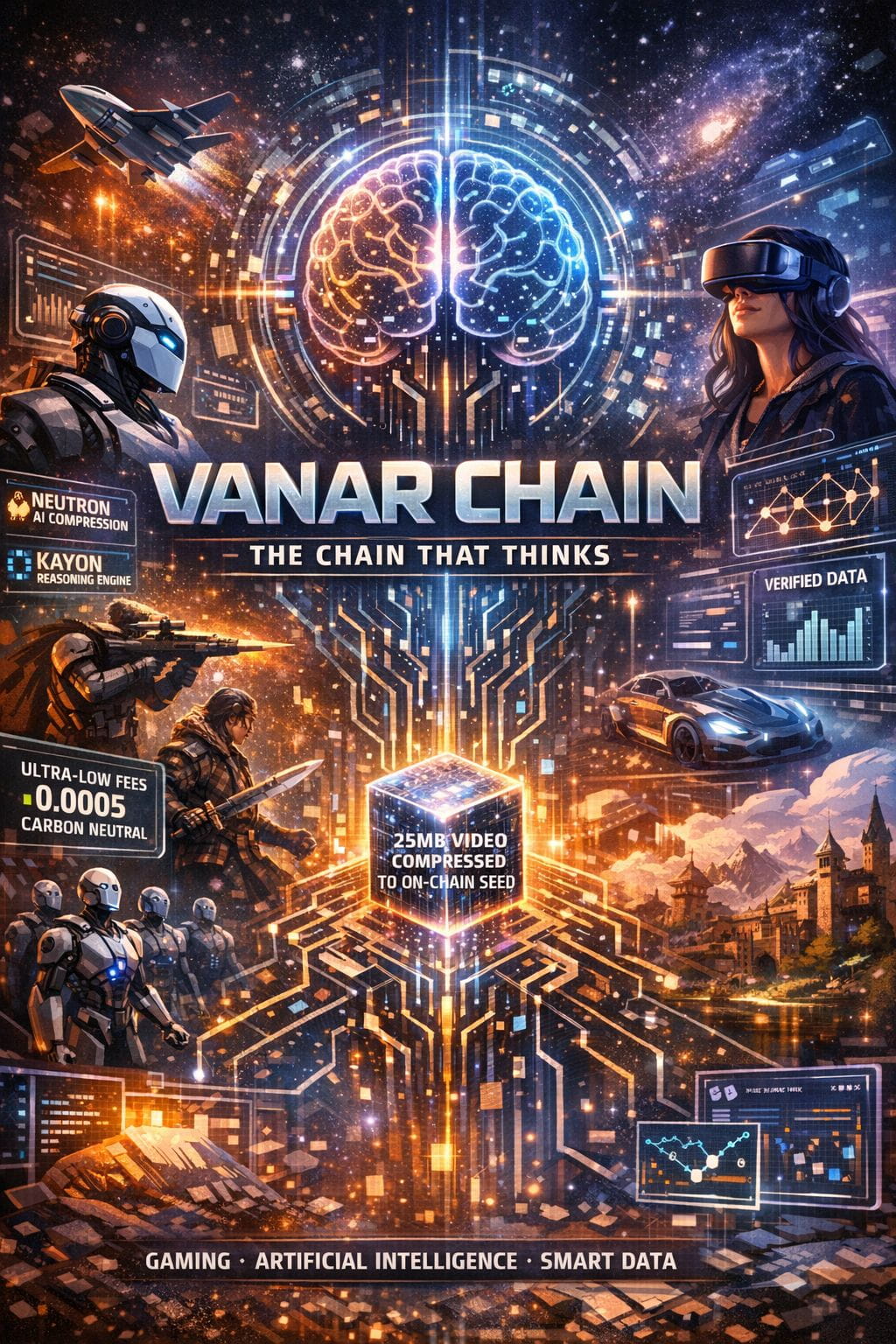
Vanar Chain is a Layer-1 that is specifically designed to be entertainment-focused, game-oriented, and AI-oriented. In contrast to general purpose chains who aim to become all purpose, Vanar has the mission of Being the Chain that Thinks.
It is distinct in its AI native stack that combines Neutron, an AI being compression engine, and Kayon, a decentralized reasoning engine. These tools enable the chain to do not only take record events but also process and compress huge data such as 25 MB video files into small on-chain seeds. Having a fixed, ultra-low transaction cost (~ 0.0005) and being carbon-neutral by its operations, Vanar fulfills high-frequency and low-latency requirements of contemporary games and artificial intelligence agents, resolving the economic drag that could not be overcome by legacy chains.
The problem with why New L1 Launches will not be successful in the AI Era.
Build it and they will come model is completely shattered. In a world controlled by AI, a new blockchain will not be able to compete on the basis of improved decentralization or even slightly faster block times.
AI Requires Data, Not Only Transactions.
The large quantities of data that AI agents and LLMs require are huge volumes of verified data. Classical L1s aim to check financial ledgers, not to check the provenance of training data or even to interact with the intricate semantic queries. The generic L1 of now is the equivalent of throwing a flip phone in the smartphone world, you can use it but you cannot use it to use the applications that count.
Liquidity Fragmentation
Every introduction of L1 divides the liquidity and user base. Devs do not have a reason to move beyond (or across domains) to toolsing to switch, unless game studios have a reason to move users to a different network.
The “Agent Economy” Mismatch
The AI age will not just require humans as primary customers, but it will be autonomous AI agents who buy compute or data. These agents must have predictable and fixed costs in order to remain profitable, something that variable-fee chains (Ethereum or congested L2s) are unable to assure.
What’s Already Solved in Web3?
The traditional trilemma of security, scalability, and decentralization is not the constraint in most applications these days.
Throughput (Speed): Solana, Aptos, and many L2 rollups have single-handedly achieved TPS that is many times the current demand.
Price: The majority of the network charges are now under a cent.
Security: PoS systems are battle tested.
We have basically created a highways system; the issue is that the vehicles (apps) are difficult to drive, and there are not many locations (use cases).
The reason why Base Infrastructure Is No longer the Core Issue.
Devs partially attributed the lack of so-called killer apps to infrastructure constraints. The excuse was usually, It takes too long to build us a decentralized Call of Duty and that expired. Integration and utility is the actual problem today.
The “Invisible” Requirement
Gamers and other entertainment users do not need to learn that they are transacting on a blockchain. They desire perfect experiences. Today, the problem of infrastructure is more of abstraction, concealing the technology, than crude performance.
The Data Bottleneck
The question has changed to not just how many transactions it is that we can process, but how much meaningful data is it that we can verify? Speed-only chains (where data are not intellectualized, e.g. indexing, provenance tracking, compression) are becoming a commodity.
The turning point of a faster horse to a smarter engine is Vanar Chain. It demonstrates how base infrastructure is figured out, whereas specialized infrastructure optimized towards heavy AI data loads and mass-market gaming economies is being initiated.
