
The Institutional Challenge With Blockchain
Institutions have always approached blockchain with caution. While the technology promises efficiency and transparency, many public networks were not built with regulatory clarity in mind. Banks, asset managers, and financial institutions operate under strict rules that cannot be ignored. This gap has slowed adoption, even as interest continues to grow.
Think of blockchain as a new highway system built without traffic laws. It may be fast, but institutions hesitate to drive on it. Dusk addresses this hesitation by designing blockchain infrastructure that respects existing financial rules. Instead of forcing institutions to adapt to chaos, Dusk provides structure.
By focusing on institutional needs, Dusk becomes more than a technical experiment. It positions blockchain as usable financial infrastructure. This focus makes adoption practical rather than theoretical.
Designed With Regulation From Day One
Regulation is often seen as a barrier to innovation. In reality, regulation provides the guardrails that allow financial systems to scale safely. Dusk understands this deeply and builds compliance into its foundation. Rather than adding regulatory features later, Dusk integrates them directly into its architecture.
Imagine building a building with safety codes included from the blueprint stage. Retrofitting later is expensive and inefficient. Dusk avoids this by aligning its design with regulatory expectations from the start. This approach reduces uncertainty for institutions.
By supporting regulated frameworks, Dusk speaks the same language as policymakers and financial entities. Institutions do not need to compromise their obligations to experiment with blockchain. This alignment significantly lowers the entry barrier for adoption.
Privacy That Institutions Actually Need
One of the biggest misconceptions about blockchain is that everything must be public. While transparency is valuable, full openness is not suitable for institutional finance. Client data, transaction details, and contractual terms require confidentiality. Dusk addresses this reality through privacy-preserving technologies.
Think of institutional finance like a secure office building. Outsiders can see activity happening, but they cannot access private rooms. Dusk applies this same concept onchain. Transactions can be validated without exposing sensitive information to everyone.
This balance between privacy and verification is critical. Institutions can operate confidently, knowing data is protected while rules are still enforced. Dusk makes privacy a feature that supports compliance, not a tool to avoid it.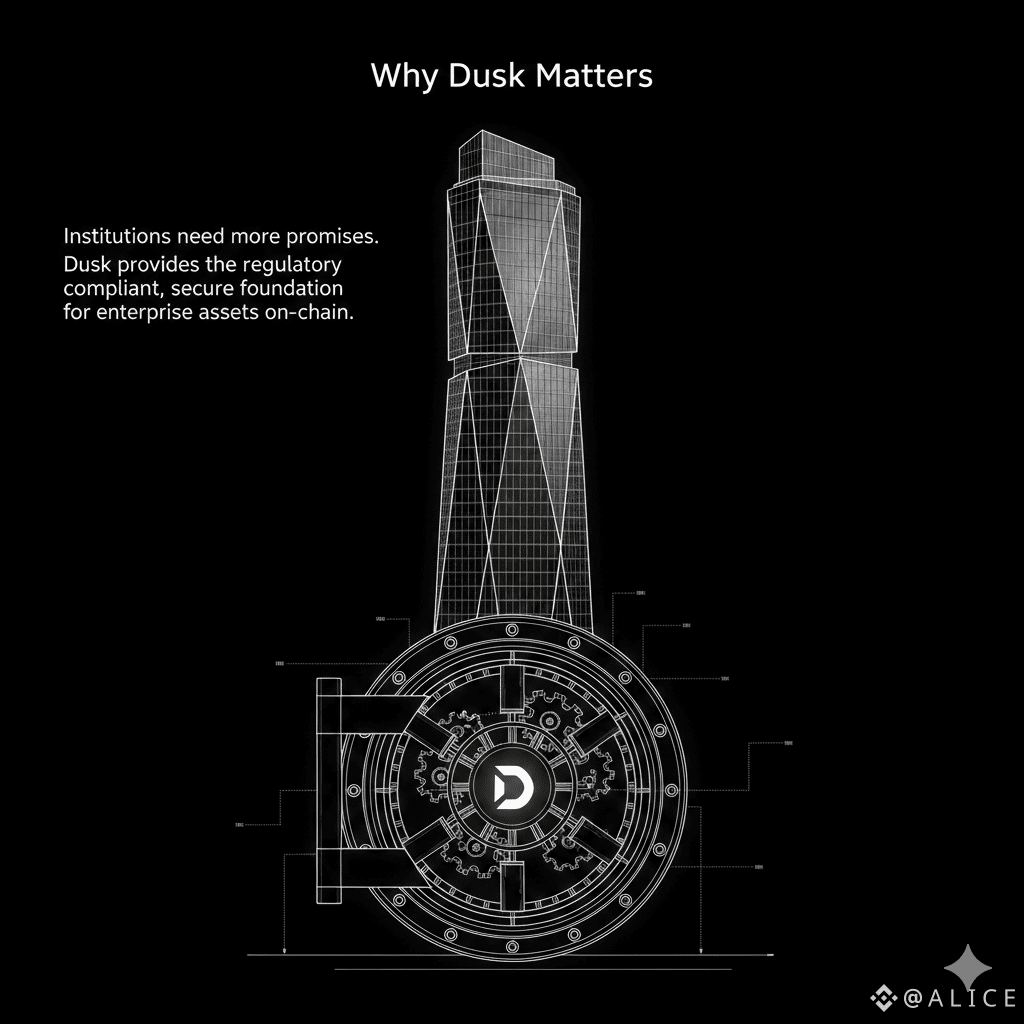
Making Blockchain Familiar For Institutions
Institutions prefer systems that feel predictable and structured. Many public blockchains feel experimental, with unclear processes and responsibilities. Dusk focuses on familiarity by designing workflows that resemble traditional finance. This makes the learning curve less intimidating.
Think of Dusk as a digital version of established financial infrastructure. Processes like asset issuance, settlement, and reporting follow logical steps. Automation replaces paperwork, but the underlying structure remains recognizable. This familiarity builds confidence.
By reducing operational uncertainty, Dusk allows institutions to focus on value creation rather than risk management. Blockchain becomes a tool, not a threat. This practical design encourages institutions to move from observation to participation.
Supporting Real Institutional Use Cases
Institutional adoption depends on real-world applicability. Dusk is built to support use cases such as regulated asset issuance, secondary markets, and compliant settlement. These are not experimental ideas but existing financial activities moved onchain responsibly.
Imagine upgrading from paper-based processes to digital systems without changing the rules. Dusk enables this transition. Assets can be represented digitally while still following legal and operational standards. This improves efficiency without disrupting trust.
By supporting real use cases, Dusk moves beyond speculation. Institutions can test blockchain in controlled environments. This gradual adoption model aligns with how large organizations typically innovate.
Building Long-Term Trust In Web3
Trust is the foundation of any financial system. Short-term innovation without accountability often leads to setbacks. Dusk prioritizes long-term trust by aligning blockchain with institutional expectations. This approach supports sustainable growth.
When institutions trust infrastructure, ecosystems grow stronger. Developers build with confidence, users participate responsibly, and regulators engage constructively. Dusk contributes to this cycle by providing clarity and reliability. It shows blockchain can mature.
As Web3 evolves, infrastructure that supports trust will matter most. Dusk demonstrates that compliance and innovation can coexist.
