

When I first came across the world of decentralized finance, I felt like I’d wandered into a room full of strangers speaking a language I half-understood. Tokens, smart contracts, private transactions—these were words I recognized, but their implications? That part was fuzzy. The Walrus protocol, and its native WAL token, gave me a way to actually see how a system like this could work in practice, not just in theory.
The thing that surprised me most is how much thought goes into making the system predictable. Privacy, for example, isn’t just about hiding information. At first, I assumed it was like putting a curtain over a window. But in reality, it’s more like drawing the curtain in a way that still lets the right light in at the right time. If you hide too much, nothing works; if you hide too little, the point is lost. Watching Walrus operate, I realized that every private transaction is carefully choreographed to balance safety and usability. It’s not flashy, but it feels… reliable, in a way I didn’t expect from crypto systems.
The storage side of things blew my mind. Instead of dumping a big file in one place, the system slices it up and spreads it across the network. At first, I thought, “Wait… what happens if a node goes offline?” But then it clicked—this is like sending pieces of a puzzle to different friends. Even if some of them can’t make it to the party, the puzzle can still be completed. That redundancy is simple, elegant, and quietly reassuring. I’ve lost data before in cloud drives, and it’s painful. Here, I could feel that loss would be much harder to encounter.
But reliability comes with trade-offs. Speed, for example, can’t always be instant, and staking or governance processes need to happen in a predictable order. I realized that if timing slips, even a little, it can ripple out and shake confidence. That’s why the system emphasizes consistency over flashy features. It’s like cooking: you can experiment with new ingredients, but if you don’t get the basic steps right, the dish falls apart. Walrus seems very focused on getting the fundamentals right.
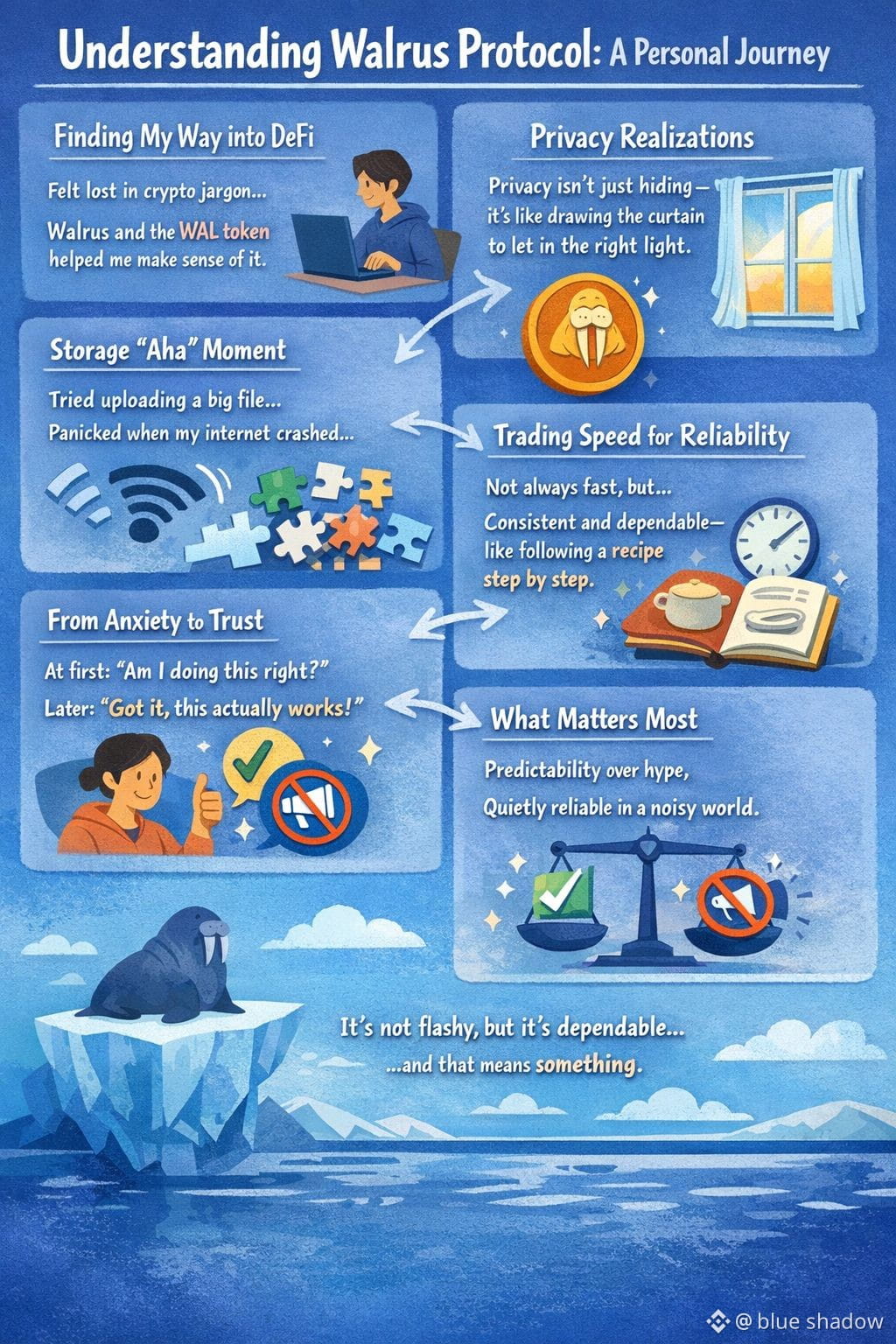
Of course, it’s not all smooth sailing. Uploading big files or navigating private transactions can be intimidating at first. I remember staring at my screen thinking, “Am I doing this right?” But the rules are clear, the process predictable, and over time, it stops feeling like an experiment and starts feeling like something I can rely on. That shift—from anxiety to trust—is subtle, but it matters.
What sticks with me most is how much this protocol values predictability over hype. There’s no flashy gimmick to catch your attention; instead, there’s careful design that quietly makes everything work as expected. WAL isn’t just a token you hold—it’s part of a system that enforces trust, accountability, and consistency. That combination of engineering and thoughtfulness feels… human, in a way.
By the time I stepped back from exploring it, I found myself thinking about reliability in a broader sense. In technology, in finance, in everyday life—systems that simply do what they promise are rare. Walrus isn’t perfect, and it doesn’t claim to be. But it does offer something practical: a framework where mistakes are less costly, and outcomes are more predictable. That feels valuable, even if it’s quiet, even if it’s invisible most of the time. It left me wondering: how many other platforms out there will focus on that kind of dependability, rather than just the next shiny feature? For me, that question matters more than any flashy headline ever could.

