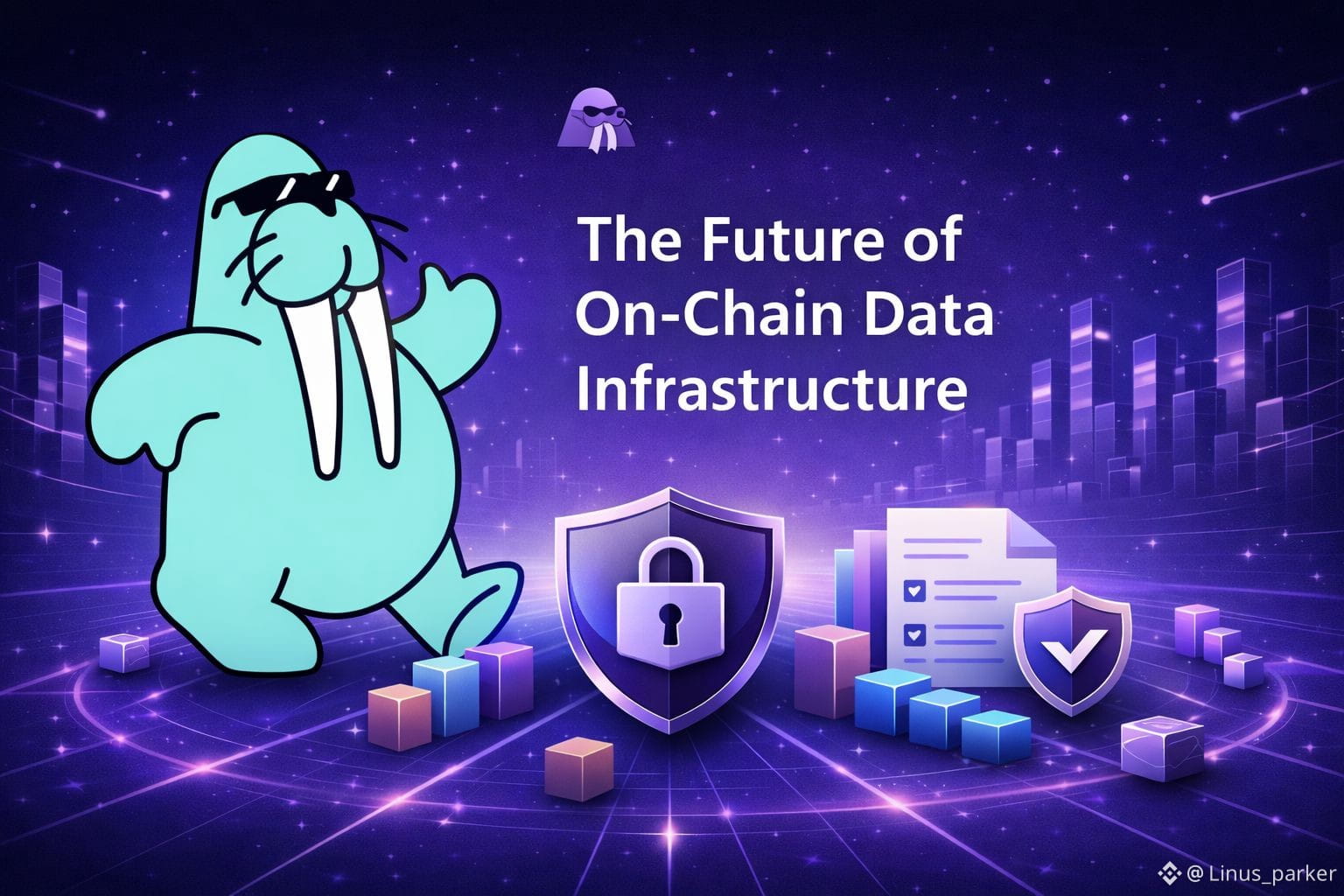
There is a major shift happening across Web3 and it is something most people do not fully understand yet. The next generation of applications will not be defined by transaction speed or lower costs. It will be defined by the ability to store, serve and manage real data directly on chain. Every major innovation in digital experiences is moving toward heavier and richer data. Games are becoming cinematic. AI is generating persistent knowledge that must live beyond a single session. Apps are producing large content libraries. Digital identities are shaping new online communities. All of this breaks when the underlying blockchain cannot carry the weight of data. Walrus is one of the only networks built from the ground up to solve this problem at scale.
Most chains today still rely on centralized servers to hold user content. They settle transactions on chain but keep the real substance of the application off chain. It is a model that worked years ago when Web3 apps were simple and lightweight. But that model collapses when real data enters the picture. Walrus takes the opposite approach by turning the network into a high performance storage and data engine. It does not settle for the idea that blockchains should only hold tiny fragments of information. Walrus believes that the entire cycle of innovation begins with data and that the chain should be designed to hold it without breaking.
This becomes even more powerful when you look at how Walrus performs in real conditions. The network recently hit huge daily storage numbers with uploads larger than many people expected. Yet the system handled the load exactly as designed. No downtime. No strain. No collapse under pressure. This is what a real data network is supposed to look like. It behaves like a serious piece of digital infrastructure and that is why builders are starting to realize how important Walrus will become in the new cycle.
If you want to understand the Walrus narrative clearly, you only need one line. Build on Walrus because the entire future of digital applications depends on scalable data. Everything begins from there. More data stored brings more developers. More developers build more apps. More apps generate more data. And that data loops back into the network again. This cycle is one of the strongest emerging forces in Web3 and Walrus is positioned exactly at the center of it.
Walrus is also one of the few networks that approaches privacy and compliance in a practical way. The comparison visuals you requested illustrate this idea perfectly. On one side you have compliance with regulatory oversight and audit capabilities. On the other side you have privacy infrastructure powered by selective disclosure and zero knowledge techniques. Walrus does not force users or builders into extremes. It does not choose between transparency and protection. Instead it offers the structure that allows both to exist without conflict. It respects user privacy while enabling regulators and enterprises to operate responsibly. This is a balance that most chains have struggled to achieve.
Data collection versus data minimization is another major topic where Walrus stands out. Traditional systems gather enormous amounts of information for analytics, storage and user tracking. This creates exposure and weakens security. Walrus leans toward a data minimization philosophy. The network stores only what is necessary for the application to function. Sensitive information is eliminated, reduced or managed through cryptographic methods. It is a smarter design because it gives users protection and gives enterprises predictability without increasing the attack surface.
Many people do not realize how big of a breakthrough it is to have a chain that treats data correctly at the protocol layer. The moment you design storage as a first class component, you open the door to new categories of applications. AI becomes more powerful. Gaming becomes more persistent. Social identity becomes richer. On chain media becomes possible. Applications no longer have to hide half of their system behind centralized servers. Walrus brings transparency and performance together in a way that aligns with how the internet is evolving.
Another important piece of the Walrus story is the role of Sui. Walrus sits inside the Sui ecosystem and inherits some of the strongest engineering foundations from that environment. Sui is known for performance, parallelization and object structures that make application logic smoother. Walrus takes that core and extends it to the world of data. The combination of Sui’s execution model and Walrus’s storage engine creates a new type of network. It is fast, reliable and capable of handling large workloads without the usual bottlenecks.
Builders are noticing this quickly. The Walrus ecosystem continues growing because developers want an environment where their apps behave as expected. Nothing breaks when usage increases. Nothing collapses when data spikes. Walrus acts like a backbone rather than a toy. And this is exactly what serious applications need. If you are building AI memory systems, dynamic worlds, content heavy platforms or data driven applications, you need a network that can handle far more than transactions. You need an actual data architecture and Walrus is delivering that with intention.
One of the most exciting things about Walrus is that it does not try to chase hype. It is not built for the race of vanity metrics. It is built for the actual future. You can see it in the engineering updates. You can see it in the way the team communicates. You can see it in the response from developers. Walrus is positioning itself as the storage cloud of Web3. Not a theoretical one but a real one where enterprises can rely on performance and where applications can grow without fear of collapse.
As the Web3 industry moves toward real scale, the chains that cannot handle data will slowly fade out. They will still exist but they will not be the place where major apps deploy. Walrus is preparing for the environment where hundreds of millions of users interact with applications that demand real infrastructure. This requires storage, bandwidth, privacy and compliance in a unified design. Walrus checks every one of those boxes.
What makes Walrus truly special is its philosophy. It believes that blockchains should not be limited to coins and tokens. They should be able to store the real building blocks of digital life. Images. Content. AI memory. Game worlds. User activity. Application state. This is the data that defines the modern internet and Walrus is one of the only chains prepared to manage it reliably.
You can feel the seriousness of the architecture when you study the network closely. There is nothing random about its design. Everything fits into a system meant to support long term growth. This is why builders trust it. This is why uploads continue increasing. This is why the ecosystem keeps maturing. Walrus is proving every day that data is the new foundation of Web3 and that the future belongs to the networks that can handle it.
As the next cycle unfolds, the biggest winners will not be the chains that shout the loudest. They will be the chains that solve the heaviest problems. Walrus solves the biggest problem of all. It gives Web3 the data layer it has always needed. And because of that one simple reason, Walrus is becoming one of the most important infrastructures in the entire ecosystem.
The future of Web3 is not just transactions. It is data. And Walrus is where that future is being built.