There's a peculiar paradox at the heart of blockchain technology that nobody talks about enough. We built this incredible infrastructure for moving value globally, instantly, without intermediaries. We proved it works. We scaled it. And then we realized that the hardest part wasn't the technology at all. It was getting people to actually use it the way they use money every day, without thinking about it, without friction, without needing to understand what's happening underneath.
The disconnect is obvious once you see it. Every blockchain promises frictionless value transfer, but then asks users to hold native tokens for gas, manage multiple assets simultaneously, accept that privacy is a luxury feature requiring separate protocols, and navigate interfaces that assume everyone wants to be their own bank. This works fine for crypto natives who treat complexity as a feature. It falls apart completely for everyone else, which is most of the world.
Plasma XPL represents something different, though the way it's different matters more than what it does technically. This isn't another layer one claiming marginal improvements in transaction speed or slightly lower fees. This is infrastructure that started by asking what stablecoins actually need to function as money, not as speculative assets or yield farms, but as the medium of exchange they're supposed to be.
The insight driving Plasma is deceptively simple: stablecoins deserve first class treatment at the protocol level. Not as tokens that happen to run on a blockchain, but as the primary reason the blockchain exists. Everything else, the architecture, the consensus mechanism, the developer tools, flows from that single principle. When you design infrastructure specifically for how stable value needs to move globally, you end up with something that looks nothing like general purpose blockchains trying to be everything to everyone.
Start with the most fundamental friction in blockchain usage: gas fees. Every transaction costs something, paid in a native token users probably don't have and definitely don't want to think about. For crypto enthusiasts, this is background noise. For normal financial activity, it's a conversation ender. Imagine telling someone they need to buy XYZ token before they can send dollars to a friend. The interaction dies right there.
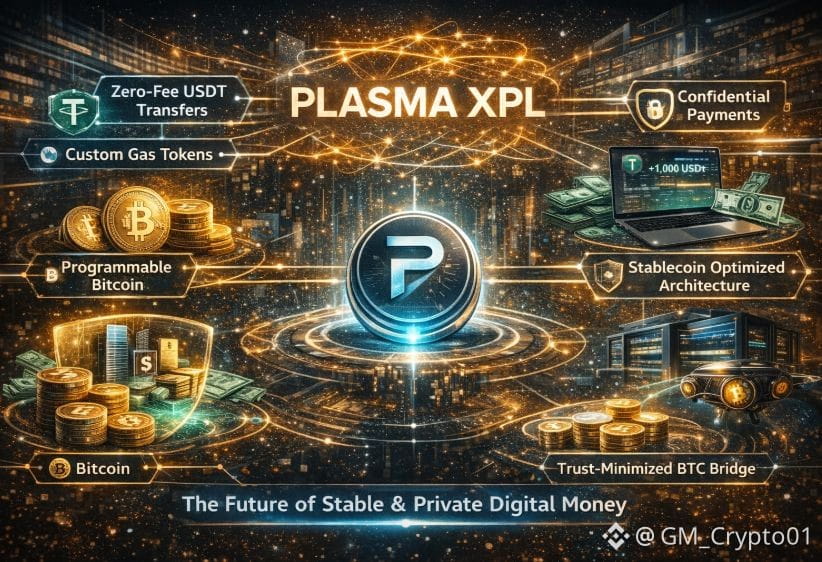
Plasma addresses this through protocol maintained contracts that sponsor gas for USDT transfers. Not as a promotional gimmick or temporary subsidy, but as foundational infrastructure. The contract is deliberately narrow, restricted to transfer and transferFrom calls, nothing arbitrary, nothing that opens exploit vectors. Eligibility uses lightweight identity verification and rate limits to prevent abuse. The result is what using digital money should feel like: you have dollars, you send dollars, nothing else enters the equation.
This seems small until you consider scale. Every person onboarding to blockchain based payments currently faces a multi step process: acquire the native token, understand gas mechanics, calculate fees, hope they bought enough but not too much. Now imagine removing all of that. Just dollars moving, instantly, globally, for free. That's not a marginal improvement. That's removing the primary barrier between blockchain infrastructure and mainstream financial usage.
But Plasma doesn't stop at eliminating gas friction. It extends the concept through custom gas tokens, allowing approved stablecoins or ecosystem tokens to pay for transactions directly. This matters tremendously for application developers trying to create cohesive user experiences. If you're building a payment app, a remittance service, or an embedded finance product, you don't want users juggling multiple tokens. You want them using your stablecoin for everything, including transaction costs. Plasma makes this possible at the protocol level, not through hacky workarounds or third party paymasters charging fees and introducing counterparty risk.
The architecture supporting this is where things get genuinely interesting. Plasma runs on PlasmaBFT, a pipelined implementation of Fast HotStuff consensus. Traditional consensus processes each stage sequentially: propose, vote, commit, repeat. Plasma parallelizes these into concurrent pipelines, dramatically increasing throughput while reducing finality time. Finality is deterministic, typically achieved within seconds, with full Byzantine fault tolerance under partial synchrony.
This matters because stablecoin workloads are different from typical blockchain traffic. High volume, low latency, consistent performance under global demand. You're not processing occasional large transactions. You're processing millions of small payments continuously. The consensus layer has to handle this without degrading, without unpredictable spikes in confirmation time, without the kind of congestion that makes blockchain based payments unreliable during peak usage. Plasma is architected specifically for this workload pattern.
The execution layer maintains full EVM compatibility through Reth, a high performance modular Ethereum client written in Rust. This is critical for developer adoption. There's no custom language to learn, no modified Solidity, no bridging layers or compilation quirks. Standard contracts deploy directly. Hardhat and Foundry work out of the box. MetaMask connects immediately. Every library, SDK, and tool developers already use just works. This removes the integration barrier that kills most alternative chains, where promising technology dies because developers can't easily port existing code or must maintain separate toolchains.
Full EVM compatibility also means liquidity and applications can flow freely. Plasma is launching with approximately two billion in USDT available from day one, not because they're subsidizing liquidity but because existing capital can move into the ecosystem without friction. Developers building on Plasma can tap into real liquidity immediately rather than bootstrapping from zero, which fundamentally changes what's viable to build.
Then there's Bitcoin integration, which Plasma approaches through a trust minimized bridge that brings real BTC directly into the EVM environment. The bridge is non custodial, secured by a decentralizing network of verifiers that validate Bitcoin transactions on Plasma without centralized intermediaries. Bridged BTC becomes programmable within smart contracts while users retain custody.
This opens entirely new design space for BTC backed stablecoins, trustless collateral systems, and Bitcoin denominated finance. Instead of BTC sitting idle or requiring centralized custodians to bring it onchain, it can participate directly in the programmable economy while maintaining the security properties that make Bitcoin valuable. Cross asset flows between BTC and stablecoins happen natively, creating composability that hasn't existed before.
Perhaps the most forward looking element is confidential payments, currently under active development. The goal is enabling privacy preserving transfers for stablecoins where amounts, recipients, and memo data can be shielded while maintaining composability and regulatory disclosure capabilities. This is opt in, built for practical use cases like payroll, treasury operations, and private settlements. Critically, it's implemented in standard Solidity without custom opcodes or alternative virtual machines, meaning it integrates cleanly with existing wallets and applications.
Privacy in financial transactions isn't about hiding illicit activity. It's about normal financial behavior. Businesses don't want competitors seeing their payment flows. Individuals don't want transaction histories public forever. Current blockchain transparency is a bug masquerading as a feature, one that prevents serious financial adoption. Plasma's approach acknowledges this while designing for regulatory compatibility, creating privacy that works within legal frameworks rather than against them.
The universal collateralization infrastructure ties everything together. Plasma accepts liquid assets, including digital tokens and tokenized real world assets, as collateral for issuing USDf, an overcollateralized synthetic dollar. This provides stable liquidity without forcing liquidation of holdings. For users with BTC, tokenized securities, or other assets, this means accessing dollar liquidity while maintaining exposure to underlying holdings.
This matters enormously for capital efficiency. Traditional finance has always allowed borrowing against assets. Blockchain-based finance has struggled to replicate this cleanly, often requiring centralized intermediaries or accepting significant liquidation risk. Plasma creates infrastructure for this at the protocol level, making it accessible, transparent, and composable.
What we're seeing with Plasma XPL is infrastructure that took stablecoins seriously as money from the beginning, then built everything around that reality. Not blockchain infrastructure that happens to support stablecoins. Infrastructure where stablecoins are the purpose, the architecture reflects that purpose, and everything else follows logically. Zero fee transfers, custom gas tokens, confidential payments, Bitcoin programmability, and universal collateralization all exist because they're requirements for stablecoins functioning as global money.
The market is still catching up to what this means. We've spent years watching blockchain infrastructure optimize for the wrong metrics, chasing transaction speeds that don't matter if user experience remains broken, building general purpose chains that serve no purpose particularly well. Plasma represents the opposite approach: start with one thing that matters tremendously, build infrastructure that serves it exceptionally, and let adoption flow from utility rather than narrative.
For developers, this is infrastructure that removes barriers rather than adding capabilities. The capabilities already exist in the EVM ecosystem. What's been missing is infrastructure that makes those capabilities accessible for real financial applications at global scale. Plasma provides that foundation, which is why it matters more than the technical specifications suggest. It's not about what the chain can do theoretically. It's about what developers can actually build and deploy today, with tools they know, for users who shouldn't need to think about blockchain at all.