
Executive Summary
$AZTEC represents a fundamental architectural innovation in Ethereum scaling - a privacy-first zk-rollup that enables programmable confidentiality as a native primitive. Unlike transparent zkEVMs that focus solely on scalability, Aztec's "ZK-ZK rollup" approach delivers both validity proofs and privacy guarantees through its novel hybrid state model and client-side proof generation. Aztec Network
The protocol is at an inflection point with its TGE vote concluding January 26-February 2, 2026, potentially unlocking mainnet trading on February 12, 2026. With 10.35B $AZTEC tokens distributed across team, investors, and community participants, and a fully decentralized testnet operating with 23,000+ validators, Aztec has achieved technical milestones that position it as the leading privacy infrastructure solution for Ethereum. Aztec Network
1. Project Overview
Core Thesis: Aztec solves Ethereum's transparency problem by building privacy as a first-class primitive into a zk-rollup, enabling confidential transactions and programmable privacy without compromising Ethereum's security or composability.
Protocol Vision: Create a world where privacy is permissionless, selective, and programmable - allowing developers to choose what data to expose while maintaining full verifiability through zero-knowledge proofs.
Stage: Late Testnet → Mainnet Transition
Ignition Chain testnet operational since November 2025
23,000+ operators across 6 continents
0.2 TPS current cap (theoretical scalability much higher)
TGE vote ongoing (Jan 26-Feb 2, 2026)
Target mainnet trading: February 12, 2026 Aztec Network
Team & Funding: Aztec Labs has raised $119M+ since 2018 from leading crypto investors. The team includes pioneers in practical zk-SNARK implementations, with CTO Zac Williamson co-authoring the PLONK proving system.
2. System Architecture & zk-Rollup Design
Core Architectural Components
zk-Rollup Construction: Aztec operates as a true zk-rollup (ZK-ZK) rather than a validity rollup (ZK-only). This distinction is critical:
Validity rollups (Starknet, zkSync): Prove correct execution but maintain transparency
ZK-ZK rollups (Aztec): Prove correct execution while preserving privacy Forum Post
Execution Environment: Non-EVM Aztec Virtual Machine (AVM) optimized for zero-knowledge operations with:
Hybrid public/private state management
Client-side proof generation for private functions
Server-side proof aggregation for rollup verification
Sequencer Architecture: Fully decentralized from day one - no centralized sequencer phase
1,000 sequencer slots with 200,000 $AZTEC minimum stake
BLS signature aggregation for efficiency
Slashing mechanism with veto protection for home stakers Aztec Network
Proving System Architecture
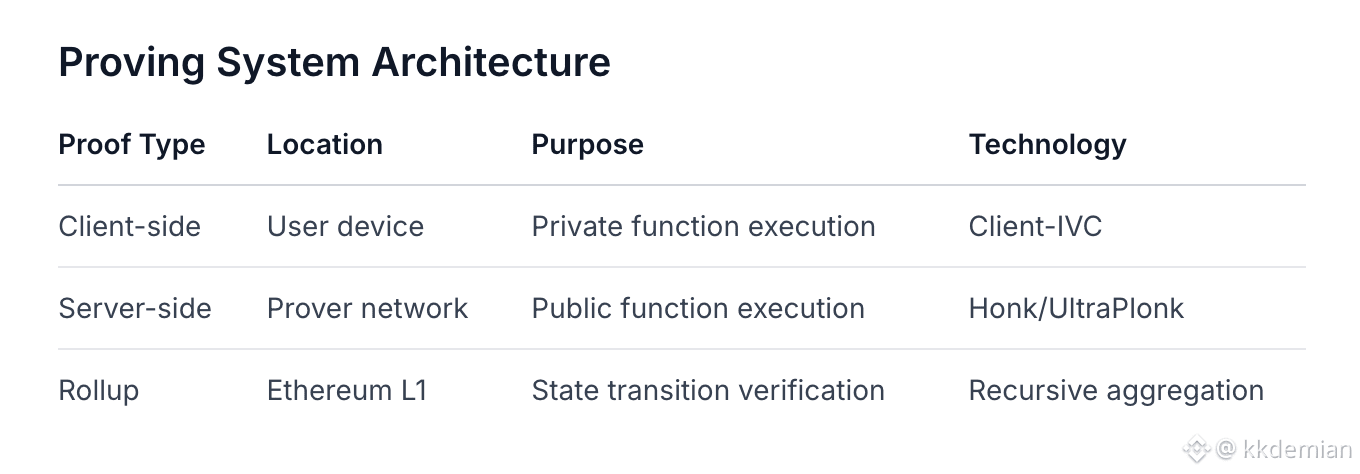
Client-IVC Innovation: Enables mobile device compatibility with memory requirements reduced from 3.7GB to 1.3GB, making private transactions feasible on older smartphones. ZkCloud
3. Private State Model & Data Representation
Hybrid State Management
Public State: Account-based model (EVM-compatible)
Transparent and globally accessible
Managed by sequencers with traditional execution
Suitable for non-sensitive application components
Private State: UTXO-based model with encrypted notes
Notes: Encrypted data chunks owned by users
Nullifiers: Prevent double-spending without revealing spending patterns
Note commitments: Stored in Merkle trees for verification Aztec Docs
State Transition Mechanics
Private Transaction Flow:1. User creates transaction locally (PXE - Private Execution Environment)2. Client generates proof of valid execution (Client-IVC)3. Encrypted notes are created/destroyed with nullifiers4. Proof and nullifiers submitted to network5. Sequencer includes in block with aggregated proof
Security Properties:
Data privacy: Only transaction participants see plaintext data
Execution integrity: Zero-knowledge proofs guarantee correct execution
Anti-censorship: Decentralized sequencer network prevents transaction filtering
4. Programmable Privacy & Application Design
Privacy Spectrum Implementation
Aztec enables developers to choose along a privacy spectrum:
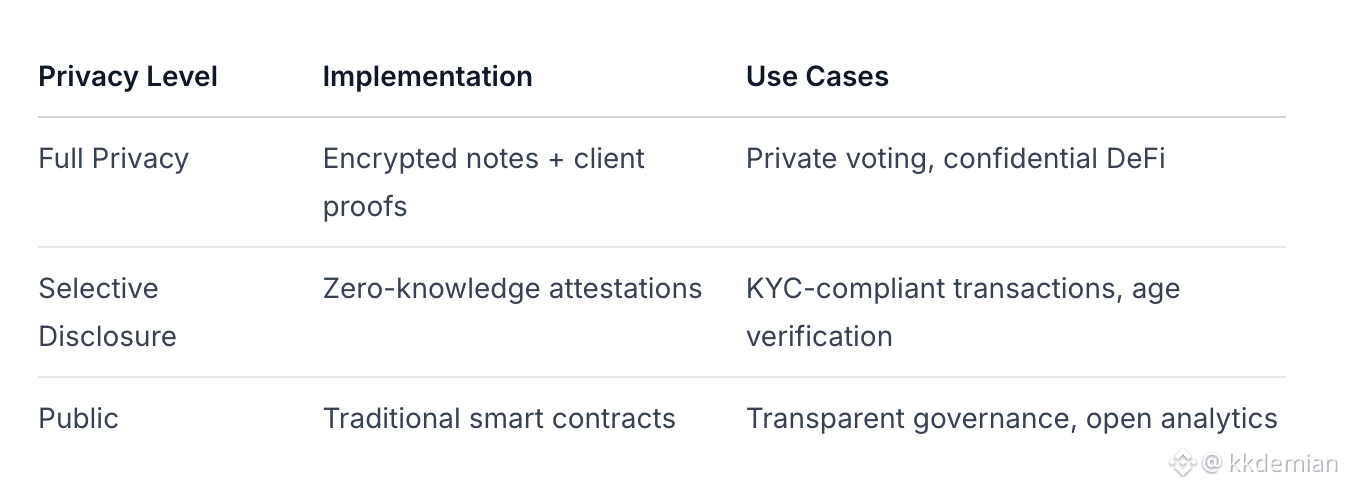
Composability: Private and public functions can interact within single applications:
Private balances can fuel public transactions
Public events can trigger private logic
Cross-contract calls maintain privacy boundaries
Application Categories with Highest Fit
Confidential DeFi: Private trading, lending without position exposure
Example: Hidden limit orders, confidential liquidity provision
Identity & Credentials: Selective disclosure of attributes
Example: zkPassport - prove citizenship without revealing passport number
Enterprise Applications: Compliance-friendly privacy
Example: Supply chain tracking with confidential business terms
Gaming & NFTs: Hidden attributes and private transactions
Example: Sealed-bid auctions, hidden game mechanics
5. Developer Tooling & Ecosystem (Noir)
Noir Language Ecosystem
Language Design: Rust-inspired syntax with ZK-specific abstractions
Backend-agnostic: Works with multiple proving systems
High-level abstractions: Developers don't need cryptography expertise
Standard library: Common ZK primitives and patterns Noir Lang
Development Workflow:
Write logic in Noir (Rust-like syntax)
Compile to intermediate representation
Generate proofs client-side or server-side
Verify on-chain or off-chain
Comparative Advantage:
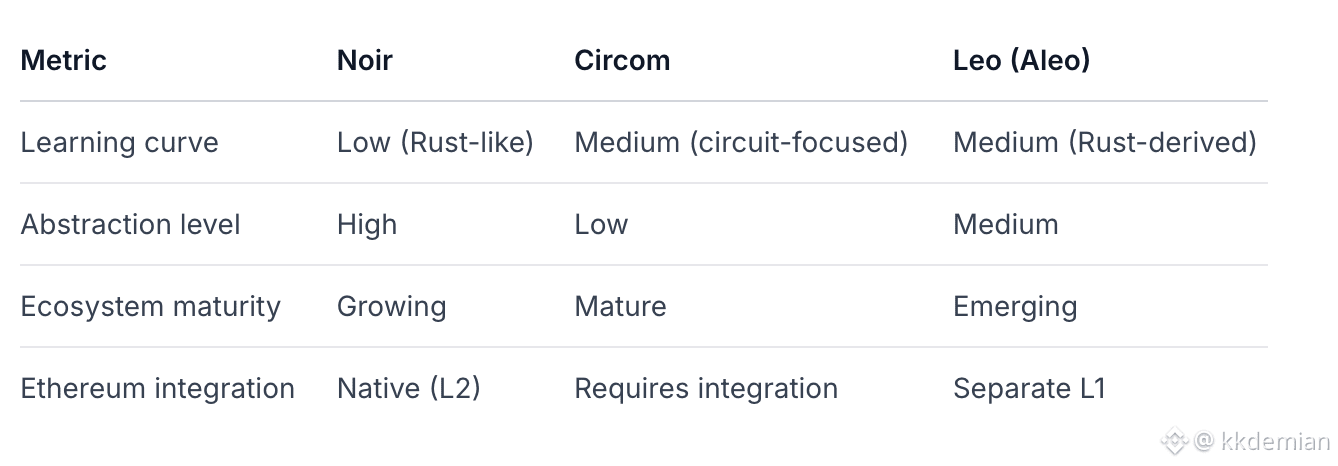
Tooling Maturity:
Documentation: Comprehensive but evolving
IDE support: VS Code extension available
Testing framework: Integrated testing utilities
Library ecosystem: Growing but limited compared to Solidity
6. Protocol Economics & Incentive Design
Tokenomics & Distribution
Total Supply: 10.35B $AZTEC Laika AI
Distribution Breakdown:
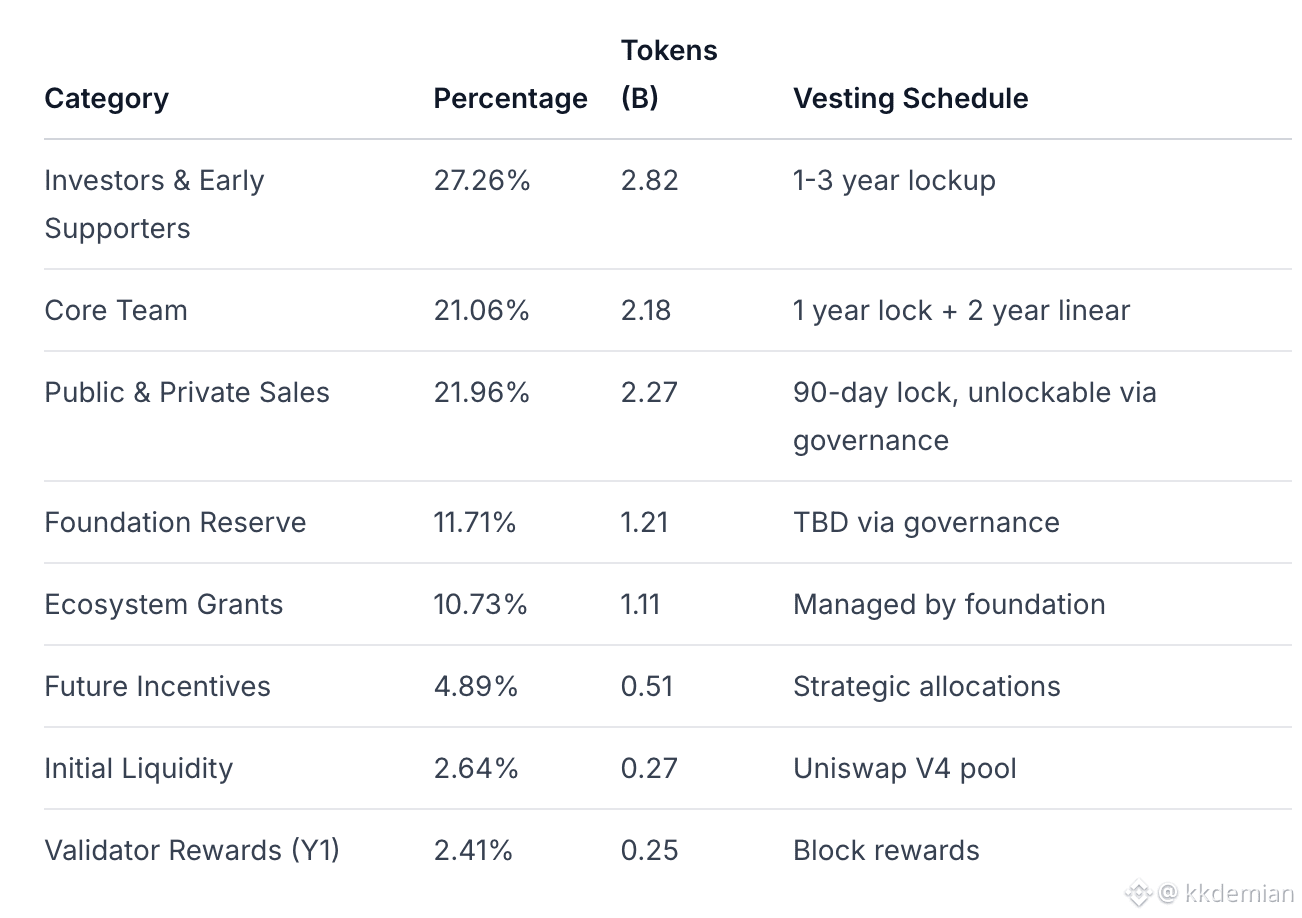
Public Sale Details:
$57M raised from 16.7k participants
1.547B tokens (14.95% of supply) sold
Continuous Clearing Auction mechanism prevented gas wars OKX
Fee Mechanics & Incentives
Transaction Fee Model:
Users pay fees in native asset or approved tokens
Protocol-level escrow handles fee collection
Sequencers earn fees for block production
Provers earn rewards for proof generation
Staking Economics:
Minimum sequencer stake: 200,000 $AZTEC
Block rewards funded from transaction fees and token inflation
Slashing protection for temporary outages (<20 minutes)
Veto mechanism prevents erroneous slashing Aztec Network
Cost Structure Analysis:
Client-side proving: User bears device computation cost
Server-side proving: Competitive marketplace determines prices
L1 verification: Fixed cost per rollup proof verification
7. Governance, Security & Risk Analysis
Governance Structure
Current State: Foundation-guided with community input
Aztec Foundation controls initial veto power on slashing
Community governance through token-weighted voting
Sequencer signaling required for proposal advancement
Decentralization Roadmap:
Phase 1: Foundation veto power (current)
Phase 2: Distributed veto committee
Phase 3: Fully decentralized slashing governance
Security Assessment
Cryptographic Assumptions:
PLONK/UltraPlonk proving system security
Honk proof system integrity
BLS signature aggregation safety
Client-side proof generation correctness
Risk Surface Analysis:
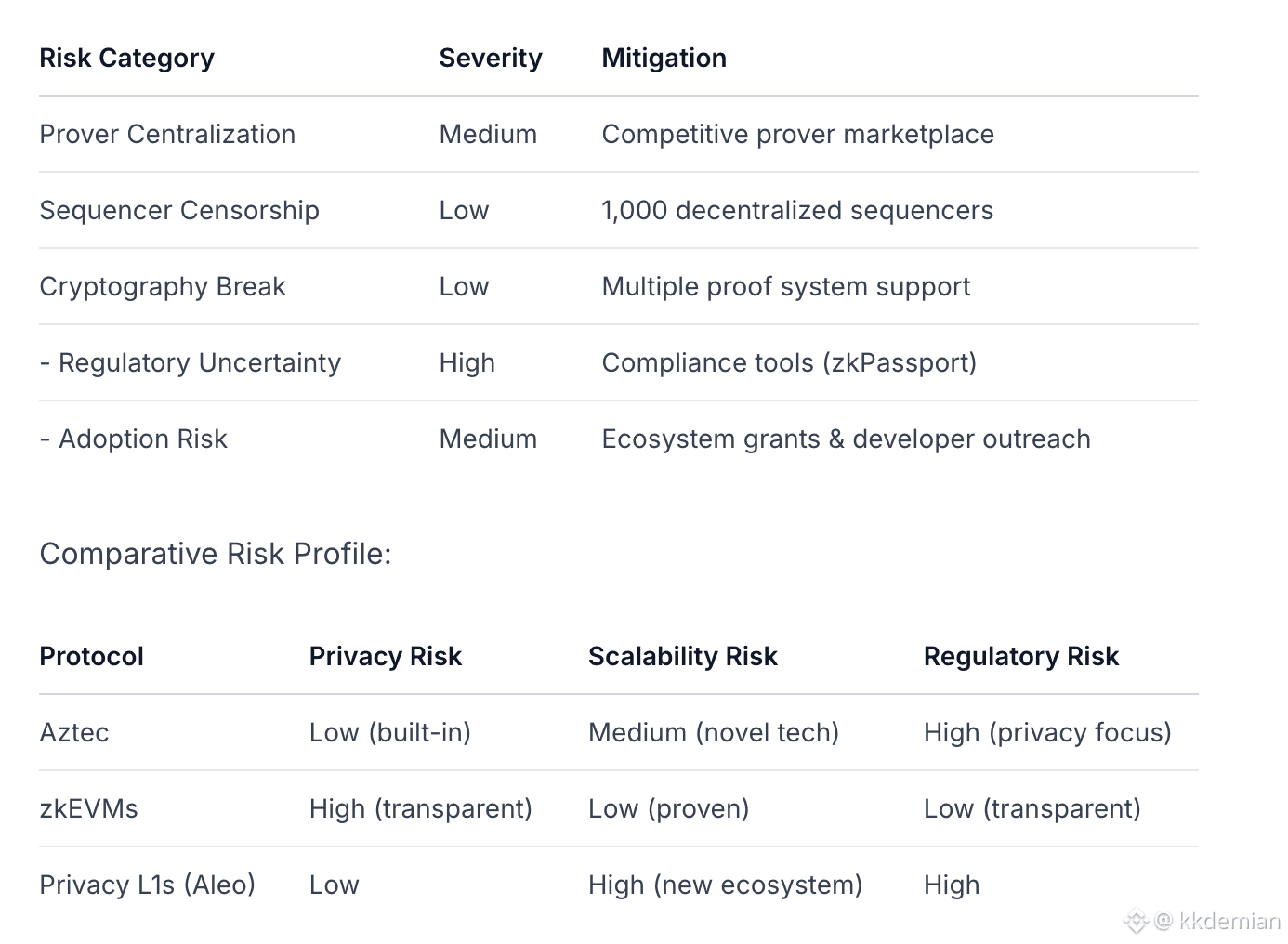
8. Adoption Signals & Ecosystem Potential
Current Ecosystem Development
Ignition Testnet Metrics:
23,000+ operators across 6 continents
7,600+ epoch proofs generated
0.2 TPS capacity (intentionally capped)
Successful Zypherpunk Hackathon with multiple privacy projects Aztec Network
Notable Projects Building:
zkPassport: KYC-compliant identity verification
Onyx (SerPepeXBT): Private DeFi primitives
NocomFinance (jp4g_): Confidential trading infrastructure
Private DAO Tools: Secure governance solutions
Confidential DeFi: Hidden liquidity protocols
Developer Activity:
Growing Noir language adoption
Active Discord community with 300k+ members
Regular hackathons and builder events
Enterprise partnership discussions underway
Market Fit Analysis
Ethereum Native Integration: Aztec's L2 approach provides key advantages:
Direct access to Ethereum liquidity and users
Composability with existing DeFi infrastructure
Regulatory clarity as Ethereum-based infrastructure
Institutional Demand: Growing need for compliant privacy solutions
Enterprise blockchain applications require confidentiality
Traditional finance migrating on-chain needs privacy features
Regulatory requirements driving demand for selective disclosure tools
9. Strategic Trajectory & Market Fit
Structural Problem Solution
Aztec addresses three fundamental gaps in Ethereum's current stack:
Native Privacy Deficiency: Transparent ledgers prevent many real-world applications
Institutional Adoption Barrier: Enterprises cannot operate with fully public data
Compliance Complexity: Traditional compliance tools don't work on transparent chains
Critical Milestones (12-24 Months)
Mainnet Launch Success: Stable operation with growing transaction volume
Ecosystem Expansion: 50+ live applications using privacy features
Enterprise Adoption: Major institutions using Aztec for confidential operations
Regulatory Clarity: Clear compliance frameworks for private transactions
Scalability Improvements: Achieving 100+ TPS with maintained privacy
Market Positioning
Aztec occupies a unique position between:
Transparent zkEVMs (Starknet, zkSync): Better privacy, similar scalability
Privacy L1s (Aleo, Miden): Better Ethereum integration, stronger security
Mixer-based solutions (Tornado Cash): Programmable privacy, not just mixing
10. Final Investment Assessment
Dimension Scoring (1-5 Scale)
zk-Rollup Architecture & Cryptographic Soundness: 4.5/5
Novel ZK-ZK approach with proven cryptography
Client-side proving enables mobile compatibility
Missing: Long-term battle testing at scale
Privacy Model & State Design: 5/5
Hybrid UTXO/account model is innovative and practical
Programmable privacy spectrum meets diverse needs
Excellent theoretical foundations
Developer Tooling & Ecosystem Maturity: 3.5/5
Noir language shows promise but ecosystem still young
Good documentation but limited production examples
Strong hackathon participation signals interest
Economic & Incentive Alignment: 4/5
Well-designed token distribution with proper vesting
Staking model protects against centralization
Unproven fee market dynamics at scale
Security & Risk Management: 4/5
Conservative cryptographic choices
Decentralized sequencer network from launch
Regulatory risk remains significant challenge
Strategic Differentiation: 5/5
Unique position in Ethereum privacy landscape
Solves fundamental transparency problem
First-mover advantage in programmable privacy L2
Investment Recommendation
BUILD & STRATEGIC PARTNERSHIP (Not Direct Investment)
Aztec represents foundational infrastructure that will enable the next generation of private applications on Ethereum. However, the regulatory uncertainty around privacy technologies and the early stage of ecosystem development suggest that strategic partnership and building on the platform offers better risk-adjusted returns than token speculation at this stage.
Key Investment Considerations:
Protocol Value: Aztec solves a real and growing need for programmable privacy
Technical Merit: Sound architecture with innovative approaches to hard problems
Execution Risk: Team has delivered complex cryptography systems before
Market Timing: Privacy narrative is accelerating with institutional demand
Regulatory Overhang: Significant uncertainty may impact adoption timeline
Optimal Strategy: Partner with Aztec Labs to build privacy-focused applications while monitoring regulatory developments. Accumulate tokens through ecosystem participation rather than speculative positioning.
Appendices
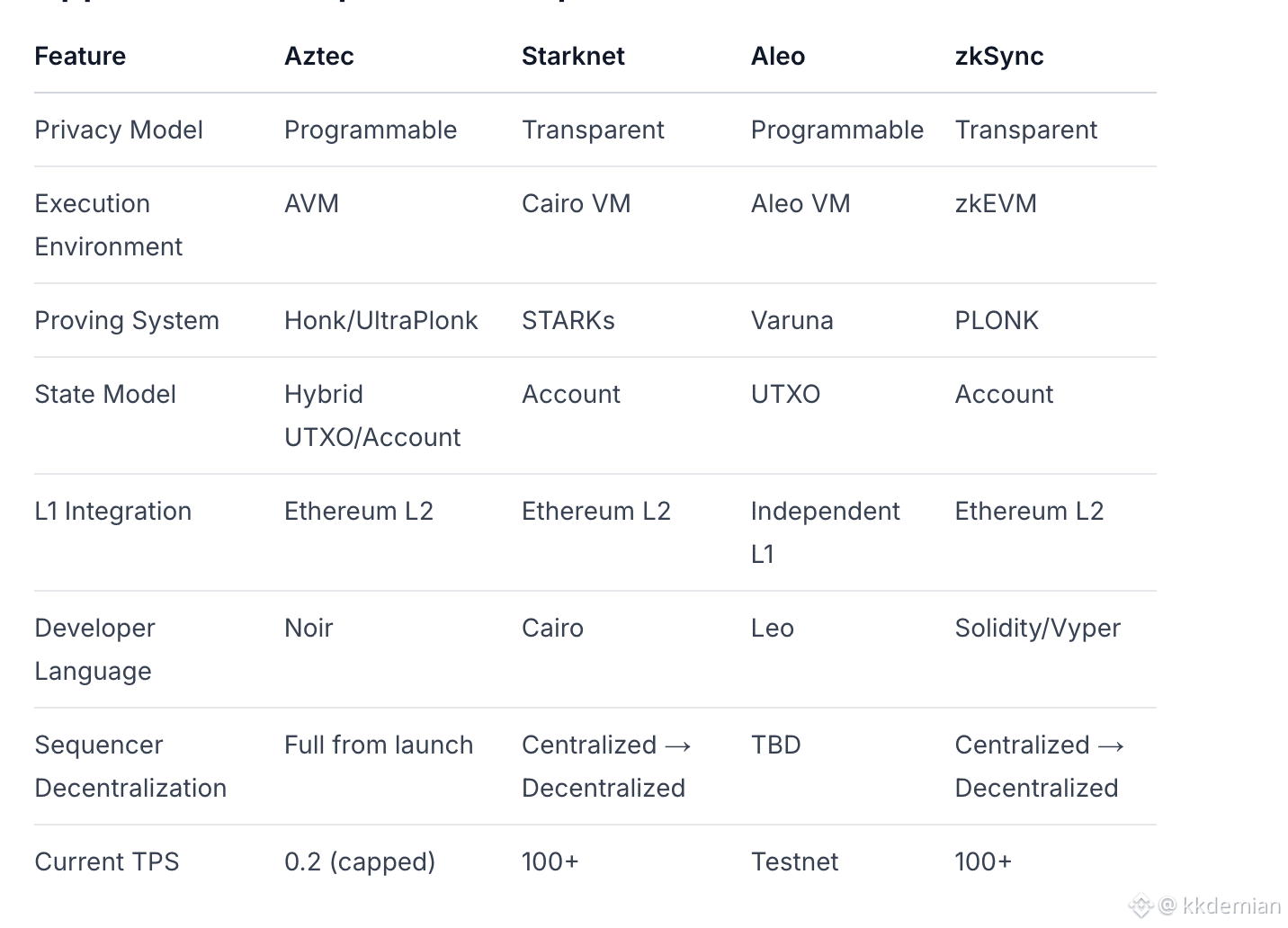
Appendix A: Competitive Comparison Table
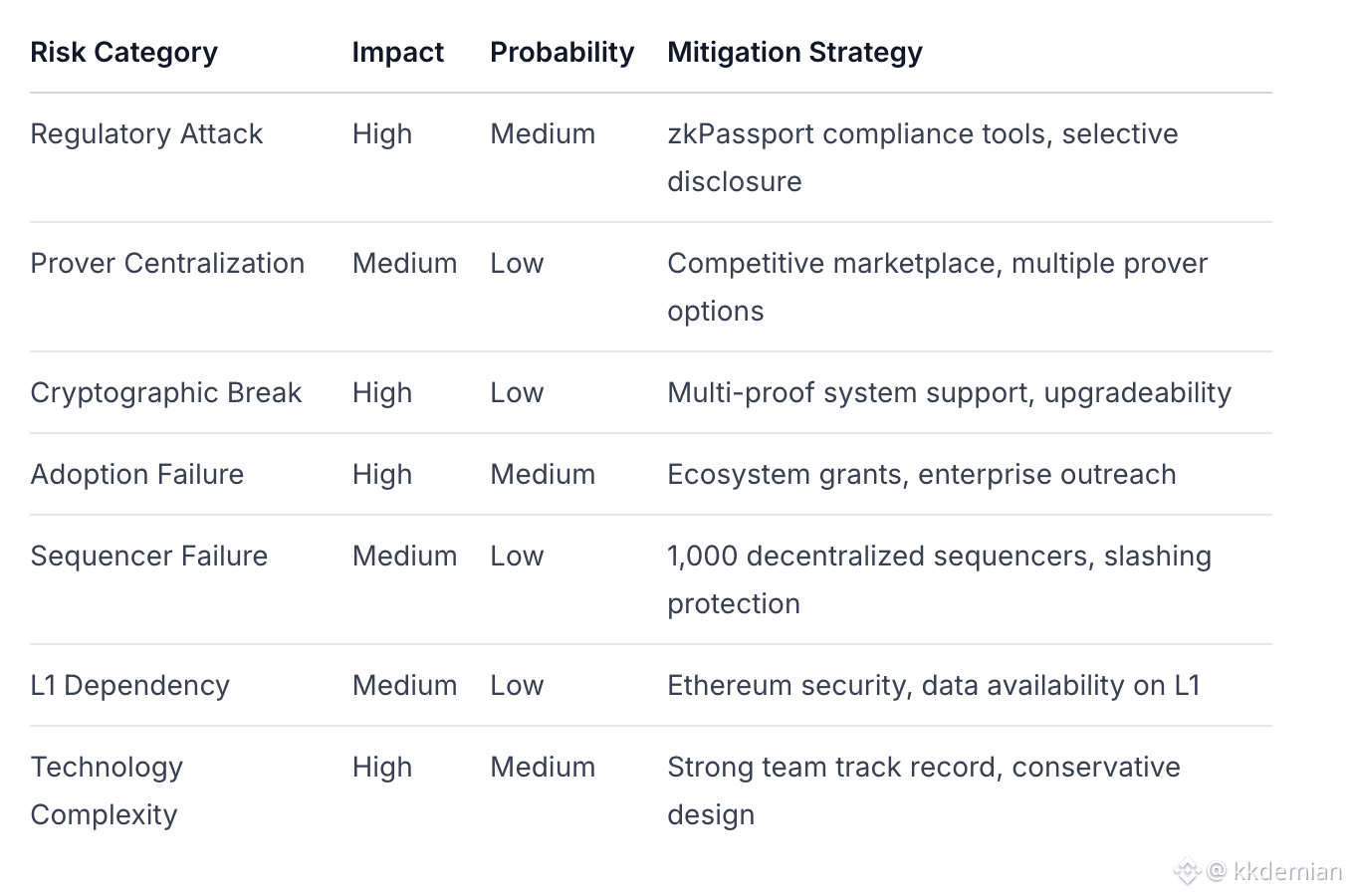
Appendix B: Risk Decomposition Matrix
Appendix C: Economic Model Scenarios
Base Case (2026-2027):
10 TPS average throughput
$0.50 average transaction fee
50% sequencer fee share
$45M annual protocol revenue
20% token inflation to validators
Bull Case:
50 TPS average throughput
$1.00 average transaction fee
60% sequencer fee share
$300M annual protocol revenue
15% token inflation to validators
Bear Case:
2 TPS average throughput
$0.20 average transaction fee
40% sequencer fee share
$5M annual protocol revenue
25% token inflation to validators
Report Conclusion: Aztec represents one of the most architecturally innovative approaches to solving Ethereum's privacy problem. While regulatory risks and adoption challenges remain, the protocol's technical merits and first-mover advantage in programmable privacy L2s position it as foundational infrastructure worthy of strategic partnership and building investment.