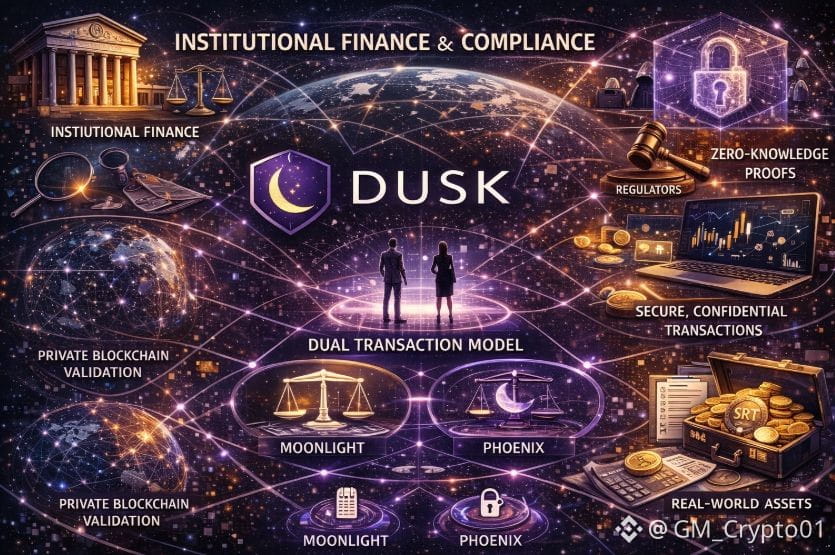
There exists a peculiar tension at the heart of modern finance, one that blockchain technology promised to resolve but instead amplified. Traditional financial institutions operate under suffocating regulatory frameworks requiring complete transaction transparency for authorities, yet simultaneously face legal obligations to protect client privacy from competitors, hackers, and the general public. This isn't a philosophical dilemma debated in academic journals; it's a practical nightmare preventing trillions in institutional capital from migrating onchain despite obvious efficiency gains.
Dusk emerged from wrestling with this exact paradox. The team watched as privacy-focused blockchains like Monero and Zcash achieved remarkable cryptographic innovations, creating transactions where amounts, senders, and receivers remained completely obscured. Brilliant technology, genuinely groundbreaking cryptography, and absolutely useless for regulated financial institutions. When a securities regulator demands audit trails, when anti-money laundering compliance requires transaction monitoring, when tax authorities need verifiable records, complete opacity isn't privacy protection, it's a regulatory non-starter that guarantees your blockchain will never touch a licensed securities exchange.
Conversely, public blockchains like Ethereum offered full transparency, every transaction permanently visible to anyone with an internet connection. Perfect for regulators, catastrophic for actual financial operations. When a hedge fund executes a large position, broadcasting their strategy to the world ahead of settlement invites front-running. When a corporation manages treasury operations, exposing real-time cash flows to competitors creates strategic vulnerabilities. When individuals conduct everyday transactions, having complete financial histories publicly available forever violates basic privacy expectations that modern societies consider fundamental rights.
The breakthrough Dusk achieved wasn't purely technical, though the cryptography is sophisticated. It was conceptual: recognizing that privacy and compliance aren't opposites but complementary requirements both necessary for institutional blockchain adoption. Financial privacy means hiding transaction details from the public and competitors while maintaining the ability to prove compliance to authorized regulators. This distinction seems obvious in retrospect, yet previous blockchain projects consistently failed to architect systems supporting both simultaneously.
The dual transaction model of Moonlight and Phoenix represents this philosophy made concrete. Moonlight provides transparent, account-based transactions similar to traditional blockchains, suitable for operations where publicity isn't problematic or where regulatory requirements demand immediate visibility. Phoenix implements obfuscated transactions using zero-knowledge proofs, hiding amounts and participants from public view while maintaining cryptographic guarantees that transactions remain valid, properly funded, and compliant with network rules. Users choose their privacy level based on context rather than accepting one-size-fits-all transparency or opacity.
What makes Phoenix architecturally interesting is how it achieves privacy without sacrificing verifiability. Traditional financial privacy relies on trusted intermediaries who see everything but promise not to tell anyone except regulators. Phoenix inverts this: the network verifies transaction validity through zero-knowledge proofs without seeing transaction details, while authorized parties can decrypt specific transactions using view keys. This separation of verification from visibility creates privacy that's cryptographically enforced rather than merely promised, while maintaining regulatory compatibility that pure privacy coins cannot offer.
The Zedger protocol extends this principle to securities and tokenized real-world assets, arguably the most compliance-intensive category of financial instruments. Securities trading involves layers of regulation around investor accreditation, transfer restrictions, corporate actions like dividend distributions, and mandatory disclosures. Zedger doesn't eliminate these requirements; it implements them cryptographically. Proof systems verify investor eligibility without revealing identities publicly. Force transfer capabilities allow issuers to implement regulatory actions while maintaining general transaction privacy. Audit functions provide regulators with necessary oversight without broadcasting sensitive corporate information to competitors.
This approach recognizes something the broader blockchain industry resisted for years: compliance isn't just regulatory burden to minimize, it's feature functionality that institutional users actually need. When a company issues security tokens representing equity ownership, they require mechanisms for corporate governance, shareholder voting, dividend distribution, and regulatory reporting. Pure decentralization that makes these operations impossible or impractical isn't liberation from institutional control; it's abdication of fiduciary responsibility that makes the technology unsuitable for serious financial applications.
The succinct attestation consensus mechanism reveals similar pragmatism about what institutional users need from blockchain infrastructure. Sub-second transaction finality isn't just performance bragging; it's required for real-time settlement systems that financial markets increasingly demand. The rolling finality algorithm provides probabilistic security that strengthens over time, allowing users to make risk-adjusted decisions about when transactions are sufficiently confirmed for their use case rather than waiting for absolute certainty that might never come or takes too long to be practical.
Dusk's integration of Kadcast for peer-to-peer communication demonstrates attention to details that seem minor until you're operating at institutional scale. Reducing bandwidth consumption by 25-50% compared to gossip protocols matters enormously when processing thousands of transactions per second across a global network. Lower stale block rates mean less wasted computation on blocks that ultimately don't get accepted, directly reducing operational costs for node operators. These optimizations compound into meaningful efficiency gains when extrapolated across network lifetime.
The environmental focus embedded throughout Dusk's architecture acknowledges another practical reality of modern finance: sustainability isn't optional anymore. Major institutions face ESG mandates from stakeholders, regulatory requirements around climate risk disclosure, and reputational pressure to minimize environmental impact. Proof-of-stake consensus using 99.95% less energy than proof-of-work isn't just ecological responsibility; it's prerequisite for partnerships with organizations that cannot adopt technology with significant carbon footprints regardless of other benefits.
Perhaps most tellingly, Dusk built a virtual machine specifically designed for zero-knowledge proof verification and cryptographic operations, recognizing that general-purpose blockchain VMs impose performance penalties for the specific operations privacy-preserving financial applications require most. Host functions handling proof verification, signature validation, and hashing natively rather than through virtualized WebAssembly environments deliver 45-255% performance improvements for complex cryptographic workloads. At institutional transaction volumes, this efficiency difference separates viable infrastructure from systems that theoretically work but practically cannot scale.
The Citadel protocol for self-sovereign identity integration points toward Dusk's longer-term vision: comprehensive financial infrastructure where identity, compliance, privacy, and programmability coexist rather than conflict. Financial services inherently involve identity because regulations require knowing your customer, verifying accreditation, preventing fraud, and enforcing sanctions. Blockchain systems pretending identity doesn't matter or can be completely eliminated aren't revolutionary; they're incompatible with how regulated finance operates and likely always will operate.
Whether Dusk captures significant institutional adoption remains uncertain. Incumbent financial infrastructure has enormous inertia, powerful network effects, and deep regulatory relationships that new technology cannot easily disrupt regardless of technical superiority. Traditional finance moves slowly, values proven stability over innovative efficiency, and requires years of operational track record before trusting critical infrastructure to new platforms.
But the fundamental problem Dusk addresses isn't disappearing. Institutions continue recognizing that current financial infrastructure is inefficient, expensive, and unnecessarily opaque to participants while being insufficiently auditable for regulators. The technology for better systems exists. What's been missing is infrastructure threading the needle between privacy and compliance, between programmability and regulation, between decentralization and institutional requirements. Dusk built exactly that infrastructure. Whether it becomes the standard or merely demonstrates what's possible, it solved a problem the industry desperately needed solved, doing so with sophistication that respects both cryptographic rigor and regulatory reality.