
@Dusk $DUSK was founded in 2018 with the explicit goal of building blockchain infrastructure that could realistically support regulated financial markets rather than operating in parallel to them. At that time, most public blockchains were optimized either for full transparency or for unrestricted anonymity, both of which created serious barriers for institutional adoption. Financial institutions are required to protect sensitive data, enforce compliance rules, and remain auditable under existing legal frameworks. Dusk was designed from the outset to reconcile these requirements with the benefits of decentralized technology, positioning itself as a layer 1 blockchain purpose-built for privacy-focused and regulation-aware financial applications.
The core philosophy behind Dusk is that  privacy and compliance are not opposing forces but complementary design requirements. Instead of exposing every transaction detail on a public ledger or completely hiding activity in a way that prevents oversight, Dusk implements selective disclosure. Using zero-knowledge cryptography, the network allows transactions and smart contract interactions to remain confidential to the public while still being mathematically verifiable. This means the network can guarantee correctness and enforce rules without revealing sensitive information such as transaction amounts, counterparties, or business logic. At the same time, authorized entities such as regulators or auditors can be granted the ability to inspect relevant data when legally required, preserving accountability without sacrificing confidentiality.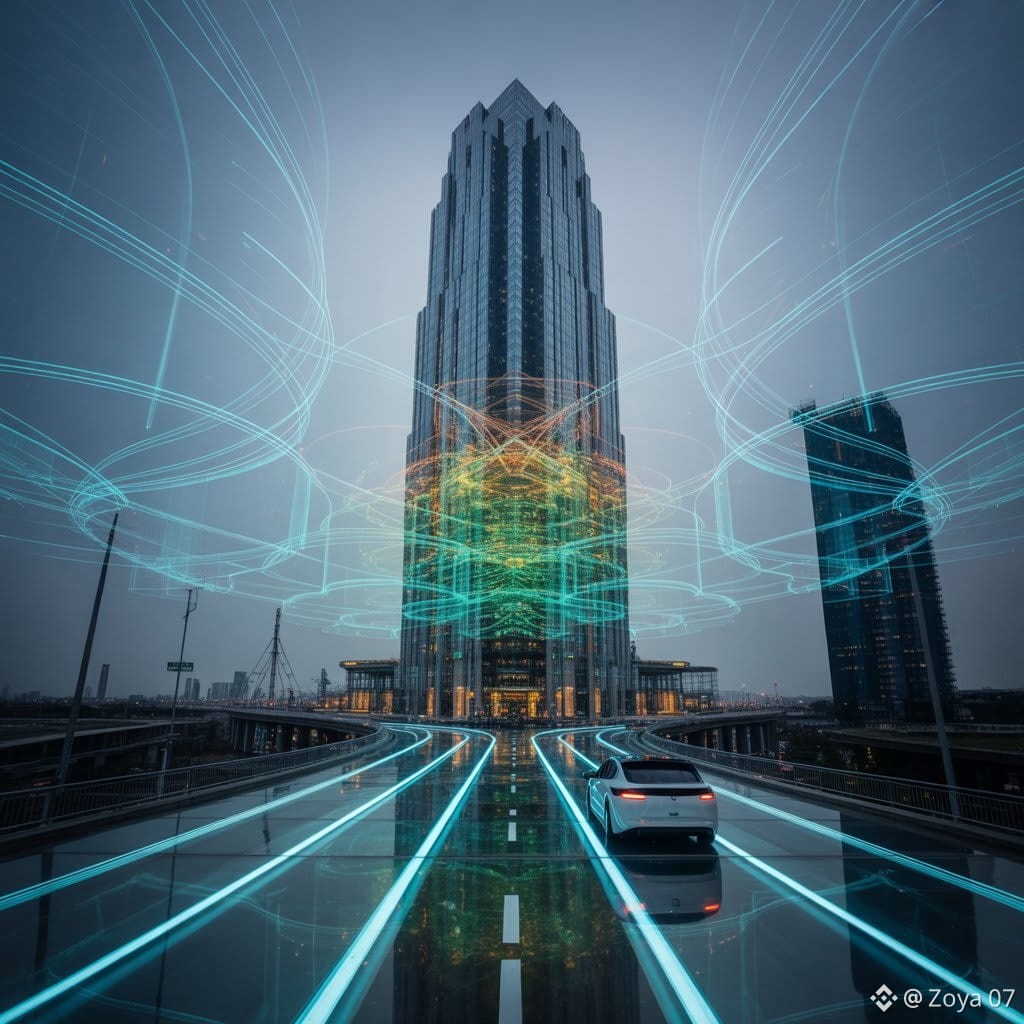
Dusk’s modular architecture plays a key role in achieving this balance. By separating the core blockchain functions such as consensus, execution, privacy, and compliance logic, the protocol can evolve over time without compromising its foundational guarantees. This modularity allows Dusk to integrate new cryptographic techniques, adapt to changing regulatory requirements, and support a wide range of financial products. Rather than locking developers into a rigid framework, Dusk provides flexible primitives that can be combined to build institution-grade applications with embedded compliance and privacy features.
Consensus on Dusk is based on a proof-of-stake mechanism designed to provide fast and predictable finality, a critical requirement for financial use cases. In traditional finance, settlement delays introduce counterparty risk and operational complexity. Dusk’s consensus model aims to minimize these issues by ensuring that transactions are finalized quickly and deterministically. Validators stake the native DUSK token to participate in securing the network, and economic incentives are structured to reward honest behavior while penalizing misconduct. This approach aligns network security with financial reliability, making the blockchain suitable for settlement, issuance, and trading workflows.
Smart contracts on Dusk are tailored for financial logic rather than generic computation alone. Developers can create programmable assets and applications that enforce regulatory constraints directly at the protocol level. For example, tokenized securities can be issued with built-in transfer restrictions, identity checks, or jurisdictional rules that are automatically enforced by the smart contract. Because these rules are encoded on-chain and validated through cryptographic proofs, they reduce the need for off-chain compliance processes and manual intervention. This automation not only lowers operational costs but also reduces the risk of human error and regulatory breaches.
A major focus of the Dusk ecosystem is the tokenization of real-world assets. Traditional financial instruments such as equities, bonds, and funds are governed by complex regulatory frameworks that require strict control over ownership, transferability, and disclosure. Dusk’s infrastructure is designed to support these requirements by enabling assets to exist on-chain with privacy-preserving yet auditable characteristics. Ownership changes can be settled quickly, compliance rules can be enforced automatically, and sensitive information can remain confidential, all while maintaining a verifiable and tamper-resistant record of activity.
Decentralized finance on Dusk follows a markedly different path from the open and often anonymous DeFi ecosystems seen on many public blockchains. Rather than prioritizing unrestricted access, Dusk emphasizes compliant DeFi, where decentralized protocols are designed to be usable by regulated institutions. This enables financial entities to benefit from automation, composability, and reduced intermediaries without stepping outside legal boundaries. Lending, trading, and settlement protocols built on Dusk can incorporate identity frameworks, risk controls, and reporting mechanisms while still operating in a decentralized and trust-minimized environment.
The DUSK token underpins the economic and governance model of the network. It is used for staking by validators, for paying transaction fees, and for participating in governance decisions that shape the future of the protocol. Governance is designed to allow stakeholders to influence upgrades and parameter changes while maintaining stability and long-term reliability, which are essential for institutional users. This balance reflects Dusk’s broader philosophy of gradual, considered evolution rather than rapid, disruptive changes that could undermine trust.
Taken as a whole, Dusk represents a pragmatic approach to blockchain adoption in finance. It does not assume that regulation will disappear or that institutions will abandon existing legal obligations. Instead, it embeds privacy, auditability, and compliance directly into the protocol, using cryptography and modular design to satisfy real-world requirements. By doing so, Dusk aims to serve as foundational infrastructure for regulated DeFi, tokenized assets, and next-generation financial applications, offering a path toward decentralized systems that are not only innovative but also legally and operationally viable