
 Blockchains were originally built to record value. Over time, they became good at proving ownership, tracking transfers, and enforcing rules through smart contracts. But as the digital world grows more complex, these abilities are no longer enough on their own.
The next phase of blockchain adoption will not be driven by people clicking buttons or signing transactions manually. It will be driven by software. AI agents, automated services, and background systems will move value, verify information, and make decisions continuously. Vanar Chain is being designed with this future in mind.
Rather than chasing speed or speculation, Vanar focuses on something less visible but far more important: infrastructure that machines can trust.
Why Automation Changes Everything
When humans interact with blockchains, inefficiency is tolerated. Waiting for confirmations, paying unpredictable fees, or manually handling documents is inconvenient, but manageable.
For machines, this does not work.
AI agents operate at scale. They may verify thousands of records, process many micro-payments, or monitor compliance rules in real time. For this to be possible, the blockchain underneath must be predictable, stable, and structured.
Vanar starts from this assumption. It treats automation not as a feature, but as the default mode of operation.
From Storage to Memory
Most blockchains store data in a way that proves it exists, but does not explain what it means. Files are saved, hashes are verified, and context is lost.
Vanar approaches data differently.
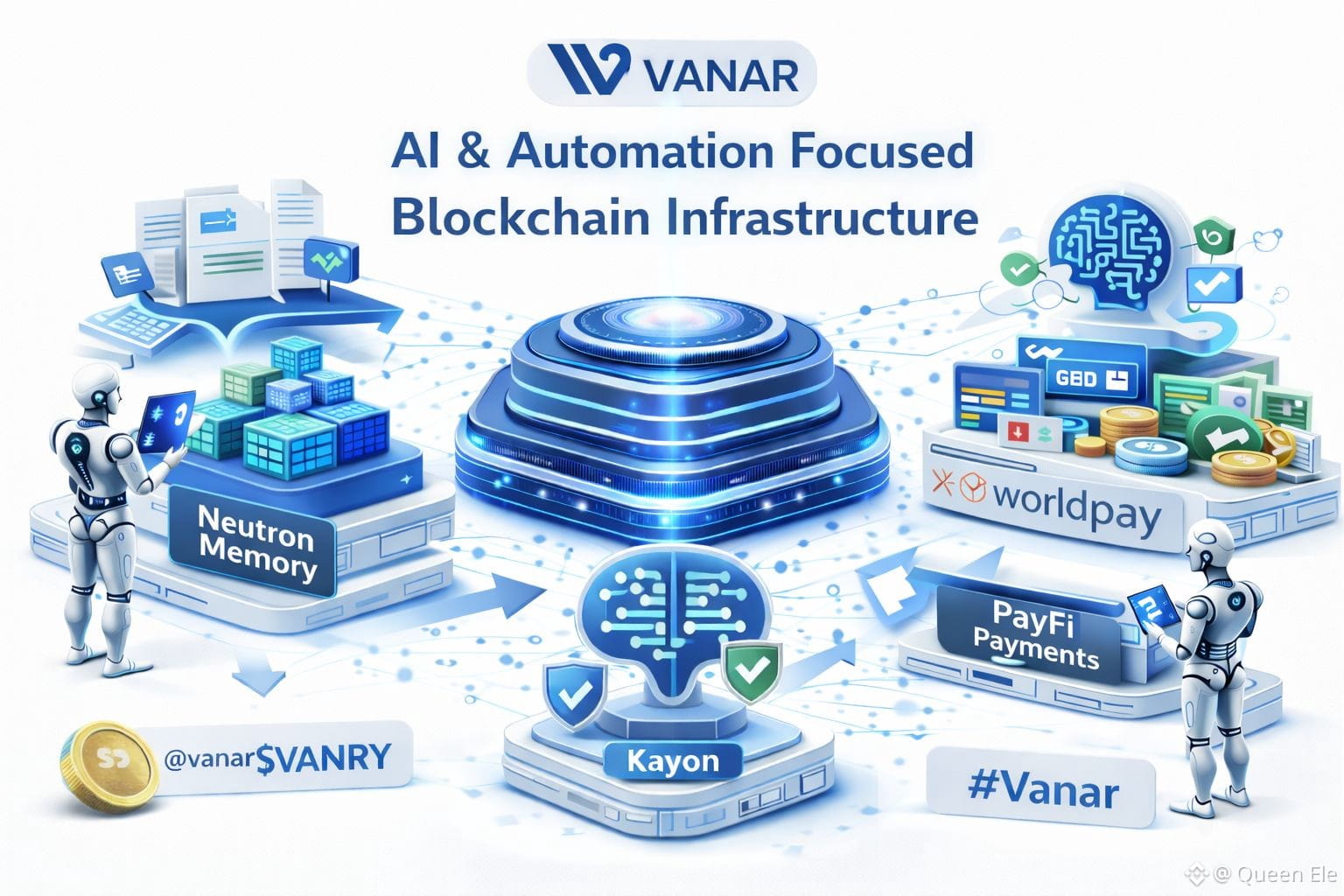
Through its Neutron system, information is compressed into small, verifiable units designed to retain meaning. Instead of dealing with large, unstructured files, applications and AI agents can work with compact references that are easy to verify and reason over.
This turns the blockchain into a memory layer rather than a filing cabinet. Data is not just stored, it becomes usable.
Reasoning as Part of the Stack
Data alone is not enough. Decisions require interpretation.
Vanar introduces Kayon as a reasoning layer that allows applications to apply logic, context, and compliance rules directly on-chain. This moves blockchains closer to decision-making systems rather than simple execution engines.
Instead of relying on rigid if-then rules, Kayon enables more flexible checks that reflect real-world conditions. This is especially important for financial workflows, identity verification, and regulated assets.
In simple terms, Vanar wants blockchains to understand what data represents before acting on it.
Payments as a Real-World Test
Many blockchain ideas sound good in theory but fail at the point of payment. That is where friction appears immediately.
Vanar’s PayFi focus reflects this reality. By prioritizing predictable fees and integration with existing payment systems, the network aims to support automated settlement that works in real commerce.
Fixed fees are a key part of this design. While volatile fees may be acceptable for speculation, they break automation. Stable costs allow AI agents and services to operate without constant risk.
This may not generate excitement, but it creates trust.
A Different Approach to Growth
Vanar does not position itself as a consumer-facing blockchain competing for attention. It behaves more like backend infrastructure.
This means slower visibility, fewer headlines, and less hype. But it also means durability. Most lasting systems are not the loudest ones. They are the ones that quietly become indispensable.
The design of the $VANRY token reflects this mindset. Incentives are aligned with validators and ecosystem development rather than short-term speculation. The focus stays on security, stability, and long-term participation.
Where This Leads
If AI agents become the primary users of blockchains, the requirements will change. Predictable costs, structured data, reasoning, and compliance will matter more than raw speed.
Vanar Chain appears to be preparing for that shift.
It is not trying to reinvent everything at once. It is making deliberate choices about how data is handled, how payments flow, and how automation is supported.
Whether Vanar succeeds will depend on execution. Tools must work outside of demos. Systems must remain stable under load. Automation must reduce friction rather than add complexity.
But if these pieces come together, Vanar could represent a meaningful step toward blockchains that are not just programmable, but intelligent in practice.
