

The first time I really sat with Vanar’s roadmap, what struck me was not what it promised. It was what it quietly stopped talking about.
For a long time, Vanar Chain lived comfortably in the gaming and metaverse category. Fast transactions, predictable fees, assets moving quickly enough that players did not feel friction. That framing made sense in 2021 and 2022. Games needed chains that stayed out of the way. But somewhere along the line, the tone shifted. Not loudly. No big rebrand moment. Just a slow reweighting of attention toward memory, reasoning, and systems that persist beyond a single interaction.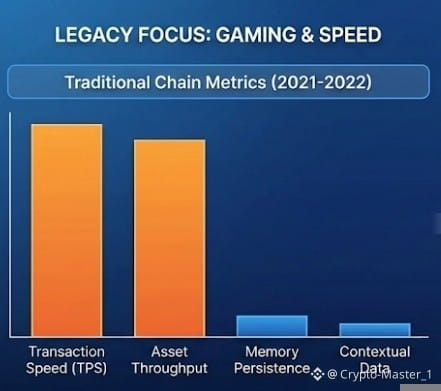
When I first looked at this shift, I wondered if it was just narrative drift. Chains often chase the next headline. But the deeper I went, the more it felt like an architectural change, not a marketing one. Gaming was never the end state. It was a training ground.
On the surface, Vanar still looks fast. Blocks finalize quickly, fees stay low, and throughput is high enough that latency barely registers for most users. Those are table stakes now. Underneath that, though, the roadmap starts spending more time on what happens between transactions. That is where things get interesting.
Take Neutron, Vanar’s persistent memory layer. At a simple level, it stores context. Not just raw data, but structured information that AI systems can recall later. That sounds abstract until you compare it with how most chains work today. Ethereum, Solana, even newer L2s are good at executing instructions. They are bad at remembering anything beyond state snapshots. Every interaction is treated like a fresh start.
Early benchmarks suggest Vanar is trying to flip that. Internal tests shared by the team show memory retrieval times measured in milliseconds rather than seconds, with storage costs per memory object staying below a cent at current gas pricing. The exact numbers will shift, but the direction matters. Cheap recall changes how applications behave. An AI agent that does not need to re-ingest its entire history every time it acts becomes cheaper to run and easier to trust.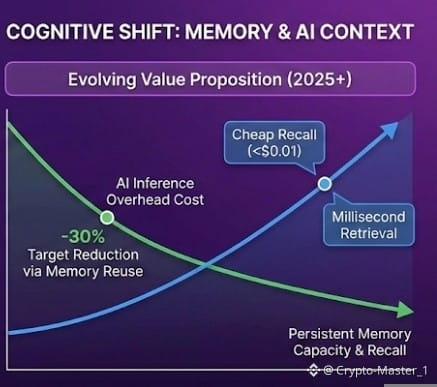
That momentum creates another effect. Once memory is persistent, behavior becomes cumulative. A gaming NPC that remembers player choices is one example, but a compliance agent that remembers past transactions or an AI moderator that learns community norms over time is something else entirely. The same foundation supports both, but only one points toward enterprise use.
This is where the cognitive chain idea starts to make sense. Vanar is positioning itself less as a place where things happen fast and more as a place where things learn slowly. That is a different value proposition.
There is data to back this shift. Over the past year, Vanar’s developer updates have increasingly referenced AI inference costs and memory persistence rather than frame rates or asset minting. One roadmap snapshot from late 2025 noted a target reduction of inference-related compute overhead by roughly 30 percent through on-chain memory reuse. That number matters because inference, not training, is where most AI systems bleed money at scale.
Meanwhile, the broader market is signaling similar pressure. In 2024 alone, enterprises deploying stateless AI agents reported retraining and context reconstruction costs growing faster than usage. Some internal surveys put that growth above 40 percent year over year. Those systems work, but they are wasteful. They forget everything between actions.
Understanding that helps explain why Vanar’s roadmap feels quieter than others. There is no rush to ship flashy consumer apps. Instead, there is a steady layering of primitives that make forgetting optional. If this holds, it opens doors beyond gaming without abandoning it.
Of course, there are risks. Persistent memory on-chain raises questions about data bloat and privacy. Storing context cheaply is one thing. Governing who can read, write, and forget that context is another. Vanar’s current approach relies on permissioned memory access and selective pruning, but this remains untested at scale. A cognitive chain that remembers too much can become brittle.
There is also the adoption question. Developers understand games. They understand DeFi. Cognitive infrastructure is harder to sell because it solves problems people only notice once systems grow complex. Early signs suggest interest, though. Hackathon participation focused on AI-native apps has increased steadily, with Vanar reporting a doubling of submissions in that category over the last two quarters. That is still a small base, but trends start small.
What I find most telling is what Vanar is not optimizing for. There is little emphasis on raw TPS bragging rights. No obsession with being the cheapest chain this week. The focus stays on texture rather than speed. On systems that feel steady rather than explosive.
Zooming out, this mirrors a larger pattern in the market. Blockchains are slowly splitting into two camps. Execution layers that prioritize throughput and cost, and cognitive layers that prioritize context and continuity. The first camp serves traders and gamers well. The second serves AI systems, compliance tools, and long-term coordination problems. Both will exist. Few chains can credibly do both.
Vanar seems to be betting that the next wave of value does not come from faster clicks but from systems that remember why they clicked in the first place. That is a quieter bet than most, and harder to explain in a tweet. It is also harder to reverse once the foundation is laid.
Remains to be seen whether developers follow, or whether the market stays fixated on speed and spectacle. Early signs suggest at least some builders are tired of rebuilding context from scratch every time. If that fatigue grows, cognitive chains will stop sounding abstract and start feeling necessary.
The sharp observation that sticks with me is this. Gaming taught blockchains how to react in real time. Cognitive chains are about teaching them how to remember over time. The roadmap suggests Vanar is betting that memory, not motion, is where the next edge quietly forms.