
When I first started looking into @Walrus 🦭/acc Protocol I was struck by how different it feels from so many other projects in the blockchain space. Right away I could see that this was not just another token or gimmick but a real attempt to solve something we’re all seeing become more and more important as the internet grows and the world generates more data faster than ever before. The idea behind the Walrus Protocol is to create a decentralized system for storing large amounts of data in a way that is secure, reliable, and cost-efficient while allowing anyone to participate in providing storage and earning rewards for doing so. It was built by a team of experienced developers at Mysten Labs and is tightly linked with the Sui blockchain, which helps coordinate all the key functions of the network in a way that feels seamless and robust.
The reason this protocol exists is simple yet powerful. Today most data either lives on centralized servers run by a handful of tech companies or in existing decentralized systems that are either too expensive or too slow to handle big files like videos or large datasets. Walrus asks why we should accept those limitations when we can build something better with distributed technologies. The project’s native token, called WAL, is the fuel that keeps everything moving. It’s used to pay storage providers when users upload files, to reward people who stake tokens to secure the network, and to give holders a say in how the protocol evolves over time. This balance of utility and incentives was designed so that value doesn’t just flow upward to a few insiders but circulates through the whole ecosystem, rewarding anyone who contributes either by storing data, staking tokens, or helping coordinate and govern the network’s future.
At its core the Walrus Protocol is about storing blobs, which is just a technical way of saying really big blocks of binary data like movies, high-resolution images, AI datasets, or archives of blockchain history. Instead of uploading a whole file to one place like you might today with traditional cloud storage, Walrus will slice that file into many smaller encoded pieces and spread them across a global network of storage nodes. If some of those nodes go offline or fail the data can still be reconstructed from the pieces that remain, which makes the whole system incredibly resilient and reliable in a way that centralized servers simply can’t match. It’s a system born out of necessity, because as we generate more data every day the classical approach of storing everything in one place becomes more risky, more expensive, and more subject to failure.
The mechanics of how Walrus actually works are both simple in idea and complex in execution. Users who want to store data prepay for that service using WAL tokens, and those tokens are split and released over time to the storage providers that hold the pieces of your data. This ensures that storing data isn’t a one-time transaction but a continuous interaction between users and providers where both sides are committed to keeping the data available and intact. At the same time, people can stake WAL tokens to support the network’s security and earn rewards as long as they act in ways that benefit the community rather than harm it. Over time that creates a powerful coordination of incentives where everyone who contributes something valuable to the system shares in the upside.
One of the things that really makes Walrus stand out is its integration with the Sui blockchain. Sui isn’t just a place where transactions happen but also a coordination layer that keeps track of where every piece of data lives, who is responsible for holding it, and how payments and rewards are distributed fairly and transparently. That means developers can build applications on top of Walrus that need storage without reinventing the wheel each time, and users benefit from a level of accountability and automation that older storage networks don’t offer. The combination of decentralization, programmability, and efficient encoding techniques like erasure coding gives Walrus the ability to scale far beyond what many older systems have been able to achieve. 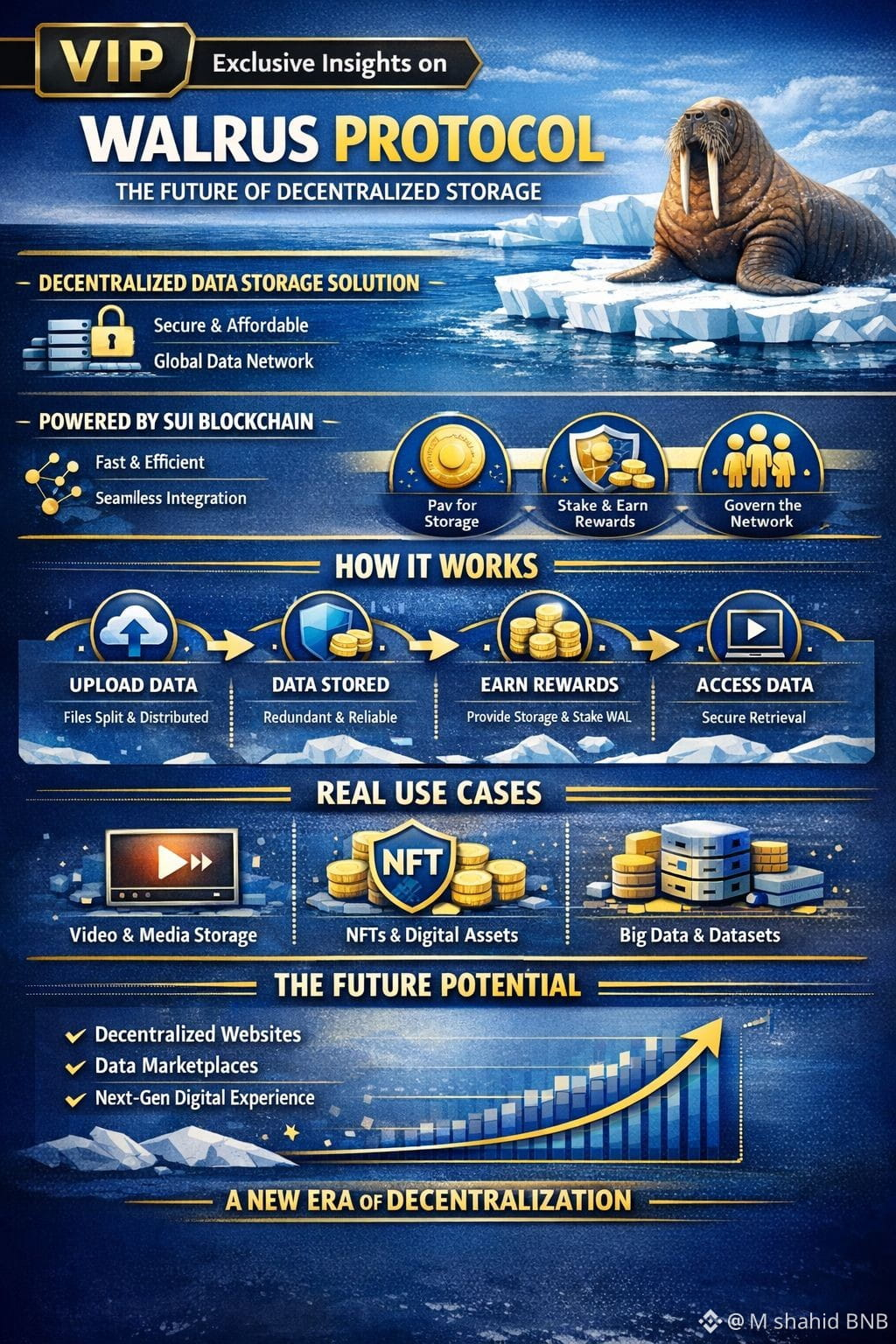
For many people value in a project is ultimately about real world use cases, and here’s where Walrus begins to feel truly alive. Imagine decentralized applications that need to store video content without paying huge cloud fees, or NFT platforms where the artwork and metadata are stored in a way that cannot be censored or taken down. Imagine researchers who want to share and preserve large datasets, or media platforms that want to give creators more control over their assets rather than forcing them into a centralized ecosystem. Walrus has the potential to touch all of those things because it isn’t limited by the size or type of data it can handle, and because its economic model incentivizes people to participate and help grow the network over time.
When I think about where Walrus might be heading over the coming years I see a world where decentralized storage becomes as normal as traditional web hosting is today. The technology could be used not just for storing static files but as a backbone for entire decentralized websites, data markets where creators sell access to datasets, and infrastructure that supports next generation digital experiences. As the network grows and more builders adopt it, the WAL token could become an even more integral part of how value moves in decentralized ecosystems, especially as people start paying for storage and staking tokens not just as speculation but because they are actively using and benefiting from the network.
Of course, nothing in technology evolves without challenges. Walrus has to prove that its decentralized model can consistently deliver performance and reliability on par with centralized services, and it must continue to attract enough node operators and developers to keep expanding its capabilities. But the fact that the project has raised significant funding and is backed by teams with deep technical expertise gives it a strong foundation to build on. It’s not just a theoretical idea; it’s being actively developed, tested, and used in the real world, with growth in both technical use cases and community participation.
What strikes me most about the Walrus Protocol is the sense that we’re witnessing the early stages of something that could become fundamental to how data is stored and shared in the future. It feels like watching a new layer of the internet unfold, one where users and builders have more control, more transparency, and more opportunity to capture and create value directly from the data they generate. If decentralized storage becomes as commonplace as recording a photo or sending a video, projects like Walrus will have helped build that foundation — not by promising quick gains but by offering a real solution to a real problem.


