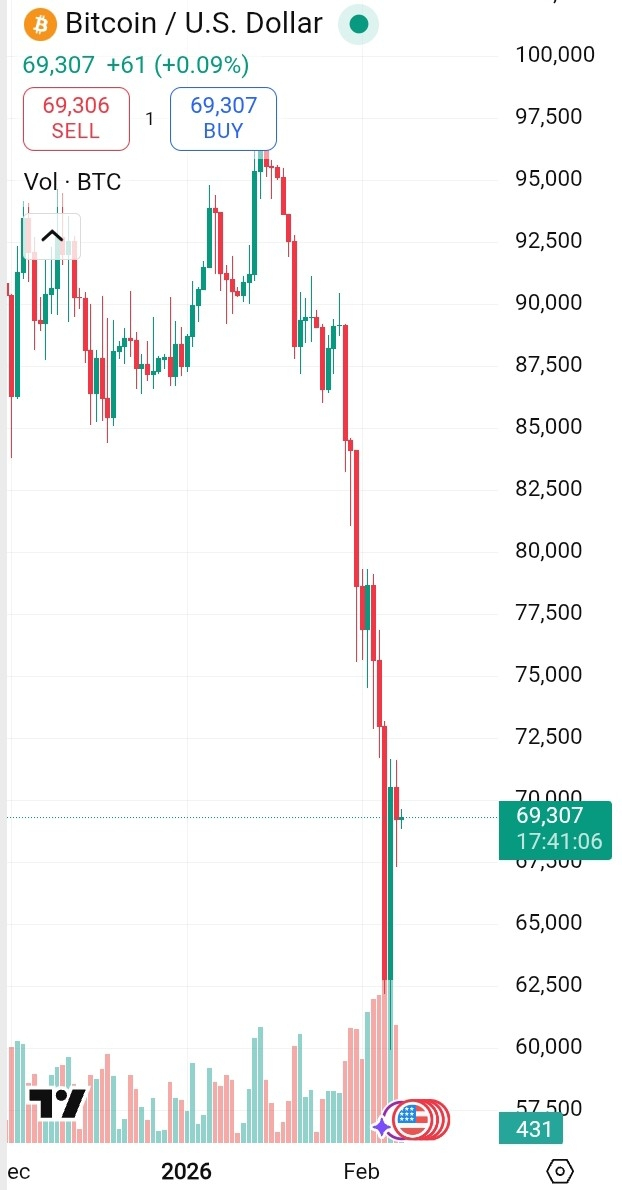
Bitcoin’s recent price action has sent shockwaves through the digital asset landscape, mirroring the intensity of the 2022 FTX collapse. Over the past 24 hours, the flagship cryptocurrency experienced a sharp decline toward the $60,000 mark, driven by an accelerated selloff. While BTC has since staged a partial recovery to approximately $69,800, on-chain data reveals a market still grappling with significant structural pressure. 📉
🔍 The Gap Between Price and On-Chain Reality
Data from Glassnode highlights a stark divergence between Bitcoin's spot price and several critical on-chain benchmarks. As the market plunged, the price fell well below key investor cost bases:
Short-Term Holder (STH) Cost Basis: $94,000 🚩
Active Investors Mean: $86,800 🚩
True Market Mean: $80,100 🚩
Current Realized Price: $55,600 📍
📉 A Mechanical Unwind, Not a "Smoking Gun"
While social media platforms like X (formerly Twitter) were flooded with speculative theories—ranging from hedge fund collapses in Hong Kong to yen-funding volatility—the evidence suggests a more technical and mechanical "unwind." ⚙️
The primary drivers of this volatility include:
Persistent ETF Outflows: US spot Bitcoin ETFs have seen over $6 billion in net outflows over the last four months. This shift removes the "automatic dip buyer" from the equation, leaving the market vulnerable to sharp downward breaks. 🏦
Unrealized Losses: Bloomberg analysts note that ETF holders are currently facing their deepest losses since the products launched in January 2024, with the current pullback representing a 42% decline from the local high. 📊
Liquidation Cascades: Once key support levels failed, a mechanical domino effect took over. Over $1.2 billion in leveraged positions were liquidated, turning a standard correction into a violent descent. 🌊
🐋 Whale Behavior and Market Capitulation
On-chain signals confirm that investors are locking in losses at a scale not seen since the 2022 bear market. On February 4, realized losses reached $889 million per day, a clear indicator of capitulation. 🏳️
Furthermore, CryptoQuant data tracked significant whale activity on Binance, with large-scale holders moving supply onto exchanges—likely to sell or hedge their positions. This influx of supply, combined with thinning liquidity, has allowed forced selling to dominate price discovery. 🚢
What’s Next?
The current environment reflects a market flushing out excess leverage. While the "narrative vacuum" remains filled with rumors, the data points to a straightforward correction fueled by ETF outflows and forced liquidations.
#Bitcoin #CryptoMarket #BlockchainData #BTC #CryptonewswithJack