

It was close to midnight, the kind of late hour where the office is quiet but your terminal is loud. Fans spinning, logs scrolling, Slack half muted. I was deploying what should have been a routine update, a small logic change tied to an exchange facing workflow. Nothing exotic. No novel cryptography. Just plumbing.
And yet, the familiar frictions piled up. Gas estimates jumped between test runs. A pending transaction sat in limbo because congestion elsewhere on the network spiked fees system wide. Tooling worked, technically, but every step required context switching bridges, indexers, RPC quirks, monitoring scripts duct taped together from three repos. Nothing broke catastrophically. That was the problem. Everything kind of worked, just slowly enough, unpredictably enough, to make me uneasy.
As an operator, those moments matter more than roadmaps. They’re where systems reveal what they actually optimize for. That night was when I started experimenting seriously with Vanar Network, not because I was chasing a new narrative, but because I was tired of infrastructure that insisted on being visible.
Most blockchains advertise themselves as platforms. In practice, they behave like obstacles you learn to work around. Fee markets fluctuate independently of your application’s needs. Throughput collapses under unrelated load. Tooling assumes you’re a protocol engineer even if you’re just trying to ship a product. As a developer, I don’t need to feel the chain. I need it to disappear. That was the frame I brought into Vanar: not is it faster? or is it more decentralized? but a more operational question, does it stay out of my way when things get messy?
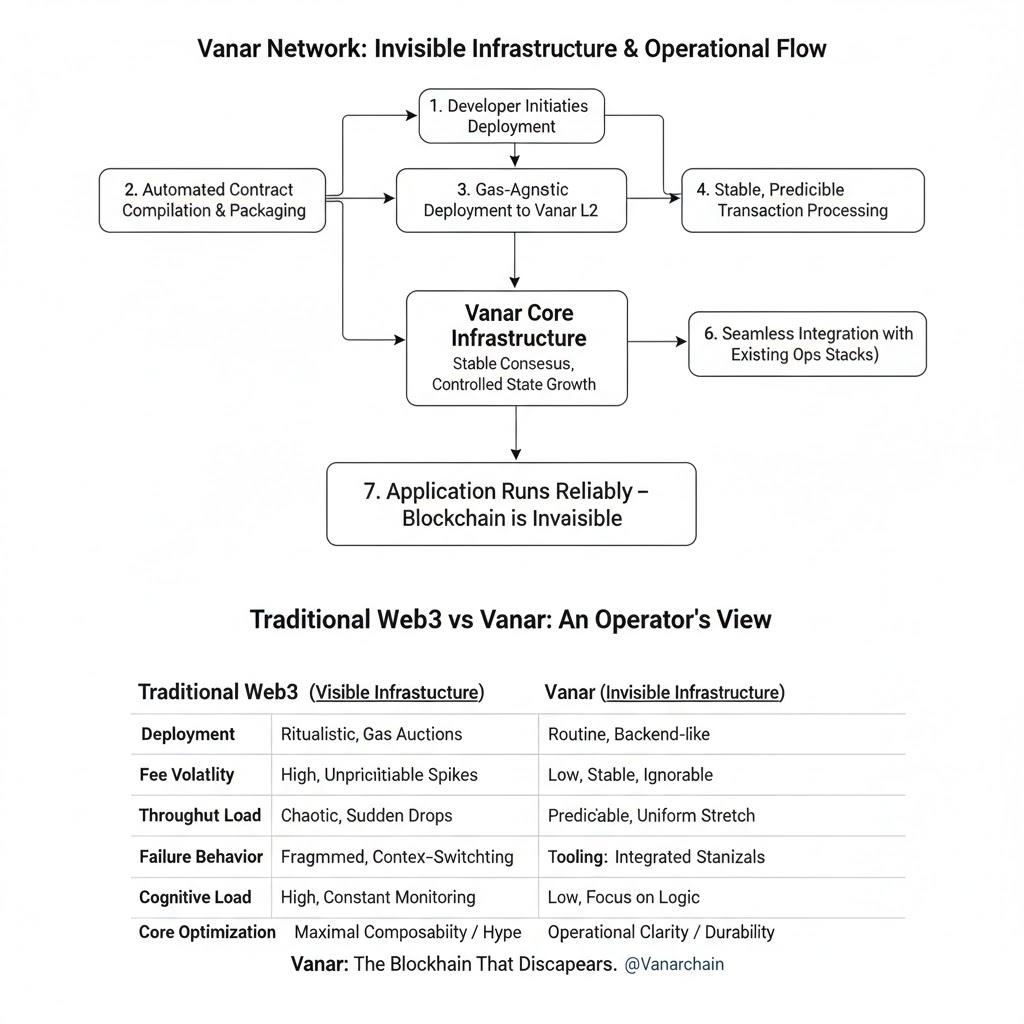
The first thing I noticed was deployment cadence. On Vanar, pushing a contract or service felt closer to deploying conventional backend infrastructure than ritual blockchain ceremony. Compile, deploy, verify without the constant recalibration around gas spike. Gas costs were stable enough that I stopped thinking about them. That sounds trivial until you realize how much cognitive load fee volatility adds to everyday decisions, batching transactions, delaying jobs, rewriting flows to avoid peak hours.
That consistency is an operational signal. It suggests the system is designed around predictability, not adversarial fee extraction. I didn’t benchmark Vanar to produce a marketing chart. I stressed it the way real systems get stressed: bursty traffic, repeated state updates, nodes restarting mid-process, indexers lagging behind. Under load, throughput held in a way that felt boring. Transactions didn’t race, they flowed. Latency didn’t collapse into chaos,it stretched, but predictably. More importantly, when things slowed, they slowed uniformly. No sudden cliffs, no pathological edge cases where a single contract call became a black hole.
Node behavior mattered here. Restarting a node didn’t feel like Russian roulette. Syncing was steady. Logs were readable. Failures surfaced as actionable signals rather than cryptic silence. This is the kind of thing you only appreciate when you’ve babysat infrastructure at odd hours. Glamorous systems fail loudly. Durable ones fail plainly.
Vanar’s tooling isn’t flashy, and that’s a compliment. CLIs behave like you expect. Configs don’t fight each other. You don’t need a mental model of five layers just to understand where execution happens. Monitoring hooks are straightforward enough that you can integrate them into existing ops stacks without rewriting everything.
Compared to more established platforms, the difference isn’t raw capability, it’s intent. Many ecosystems optimize for maximal composability or theoretical decentralization, then ask developers to absorb the complexity. Vanar flips that: it constrains certain freedoms in favor of operational clarity. That trade-off won’t appeal to everyone. If you’re building experimental primitives, you might miss the chaos. If you’re wiring real workflows, exchanges, games, enterprise rails, that constraint feels like relief.
Intellectual honesty means acknowledging what didn’t work as smoothly. The ecosystem is thinner. You won’t find a dozen competing libraries for every task. There’s also an adoption risk inherent in invisibility. Systems that don’t shout about themselves rely on patient builders, not hype cycles. That’s a slower path, and it can be lonely if you expect instant network effects. But these are solvable problems. More importantly, they’re problems of absence, not fragility. Nothing fundamental broke. Nothing felt brittle.
Compared to high throughput chains chasing maximal TPS, Vanar feels less like a racetrack and more like a freight line. Compared to heavily decentralized but congested networks, it trades some ideological purity for operational sanity. None of these approaches are right in the abstract. Decentralization, performance, and enterprise readiness pull against each other. Every system chooses where to compromise. Vanar’s choice is clear: reduce surface area, reduce surprise, reduce friction.
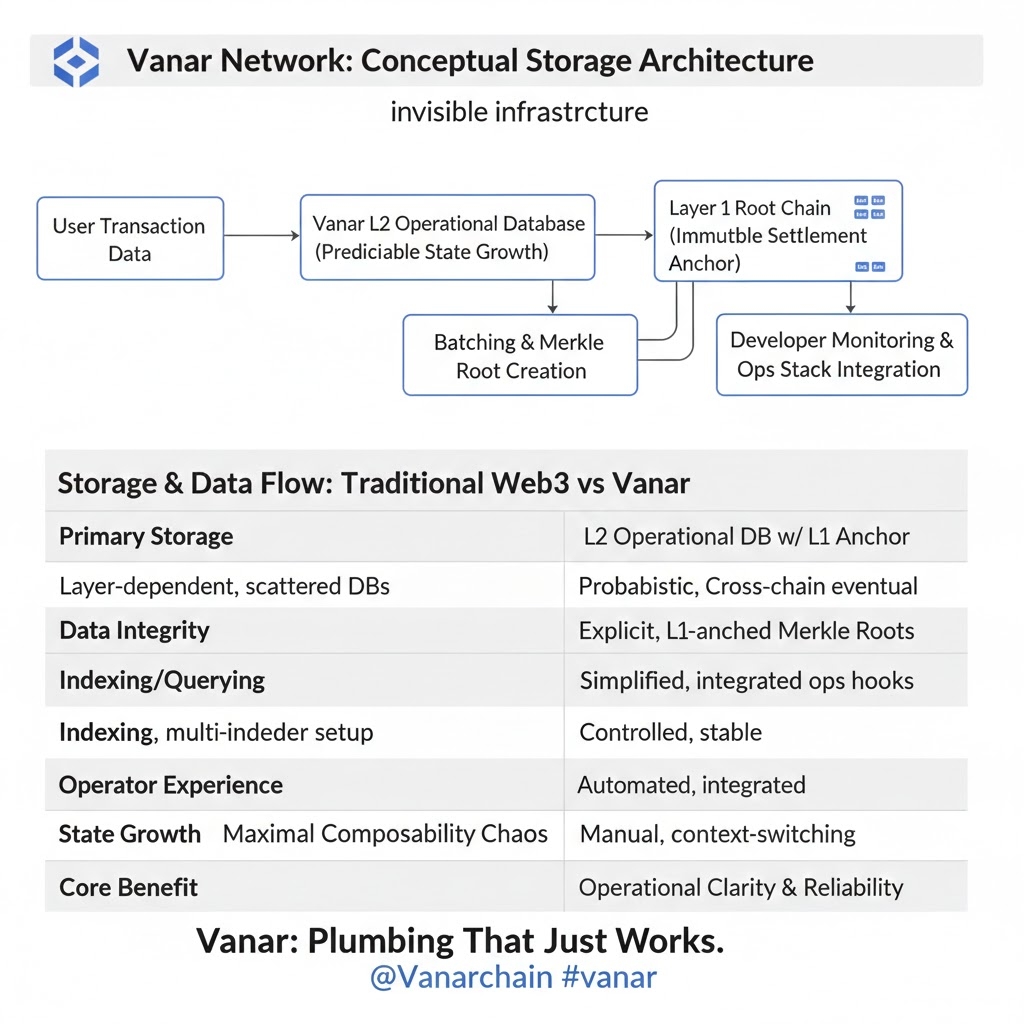
After weeks of working with it, the most telling sign was this, I stopped thinking about the blockchain. Deployments became routine. Monitoring became boring. When something went wrong, it was usually my code, not the network. That’s not a failure of imagination, it’s a success of design.
It sticks for me isn’t a rocket ship or a financial revolution. Pipes you don’t notice until they leak. Infrastructure that earns trust by being unremarkable. In the long run, survival doesn’t favor the loudest systems or the most visionary promises. It favors the ones that execute reliably, absorb stress without drama, and reward the hard, boring work of operators who just want things to run. Vanar, at its best, feels like that kind of system: invisible, durable, and quietly useful.
