
In every major technological shift, there is a moment when the conversation stops being about what something could become and starts focusing on whether it actually works. The early internet was full of grand promises long before most households could even load a webpage without interruption. Smartphones were once pitched as futuristic curiosities before battery life, app ecosystems, and mobile networks made them indispensable. Blockchain now sits at a similar inflection point, especially in entertainment and interactive digital worlds, where aspiration has long outrun execution. Against that backdrop, Vanar has chosen a path that feels almost countercultural in an industry obsessed with branding itself as the next great “AI chain” or “gaming chain.” Instead of leading with spectacle, it has leaned into a quieter thesis: build the rails first, let the stories emerge later.
That decision immediately sets Vanar apart in a space dominated by rapidly shifting narratives. Over the past several years, blockchains have often been packaged through whatever theme was gaining traction at the time—DeFi in one cycle, NFTs in another, then gaming, then artificial intelligence. Each wave brought bursts of attention and capital but also exposed a structural weakness: too many networks were optimized for speculation rather than continuous, everyday use. When the spotlight faded, congestion, unpredictable fees, slow settlement, and developer-unfriendly tooling became impossible to ignore. Vanar’s approach appears shaped by those lessons. Rather than assuming that a compelling label will create sustainable demand, it treats compute, data, and transaction throughput as foundational utilities, the sort of things users only notice when they fail.
At the heart of that philosophy lies the Neutron and Kayon architecture, which reframes how data is handled on-chain. In many systems, data storage is treated as a passive function—records are written, states are updated, and that information remains largely inert until another transaction explicitly references it. Vanar’s design pushes toward something more active: data that is not merely archived but structured so it can be verified, queried, and programmed against in real time. This is not a cosmetic distinction. In environments where autonomous agents act continuously, where in-game economies operate around the clock, where digital worlds adapt dynamically to player behavior, and where content pipelines are partially automated, the blockchain ceases to be a slow-moving ledger in the background. It becomes a live coordination layer. If that layer is expensive, unpredictable, or sluggish, the entire experience degrades.
The importance of predictable fees and low-latency execution cannot be overstated in such contexts. Speculative trading can tolerate bursts of congestion; users might complain, but they are often willing to wait minutes for settlement if they believe a position is profitable. Entertainment does not afford that luxury. A two-second delay can break immersion in a multiplayer game. A sudden spike in transaction cost can turn a routine micro-action into an annoyance that drives players away. A wallet prompt at the wrong moment can interrupt narrative flow so completely that a user never returns. Vanar’s fixed-fee mindset and focus on rapid finality appear tailored for these realities, not for occasional spikes in activity but for nonstop, machine-driven workloads where actions compound by the thousands every minute.
This emphasis on relentless reliability reflects a sober reading of why so many Web3 entertainment experiments struggled to find traction. The problem was rarely that digital ownership or player-driven economies lacked appeal. In fact, those ideas resonated strongly with communities accustomed to modding, trading skins, or building in virtual worlds. The friction came from elsewhere: cumbersome onboarding processes, volatile transaction costs, and performance constraints that were acceptable in financial experiments but disastrous in consumer-facing products. Players do not want to become amateur systems engineers just to start a session. They want to click “play” and be inside a world instantly. They want in-game purchases to feel like native interactions, not like navigating a foreign financial interface. They want to trade items with friends without wondering whether network congestion will freeze the transaction mid-match.
Vanar’s tooling and performance targets suggest that it has internalized those lessons. Fast confirmations are not framed as a technical achievement to boast about but as a prerequisite for uninterrupted gameplay. Stable, predictable costs are not positioned as a speculative edge but as the only way to make microtransactions viable at scale. Resilience during peak demand is not a nice-to-have; it is the difference between a launch weekend that builds momentum and one that permanently damages a title’s reputation. Developer experience, too, becomes central rather than peripheral. Studios that have spent years working with traditional game engines and centralized backends will not tolerate infrastructure that forces them to redesign their pipelines around blockchain idiosyncrasies. For adoption to occur, the platform has to adapt to creators, not the other way around.
That same understated pragmatism extends to Vanar’s handling of its token, VANRY. In many ecosystems, the token is marketed as the primary attraction, with applications and tooling framed almost as supporting characters in a story about price appreciation. Vanar inverts that emphasis. The ecosystem is presented as the product; the token as the engine quietly running beneath it. VANRY is meant to power execution, coordinate incentives, and provide a shared economic layer across applications. Governance is positioned as a later-stage function, something that becomes relevant as real usage and a diverse stakeholder base emerge. The underlying wager is demanding in its simplicity: if builders ship compelling experiences and users actually spend time and money inside them, the token’s relevance will grow organically. No constant reinvention of narratives is required becausethe utility is embedded in everyday activity.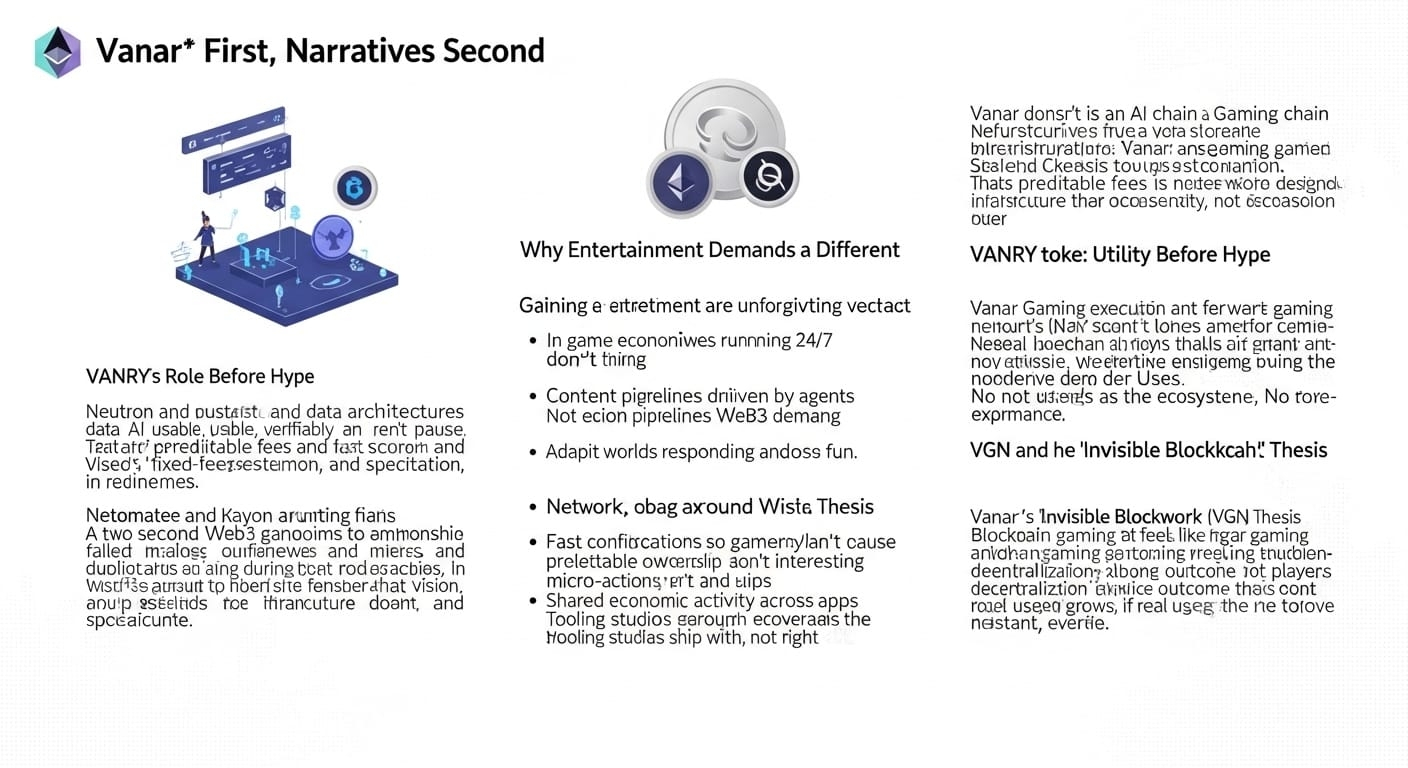
This approach carries both strengths and risks. On the positive side, it aligns the network’s success with tangible outcomes rather than speculative enthusiasm. Transaction volume driven by real gameplay or agent-driven systems is a fundamentally different signal from bursts of trading motivated by hype. Incentives can be calibrated around retention and creation rather than short-term liquidity mining. On the other hand, quieter strategies often struggle for attention in markets that reward bold storytelling. Infrastructure-first projects can find themselves overshadowed by louder competitors, at least in the short term. The challenge becomes sustaining development and community engagement long enough for usage metrics to speak for themselves.
The Vanar Gaming Network, or VGN, crystallizes this philosophy into a single, audacious idea: the best blockchain gaming experience is one where players barely notice the blockchain at all. This “invisible infrastructure” thesis runs counter to years of marketing that foregrounded decentralization, wallets, and token mechanics as selling points. VGN imagines a world where players launch into games quickly, perform actions instantly, and trade items as naturally as they would on any centralized platform, while ownership and interoperability operate quietly in the background. The technology becomes a substrate rather than a spectacle.
If assets can move fluidly across titles within the same ecosystem, the implications extend far beyond convenience. Traditional game economies are siloed by design; items, currencies, and achievements are locked inside a single product. Even when players invest hundreds of hours or significant sums of money, that value typically evaporates the moment they leave for a different world. A connected network of games changes that calculus. Items acquired in one environment might hold meaning or utility elsewhere. Reputation built in a competitive arena could translate into advantages in a role-playing setting. Entire sub-economies could arise around crafting, trading, or renting assets across multiple titles. Such a vision depends not on flashy features but on plumbing that can handle constant transfers without friction or cost shocks.
Artificial intelligence introduces another layer of complexity and opportunity. In entertainment, the most transformative applications are rarely the headline-grabbing demos that flood social media. They are the quieter systems that personalize experiences, generate dynamic content, balance in-game economies, and populate worlds with characters that respond believably to player actions. These systems thrive on continuous interaction and feedback loops. They issue transactions frequently, adjust parameters in real time, and depend on stable infrastructure to remain affordable. If the cost of updating a world state fluctuates wildly or settlement times stretch unpredictably, the entire design space contracts.
Vanar’s real test in this domain will not be whether it can host a handful of experimental projects, but whether AI-driven applications can operate at scale without degrading performance or spiking costs. If autonomous agents can transact constantly, if adaptive worlds can evolve smoothly under heavy load, and if content pipelines can run without unexpected interruptions, the network’s identity begins to shift. It stops being pigeonholed as a niche “gaming chain” and starts to resemble a general-purpose platform for real-time digital experiences, where entertainment, social interaction, and automated systems converge.@vanar$VANRY ,#Vanar