
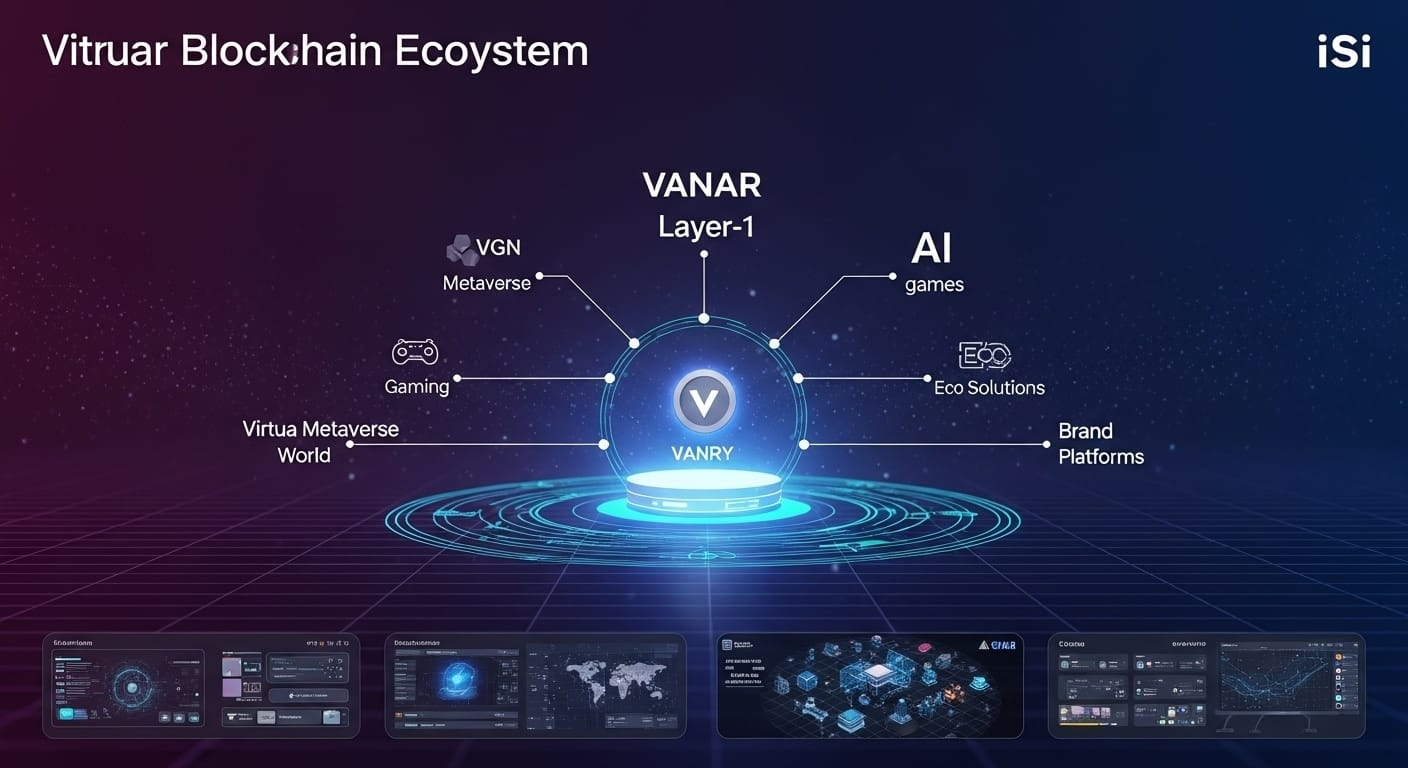
In the rapidly evolving blockchain landscape, most projects compete for attention by promoting a single headline narrative—the fastest chain, the AI chain, or the gaming chain. Yet the image presented here reflects a different philosophy. Instead of isolating one vertical, it illustrates an ecosystem approach: Vanar as the Layer-1 foundation, Vanry as the connective core, and a network of applications spanning AI solutions, Web3 gaming, digital identity, metaverses, and brand platforms.
This design language is not accidental. It signals a broader ambition—to create a blockchain environment where infrastructure comes first and specialized industries can build on top without friction. At the center of this vision lies the idea that tomorrow’s decentralized economy will not be segmented into silos. AI systems will interact with games. Brand platforms will rely on identity layers. Virtual worlds will need global settlement networks. And all of them will require a stable, scalable base layer.
Vanar aims to be that base.
The Foundation: Vanar as a Layer-1 Blockchain
At the top of the visual architecture stands Vanar Layer-1, indicating its role as the underlying settlement and execution layer. Layer-1 networks are responsible for the most critical functions in any blockchain ecosystem: validating transactions, maintaining consensus, storing data, and enforcing security.
In the context of the image, Vanar is portrayed not as a narrow-purpose chain, but as a multi-vertical infrastructure network. The connections radiating outward suggest that different industries—gaming, AI, digital identity, metaverse environments, and brand ecosystems—are all anchored to the same secure core.
This approach aligns with a growing realization in Web3: specialized applications thrive only when the base layer is reliable, predictable, and developer-friendly. Without that stability, even the most innovative use cases struggle to scale.
Vanar’s position at the top symbolizes governance over the network’s rules, economic incentives, and technical guarantees. Below it, the architecture fans out into components that convert raw blockchain functionality into real-world applications.
Vanry: The Ecosystem Hub
At the center of the diagram sits Vanry, glowing like a control node or coordination layer. Visually, it acts as the bridge between Vanar’s base protocol and the application-level ecosystems that surround it.
Vanry can be interpreted as:
A middleware layer that helps projects integrate with Vanar
A tokenized ecosystem component coordinating incentives and activity
Or a platform layer that unifies gaming networks, AI modules, and identity systems under one interoperable umbrella
Whatever its exact implementation, the symbolism is clear: Vanry is the operational heart of the network. If Vanar is the engine, Vanry is the transmission system—translating base-layer power into usable services.
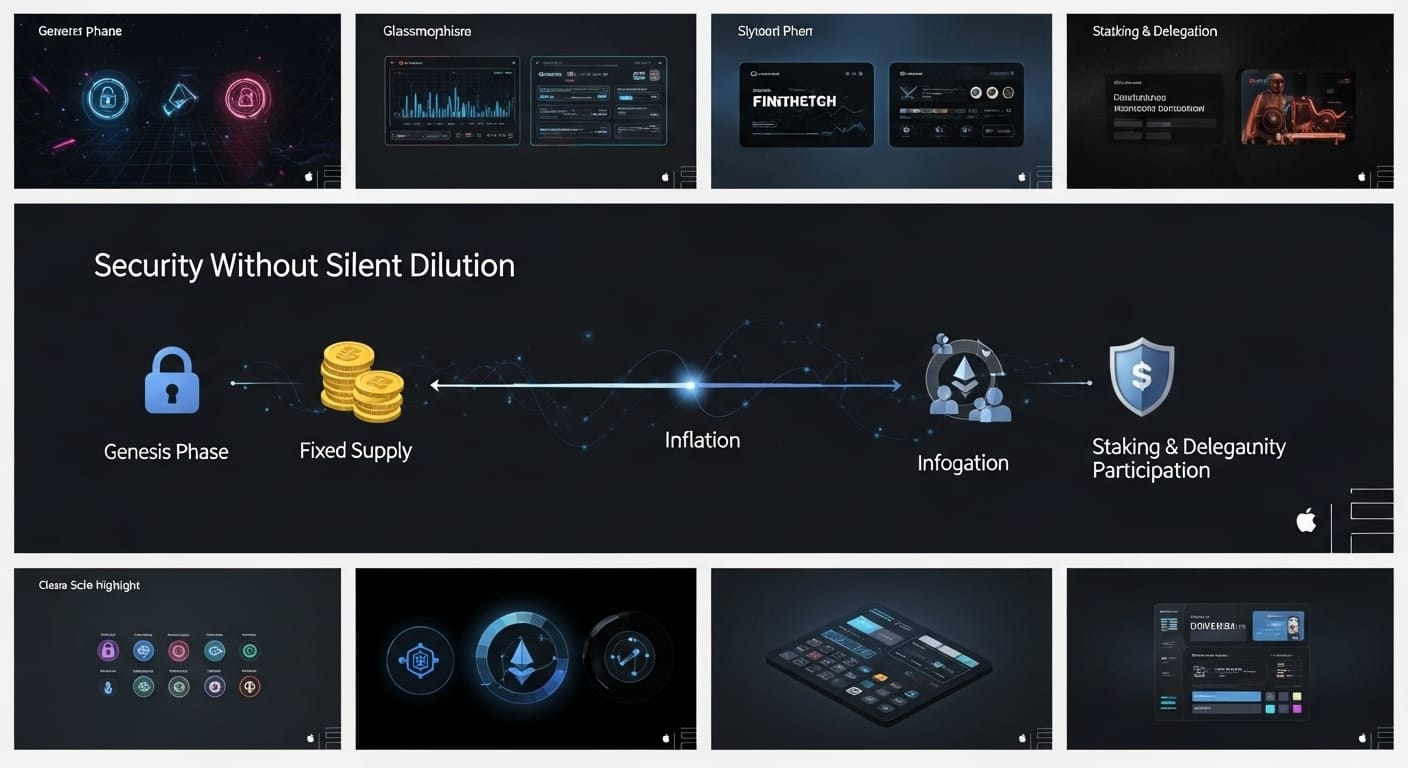
This is particularly important in multi-industry blockchains. Games, AI platforms, and enterprise brand tools have vastly different technical requirements. They handle different data types, transaction volumes, and latency constraints. A central coordination layer helps standardize interactions, allowing developers to build vertically while staying horizontally interoperable.
AI as a Native Component, Not an Add-On
One of the most striking features of the visual is the prominent placement of AI Eco Solutions and Brand Platforms connected directly to the Vanry core. This implies that artificial intelligence is not treated as an external service bolted onto blockchain infrastructure, but as a native participant in the ecosystem.
AI-driven applications in Web3 might include:
Autonomous trading agents
Game NPCs controlled by on-chain logic
Predictive analytics for supply chains
Fraud detection systems
Personalized brand experiences in digital worlds
To support such use cases, the underlying blockchain must handle frequent interactions, verifiable data feeds, and scalable computation pipelines. By embedding AI within the same architectural plane as gaming and identity systems, Vanar positions itself for a future where machine agents operate alongside human users.
This design choice hints at a long-term thesis: decentralized networks will increasingly host not only people, but algorithms with economic agency.
Gaming Networks and the Metaverse Layer
On the left side of the image, we see references to VGN Games and Virtua Metaverse, connected through network nodes into the Vanry core. This cluster represents the gaming and immersive-world vertical of the ecosystem.
Gaming has long been considered one of blockchain’s most promising adoption vectors. Digital ownership, provable scarcity, interoperable assets, and player-driven economies align naturally with decentralized systems. Yet early blockchain games often suffered from slow transactions, high fees, and fragmented ecosystems.
The visual architecture suggests that Vanar and Vanry aim to avoid those pitfalls by:
Providing a single scalable base layer
Enabling cross-game asset movement
Supporting persistent virtual worlds
Integrating identity and AI into gameplay
By linking metaverse platforms and games into the same network graph as AI and brand systems, the image paints a picture of converging digital spaces—worlds where players, creators, brands, and autonomous agents coexist.
In such an environment, a digital sword earned in one game could be authenticated via the identity layer, traded through a marketplace governed by Vanry, and used in a different virtual universe built on the same infrastructure.
Digital Identity as the Glue
At the bottom left of the architecture sits Digital Identity, depicted with waveform-like graphics and data flows. This placement is crucial. Identity systems are increasingly recognized as the missing layer in decentralized ecosystems.
Without reliable identity primitives, it becomes difficult to:
Prove reputation
Prevent Sybil attacks
Build social graphs
Onboard enterprises
Enable compliance-aware applications
In this visual narrative, digital identity is not isolated—it feeds into Vanry and, by extension, into AI platforms, games, and brand tools. That implies a future where:
AI agents can be associated with verifiable credentials
Players maintain persistent reputations across games
Brands interact with authenticated digital personas
Metaverse users control portable identities rather than being locked into single platforms
Such a system moves Web3 closer to a cohesive digital society rather than a collection of disconnected dApps.
Brand Platforms and Enterprise Adoption
On the right side of the diagram, Brand Platforms appear alongside AI solutions, signaling another major target audience: enterprises and global consumer brands.
For years, companies have explored blockchain for loyalty systems, digital collectibles, supply chain tracking, and customer engagement. But enterprise adoption requires:
Predictable transaction costs
Scalable throughput
Identity frameworks
Integration layers
Compliance tooling
By situating brand platforms within the same core architecture as gaming and AI, Vanar positions itself as a neutral settlement layer for both consumer and corporate use cases. This convergence is critical. Brands entering the metaverse or issuing tokenized assets will inevitably interact with gaming communities, creator economies, and AI-driven personalization engines.
Rather than building separate chains for each industry, Vanar’s architecture suggests a unified digital economy where all participants operate on shared rails.
A Networked World Map: Global Reach
The world-map visualization in the bottom right corner reinforces the idea of global connectivity. Blockchain networks are, by nature, borderless, but the inclusion of geographic symbolism highlights ambition: worldwide adoption, cross-jurisdictional applications, and distributed participation.
This aligns with the broader Web3 thesis that financial systems, digital identities, and virtual worlds will increasingly transcend national boundaries. A chain built for gaming alone might not need enterprise-grade tooling. A chain built for payments might ignore immersive worlds. But a chain designed for everything digital must think globally from day one.
Infrastructure Over Hype
Perhaps the most compelling takeaway from the image is its emphasis on architecture rather than slogans. Instead of a flashy marketing tagline, the design communicates systems, connections, and layers. Nodes link to cores. Platforms branch from protocols. Identity, AI, and gaming sit side by side.
This signals a philosophy increasingly valued in mature blockchain ecosystems: long-term success depends less on narrative cycles and more on durable infrastructure.
If Vanar succeeds in delivering a stable Layer-1, and if Vanry effectively coordinates diverse verticals, the network could function as a digital backbone for:
Autonomous AI economies
Persistent metaverse worlds
Interoperable gaming universes
Enterprise brand engagement
Sovereign digital identities
Such a stack would blur the boundaries between entertainment, commerce, automation, and social interaction.
Conclusion: Toward a Unified Digital Future
The image of Vanar and Vanry is more than a branding exercise—it is a conceptual map of how next-generation blockchain ecosystems might be structured. At the top sits a robust Layer-1 foundation. At the center pulses a coordinating core. Around it orbit AI platforms, gaming networks, identity systems, metaverses, and global brand infrastructures.
This is not a vision of blockchain as a niche technology for speculation. It is a vision of blockchain as digital public infrastructure—the invisible layer beneath virtual worlds, autonomous agents, and global commerce.@vanar$VANRY #vanar