
The majority of crypto initiatives vie for attention. Reliability is a competition for plasma.
Making stablecoins function like real money at real scale is Plasma Network's specific but potent aim, in contrast to many blockchains that strive for novelty. This Layer 1 blockchain was created especially for financial operations, payments, and settlements when consistency is more important than experimentation.
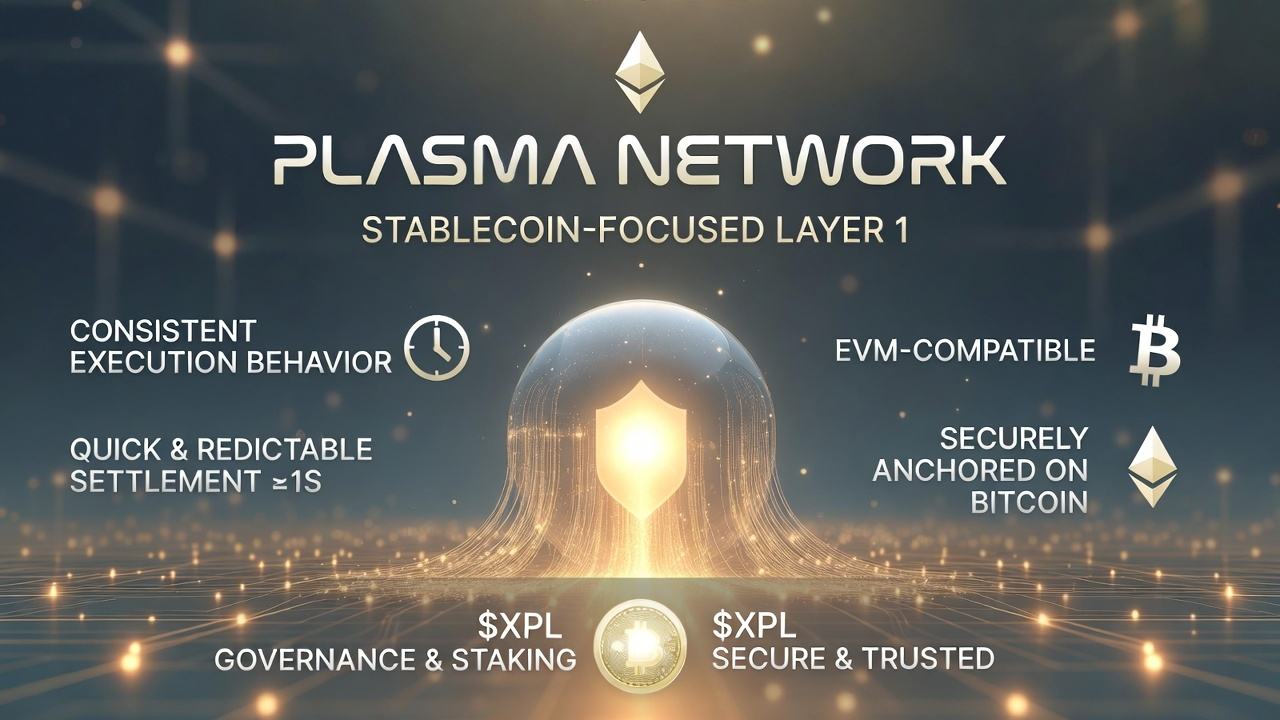
#Plasma does not want to be all things to all people. It seeks to be trustworthy.
By Design, a Stablecoin First Blockchain
Global value transfer is already powered by stablecoins. Payroll, treasury management, merchant payments, remittances, and cross-border business flows are among its uses. However, the majority of the blockchains that carried them were not made for payments. Users continue to experience inconsistent gas prices, sluggish confirmations, unsuccessful transactions, and unclear user interfaces.
Stablecoins are the main product, not an add-on, according to Plasma's premise.
Transfers of native stablecoins
Payments for gasless stablecoins
Payable fees in stablecoins
Consistent execution behavior
Users transfer and receive money in dollars, and they think in dollars. To move money, no more tokens are needed.
Move With Confidence, Not By Chance.
Payments need closure, not optimism.

With a transaction finality of around one second, Plasma is designed for quick and predictable settlement. Payment is finalized after it is sent. There is no question regarding confirmation, no waiting, and no reorganization concern.
This is important for merchant checkout processes.
Payouts to contractors and payroll
Rebalancing the Treasury
Financial processes that are automated
Without assurance, speed is only noise. Plasma concentrates on both.
Designed for Integration, Not Disruption
Integration-first design is one of Plasma's main advantages.
Plasma is designed to integrate with current operational and financial systems, rather than requiring companies to adjust to the complexities of crypto-native systems. Workflow automation, payment reconciliation, and cost planning are made simpler by clear protocol boundaries and predictable execution.
Because Plasma is completely EVM compatible, developers can utilize well-known Ethereum wallets, tools, and smart contract frameworks. In addition to providing behavior tailored for payments rather than experimentation, this reduces the learning curve.
Payment Data Is First Class
Transfers of value alone are not what constitute real payments. They have significance.
Structured payment data is necessary for invoices, payroll references, refunds, settlements, audits, and reconciliations. The architecture of Plasma is ideal for enabling finance teams to work with rich, traceable, and auditable payment flows.
Stablecoins transition from "crypto payments" to reliable financial infrastructure in this way, which CFOs can rely on.
Security with a Long-Term Anchor
Neutrality and resilience are shown by plasma. Its design incorporates censorship resistance and an external layer of trust by anchoring on Bitcoin. Long-term security is more important than short-term performance measurements for a network designed to transfer real money at scale.
The Function of $XPL
Through governance, validator incentives, and staking, the $XPL token quietly protects the network. Crucially, end users who send stablecoins are not required to possess XPL. The network continues to be economically safe, and payments remain straightforward.
Silent Infrastructure Triumphs
Plasma is operational. Blocks are being made. Transactions using stablecoin are taking place. The technology is functional.
Adoption is the true test that lies ahead. Furthermore, if Plasma is successful, it probably won't be ostentatious or noisy. It will be integrated, trusted, and subtly necessary.
Boring infrastructure is a characteristic of the banking industry. @Plasma accepts this fact and constructs in line with it. $XPL
