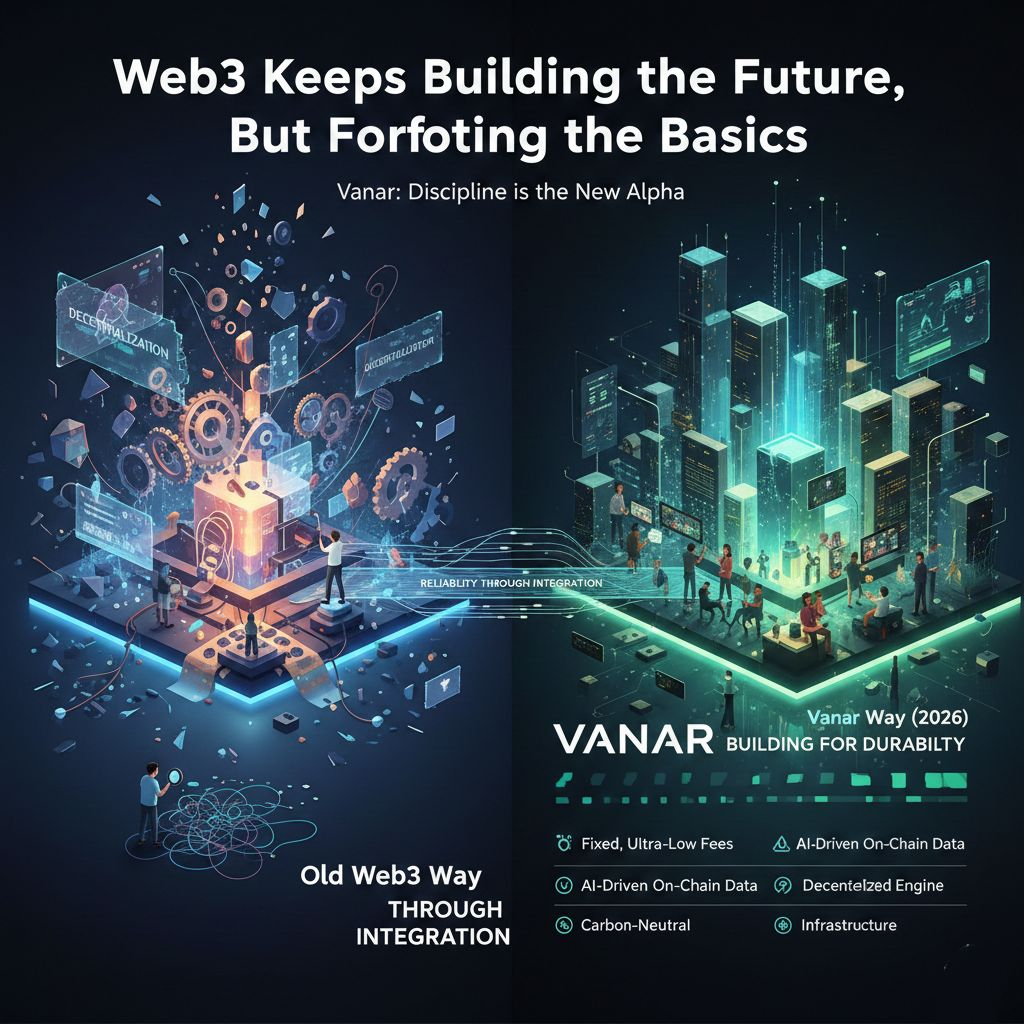
There’s an uncomfortable pattern many of us have noticed. Web3 keeps promising a better future, but it still struggles with the basics of the present.
We talk about decentralization as if it automatically leads to resilience. We talk about ownership as if it automatically leads to empowerment. We talk about scalability as if it automatically leads to adoption. But somewhere between the vision and the user experience, something gets lost.
What gets lost is reliability.
Not the kind that shows up in benchmark numbers. The kind that shows up on a normal Tuesday when someone opens an app and expects it to work. The kind that doesn’t require reading documentation or checking community channels to see if something is temporarily broken.
For an industry built on replacing fragile systems, we’ve created more fragility than we’re comfortable admitting.
We’ve all seen it. A protocol launches with energy and support, then updates slow down. A game gains traction, then small issues stack up until players drift away. A DAO gathers momentum, then governance turns into endless proposals with limited execution. An NFT collection survives on-chain, but the platform that gave it meaning slowly fades.
None of these failures are dramatic. They’re quiet. They feel almost polite. And that’s why they’re dangerous.
The industry often shrugs and says we’re early. But being early shouldn’t mean normalizing instability. It shouldn’t mean accepting that things breaking is just part of the culture.
A lot of Web3 infrastructure is built to validate ideas rather than support long-term use. We design for possibility, not durability. We optimize for theoretical decentralization while underestimating the human side of systems. Who maintains them? Who is accountable when things stall? What incentives ensure that work continues after the initial spotlight moves on?
Too often, the answers rely on trust. Trust that teams will stay committed. Trust that contributors will keep showing up. Trust that economic incentives will magically balance behavior. It’s ironic. In trying to remove trust from financial systems, we’ve ended up depending heavily on it in our own infrastructure.
And when trust erodes, so does participation.
This is the gap that matters more than the next narrative. It’s not about bigger throughput or faster blocks. It’s about whether people can build on a foundation that doesn’t shift under their feet.
This is where Vanar becomes relevant, not as a grand solution, but as a deliberate response to this reliability problem.
Vanar is an L1 blockchain designed from the ground up to make sense for real-world adoption. That statement carries weight when you consider the team’s background. They’ve worked in games, entertainment, and with brands. In those environments, users are unforgiving. If something breaks, they don’t wait for a philosophical explanation. They leave.
That perspective forces different priorities.
Vanar’s ecosystem spans multiple mainstream verticals, including gaming, metaverse experiences, AI-related initiatives, eco efforts, and brand integrations. Known products like Virtua Metaverse and the VGN games network aren’t just proofs of concept. They’re attempts to build environments that operate consistently over time.
That focus on continuity may not sound revolutionary. It’s not meant to be. It’s meant to be dependable.
The VANRY token sits within this ecosystem as part of how incentives are structured. Not as a hype vehicle, but as a mechanism that aligns participation with responsibility. Tokens don’t automatically create accountability. But when designed around real usage and long-term engagement, they can support systems that need sustained involvement rather than short bursts of attention.
What Vanar seems to recognize is that infrastructure isn’t just code. It’s coordination. It’s incentives. It’s consequences.
If a system doesn’t clearly define who is responsible for maintaining it, it will drift. If incentives reward short-term launches over long-term support, reliability will suffer. If there are no consequences for neglect, neglect becomes normal.
These mechanics are not glamorous. But they matter deeply for NFTs, DAOs, and games.
For NFTs, the promise of ownership only holds if the environment around the asset feels stable. If the platforms and experiences that give NFTs context disappear, ownership becomes abstract.
For DAOs, governance without execution is theater. Infrastructure must support decision-making and follow-through. Otherwise, participation becomes symbolic rather than functional.
For games, reliability is non-negotiable. Players invest time and emotion. They expect smooth interaction. They don’t care about technical debates. They care that the world they’re in will still be there tomorrow.
Long-term Web3 use requires infrastructure that anticipates human behavior rather than idealizes it. People will disengage. Teams will change. Markets will fluctuate. Systems must be resilient enough to handle that without constant resets.
Vanar doesn’t present itself as a savior of Web3. That restraint is important. It positions itself as a serious attempt to build infrastructure that treats usability and reliability as core requirements, not secondary concerns.
If Web3 is going to mature, it won’t be because we refine our slogans. It will be because we commit to the less exciting work. Maintenance. Clear incentives. Accountability. Real consequences when things don’t function.
Decentralization without durability is just theory. Scalability without usability is just capacity. Ownership without context is just a record.
What Web3 needs now is not another promise about the future. It needs systems that quietly prove they can last. Systems that don’t demand constant patience. Systems that respect the time and trust of the people using them.
Growing up as an industry will feel less like a breakthrough and more like discipline. And that might be exactly what we’ve been missing.