

There’s an imbalance in many payment systems that rarely gets addressed directly.
Large transfers are treated with care. Extra attention. Extra confirmation. Extra psychological weight. Small transfers, on the other hand, are often treated as disposable — quick, casual, not quite deserving of the same structural respect.
In crypto especially, design often orbits around volume and scale. Big numbers. Big flows. Big moments. Small, repetitive payments become secondary — something the system technically supports, but doesn’t deeply optimize for.
What keeps standing out about Plasma is how little that hierarchy seems to exist.
It doesn’t feel like a system built primarily for high-stakes, high-visibility transfers. It feels like a system that assumes small, frequent movements matter just as much — not financially, but behaviorally.
That distinction is important.
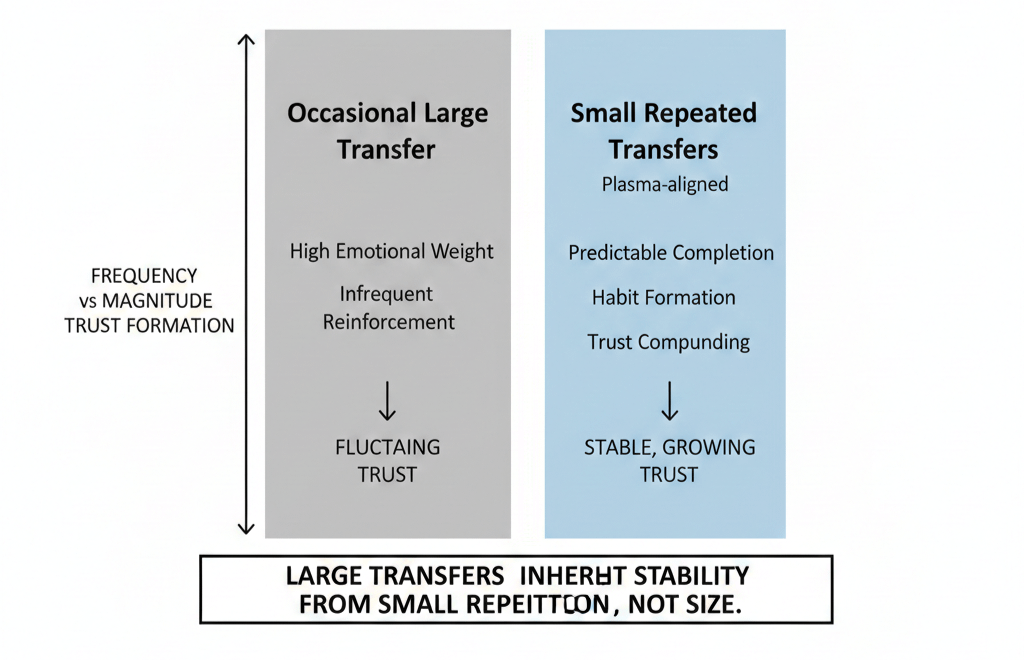 Habits form around small actions, not large ones. People don’t practice using payment rails through million-dollar settlements. They practice through everyday transfers — splitting costs, paying subscriptions, sending routine amounts.
If those small payments feel uncertain, overcomplicated, or disproportionately heavy, users subconsciously restrict them. They batch transfers. They delay them. They avoid them altogether.
Plasma seems designed to prevent that restriction from forming.
By making each payment — regardless of size — feel equally decisive and equally unremarkable, it removes the psychological signal that small amounts are less stable. There’s no visible scaling of anxiety. No sense that “this one doesn’t matter as much.”
That parity changes behavior over time.
When small payments feel solid, users increase frequency. When frequency increases, familiarity deepens. When familiarity deepens, trust stabilizes. Large transfers then inherit that trust naturally.
Many systems reverse that order. They try to prove themselves with big transactions first, then assume smaller ones will follow. Plasma feels like it understands that real adoption grows from the bottom up.
Small payments are not noise.
They are training.
If a system can’t make routine transfers feel effortless and safe, it will struggle to earn comfort at larger scales. Plasma’s design seems tuned for that foundational layer — the layer where repetition matters more than spectacle.
There’s also an accessibility dimension here.
Systems that implicitly prioritize large flows tend to marginalize everyday users. They feel optimized for institutions, power users, or high-volume actors. Small participants sense that they are secondary.
Plasma’s uniform treatment of transfers suggests a more neutral stance. Whether you’re moving a modest amount or something larger, the experience doesn’t shift dramatically. The system’s tone remains calm.
That calm builds equality into the experience.
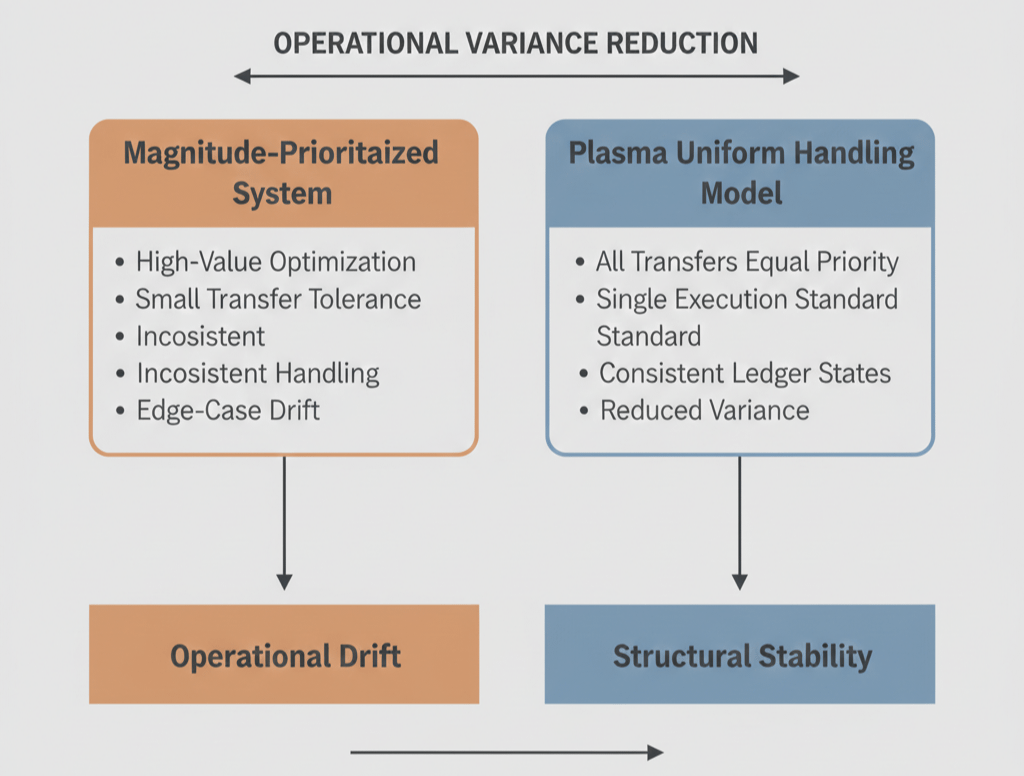 From an operational perspective, treating small payments seriously reduces edge-case drift. When systems optimize around high-value scenarios, small transfers often become testing grounds for inconsistency. Minor discrepancies are tolerated because the stakes appear lower.
Plasma appears to reject that logic. Consistency applies across the board.
That consistency is what allows micro-behaviors to scale safely. Recurring subscriptions. Per-use charges. Everyday commerce. These flows depend on confidence in small amounts. If users hesitate every time a minor transfer occurs, the entire model weakens.
Plasma feels aligned with the idea that frequency is more important than magnitude.
Of course, there’s a tradeoff. Systems optimized for routine small payments may appear understated compared to those built for headline-grabbing volumes. They don’t generate impressive screenshots or dramatic metrics.
But they generate something more durable: repetition without friction.
Repetition is what turns technology into infrastructure.
What I find compelling is how little Plasma seems to dramatize the act of sending. There’s no elevation of certain transactions over others. No subtle cues that one type of use is more important. Every transfer receives the same behavioral treatment.
That uniformity removes emotional variance.
In systems where large payments feel weighty and small ones feel casual, users internalize hierarchy. In systems where all payments feel resolved the same way, users internalize stability.
Plasma appears to be betting on stability.
As crypto payments mature, the networks that endure will likely be the ones that don’t privilege spectacle over routine. They’ll be the ones that understand that small transfers are not trivial — they’re foundational.
Plasma doesn’t feel designed to impress with size.
It feels designed to normalize movement at every scale.
And in payments, normalization is often what quietly unlocks growth — not because it’s exciting, but because it makes frequency feel safe.
When small payments stop feeling experimental, larger ones stop feeling risky.
That’s the ladder Plasma seems to be building.
Not from the top down —
but from the smallest, most ordinary transfer upward.