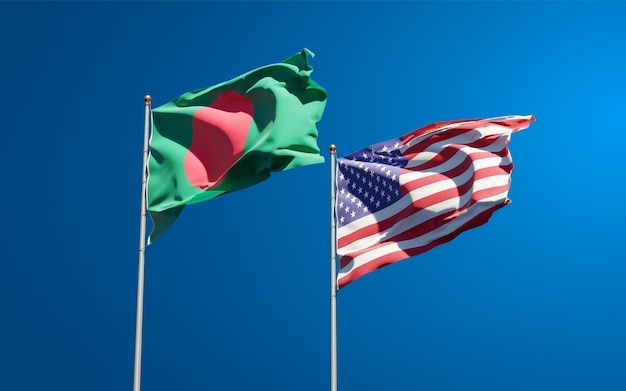
On February 9, 2026, Bangladesh and the United States entered into a sweeping new trade agreement that promises significant tariff relief but comes with strict geopolitical and economic conditions. Signed in Washington by Commerce Adviser Sk Bashir Uddin and US Trade Representative Jamieson Greer, the deal seeks to narrow the $6.1 billion trade gap between the two nations while firmly aligning Bangladesh’s economic future with Western interests.
The "Non-Market Economy" Trap
The most striking feature of this pact is a restrictive clause that could reshape Bangladesh’s foreign policy. Under the agreement, Bangladesh is effectively barred from entering into new free trade or preferential economic deals with "non-market economies." The US specifically classifies China, Russia, Vietnam, Belarus, Tajikistan, Uzbekistan, Moldova, and Azerbaijan under this category.
If Bangladesh violates this clause, the US reserves the right to terminate the agreement and reimpose a punishing 37% reciprocal tariff. Experts warn that this provision makes it nearly impossible for Bangladesh to join the Regional Comprehensive Economic Partnership (RCEP), the world’s largest trade bloc, because China is a central member and accession would require separate agreements.
Tariff Relief and the "US Cotton" Condition
For Bangladeshi exporters, the deal offers a mix of opportunities and hurdles. The reciprocal tariff on most exports has been lowered to 19%. However, a major incentive is the "zero-duty" access for garments made specifically from US-grown cotton and synthetic fibers.
While this gives Bangladesh a competitive edge over neighbors like India and Pakistan—who rely on their own domestic cotton—it forces a shift in the supply chain. To enjoy the best benefits, Bangladeshi factories must now look across the Atlantic for their raw materials rather than sourcing them locally or from regional partners.
Massive Commercial and Defense Commitments
The agreement is not just about what Bangladesh exports, but what it must buy. As part of the deal, Bangladesh has committed to massive commercial purchases from the US. This includes the acquisition of 14 Boeing aircraft (costing roughly Tk35,000 crore over 20 years) and a $15 billion long-term deal for US liquefied natural gas (LNG). Additionally, Bangladesh will import millions of tonnes of US wheat, soy, and cotton.
On the security front, the deal dictates that Bangladesh must "endeavour to increase purchases of US military equipment" while limiting defense imports from "certain countries." This signals a clear move to reduce Bangladesh’s long-standing reliance on Chinese and Russian military hardware.
Intellectual Property and Labor Reforms
Beyond trade and hardware, the US is requiring Bangladesh to overhaul its legal and regulatory frameworks. Bangladesh must now adhere to 13 international treaties outside the WTO framework, including the Berne Convention, within the next three to five years.
Domestically, the government has agreed to remove non-tariff barriers for US products, accept US certifications (such as FDA standards) unilaterally, and strengthen labor rights. This includes resolving criminal cases against factory workers and establishing more robust minimum wage review mechanisms.
What the Experts Are Saying
The reaction from trade analysts is a mix of optimism and caution. Former WTO Cell director Md Hafizur Rahman and trade expert Mostafa Abid Khan noted that while the deal opens doors, it also creates "significant legal and economic challenges."
Experts are particularly concerned about the "Potential Impact on Investment." The US now has the authority to take action against companies in Bangladesh if they export goods to the US at "below-market prices." Hafizur warned that this could deter foreign investors—particularly from China—who have long viewed Bangladesh as a low-cost production hub for reaching the American market.
Ultimately, while the deal provides a roadmap for "unprecedented access" to US markets, it transforms Bangladesh into a key strategic partner for the US, often at the expense of its ability to negotiate freely with other global superpowers.
#CZAMAonBinanceSquare #USNFPBlowout #USTechFundFlows #WhaleDeRiskETH $ASTER $ME $FIL