
There’s something plain and purposeful about Vanar. It doesn’t try to be the loudest project on the block; instead it stacks together familiar pieces an L1 that speaks EVM, a games network, a branded metaverse and tries to make them behave like real products people could use without a manual. The team leans on gaming and entertainment experience and the product names (Virtua, VGN) read like consumer projects rather than academic experiments. �vanarchain.com +1
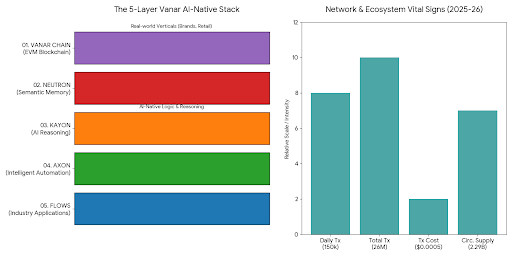 Think of Vanar less as a theoretical platform and more as a toolkit someone can hand to a studio, a mall, or a brand manager who wants tokenized experiences that don’t feel like a tech demo. That’s the claim: low-cost transactions, EVM compatibility, and a stack tuned for AI-style workloads so applications can store and query richer onchain data. The website lays out layers with names like Kayon and Neutron — not marketing fluff, but architecture notes that show intent. �vanarchain.com
Two practical products give this claim weight. Virtua is pitched as a metaverse with real on-chain utility for NFTs and experiences; the VGN (Vanar Games Network) is where the chain’s gaming instincts live, a collection of titles and mechanics designed to feel familiar to mainstream players rather than force them into crypto-first flows. Those are the places where adoption either happens or fails. The difference between a platform and a product is tiny — and Vanar is trying to stay on the product side. �virtua.com +1
 Here’s a small, specific thing I noticed: Vanar’s public materials call the chain “AI-native” and list vector search and semantic compression as features. That’s not fluff; it signals how teams might store richer proofs, or embed onchain metadata that’s usable by AI agents. For builders, that’s a neat lever. �
vanarchain.com
Why that route? Because bringing “the next 3 billion” online requires more than cheaper gas numbers it requires workflows that look like the apps people already use. Vanar’s narrative is built on that idea: yes, blockspace must be cheap and fast, but it also has to be invisible. The project’s messaging and product pushes in 2025 emphasized gaming and brand integrations as the first visible use-cases. That’s where the team’s background gives them an advantage. �OKX +1
A blunt truth: the crypto world is crowded with whitepapers. The industry is tired of vaporware. Vanar tries to answer with actual consumer-facing things — and that matters. Not every technical claim will survive scrutiny. Not every product will attract mainstream users overnight. Not always.
From a token perspective, VANRY exists as the on-chain fuel and has been listed and tracked on major market sites; it behaves like a utility token tied to usage and product activity rather than pure speculation in the messaging you see around it. Market pages show circulating supply and active trading which matters because liquidity and listings are what let studios and brands actually move value in and out. �CoinMarketCap +1
What feels different in practice is the mix: game design instincts plus a stack that claims to be AI-aware. That shows in the developer.facing notes and in the partnerships they highlight. If you’re a game studio thinking about minting dynamic items or a brand planning an experiential drop, you don’t want to learn a new blockchain language you want the chain to fold into your existing pipeline. Vanar’s play is to reduce that friction. �vanarchain.com +1
But the obvious caveats remain. Mainstream players care about user safety, chargebacks, simple fiat rails, and customer support — all things blockchains historically struggle with. Vanar’s public roadmap and product moves through 2025 focused on integrations and real-world verticals, which is a sensible path. Still, adoption is a series of tiny technical and legal negotiations with partners; success is won in those negotiations, not in a whitepaper. OKX +1
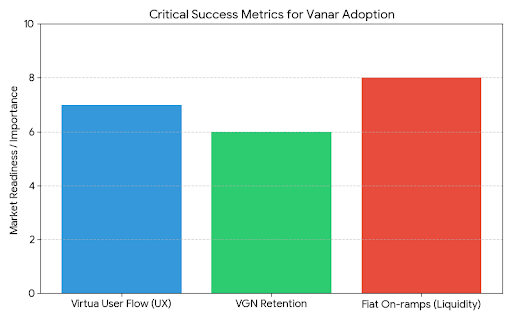
A few practical signals I’d watch if I were deciding whether to build on Vanar today: (1) real user flows inside Virtua — are people able to buy, equip, and trade without wallets tripping them up? (2) VGN titles showing retention beyond the first week, and (3) third-party wallets and exchanges offering smooth fiat on-ramps for VANRY. Those are the measures that separate a fun demo from something that fits into a company’s KPIs. The last six to twelve months of 2025 saw a steady stream of product posts and exchange coverage, which suggests momentum, but momentum is not adoption. �kucoin.com +1
Micro-detail that matters: on the Vanar site the stack diagram lists “Neutron Seeds” and “Kayon” as specific components — small labels, but they tell you the team is thinking about onchain semantic storage and validation, not just transactions. That’s the sort of detail a backend engineer actually reads. �vanarchain.com
If you’re a brand or a games studio, Vanar’s pitch is attractive: familiar tooling, token utility that ties to product use, and a narrative of low friction. If you’re a speculator, the token lists and market pages show one kind of story (price, volume), which you can inspect on CoinMarketCap and CoinGecko. Either way, the practical proof will be in how easy it is to release a playable feature with minimal crypto education for the user. �