
The blockchain industry’s evolution has repeatedly demonstrated a fundamental truth: technological capability alone doesn’t drive adoption. Vanar emerged from recognizing this reality and observing that despite blockchain’s maturation, a persistent gap separated what the technology could theoretically enable from what enterprises could practically implement. The project represents a deliberate pivot away from the field-of-dreams approach that characterized many blockchain platforms. Instead of building technology and hoping enterprises would adapt to it, Vanar engineered infrastructure specifically calibrated to how major brands and corporations actually operate, addressing their legitimate concerns and constraints rather than dismissing them as resistance to innovation.
The founding insight crystallized from watching numerous enterprises express genuine interest in blockchain applications only to abandon initiatives when confronted with existing platform limitations. Brand executives understood blockchain could transform customer engagement through true digital ownership, create supply chain transparency, and enable novel loyalty mechanisms. Yet these same leaders found themselves unable to execute on this vision because available blockchain infrastructure wasn’t designed with their operational requirements in mind. The barriers weren’t merely preferences but fundamental incompatibilities between enterprise needs and blockchain platform capabilities.
Transaction economics presented immediate obstacles. Consumer brands operate at massive scale, thinking in terms of millions of customer interactions monthly or even daily. When blockchain platforms charged fees measured in dollars per transaction, the mathematics simply didn’t support consumer applications. A loyalty program serving ten million members couldn’t justify spending millions on transaction fees for routine point redemptions. Digital collectible campaigns targeting mainstream audiences couldn’t pass multi-dollar transaction costs to consumers accustomed to frictionless digital experiences. The economics needed to work at consumer scale, not just for cryptocurrency trading volumes.
Performance characteristics created equally significant challenges. Confirmation times acceptable for cryptocurrency transactions felt broken for consumer applications. When customers redeem rewards, claim digital items, or interact with branded experiences, they expect instant confirmation matching their experience with every other digital service. Waiting even thirty seconds for blockchain confirmation created user experiences that felt fundamentally inferior to traditional alternatives. Brands couldn’t launch applications that performed noticeably worse than competitors using conventional technology, regardless of blockchain’s theoretical advantages.
Architecture Optimized for Enterprise Adoption
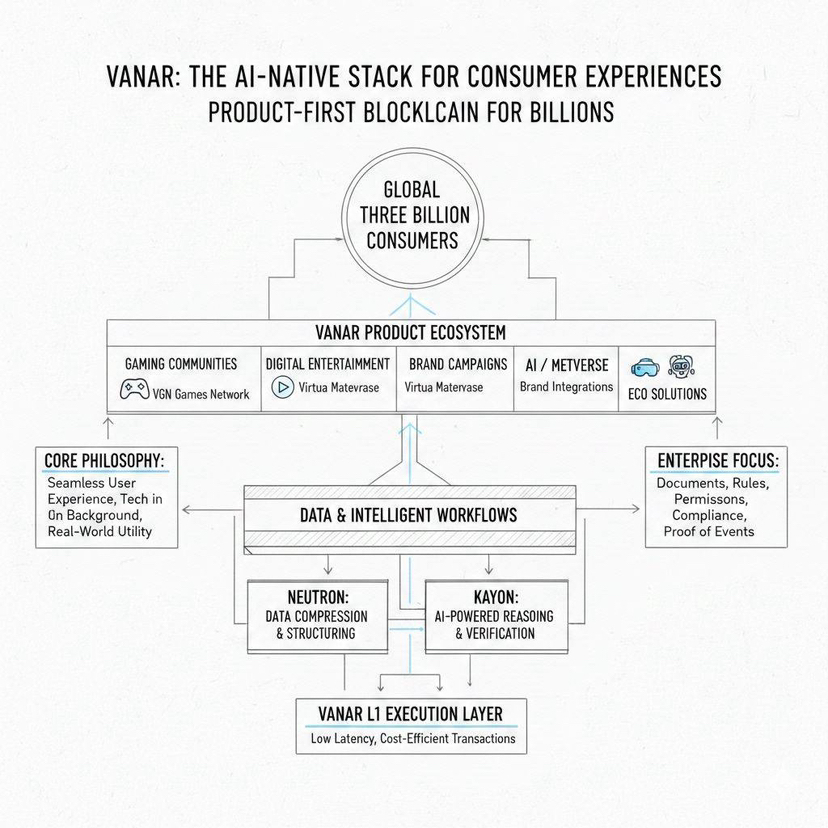
Vanar’s technical foundation reflects systematic optimization for brand requirements throughout its design philosophy. The proof-of-stake consensus mechanism delivers transaction finality in approximately two seconds, directly addressing consumer application demands for responsiveness. This performance characteristic isn’t merely about technical specifications but understanding user psychology shaped by decades of digital experiences. Consumers expect instant feedback, and interactions taking noticeably longer feel broken regardless of underlying reasons. Vanar engineered finality speeds meeting expectations established by existing digital services.
The network processes thousands of transactions per second, creating substantial capacity margins for usage patterns accompanying successful brand campaigns. Consumer brands face inherent unpredictability around engagement levels. Viral social media moments might drive ten times expected traffic within hours. Product launches might generate concurrent activity spikes as customers rush to claim limited items. Traditional blockchains frequently experience congestion under these conditions, with fees escalating precisely when brands most need reliable performance. Vanar built capacity anticipating the bursty, unpredictable traffic characterizing consumer applications rather than steady-state transaction flows.
Transaction costs operate at scales enabling business models impossible on traditional blockchain platforms. Fees measured in fractions of cents allow brands to offer blockchain experiences without forcing users to maintain cryptocurrency balances or think about transaction costs. This pricing structure wasn’t achieved through unsustainable subsidies but through architectural choices fundamentally reducing computational overhead per transaction. When brands can integrate blockchain capabilities without adding friction to user experiences, major adoption barriers disappear.
The Google Cloud integration represents Vanar’s most strategically sophisticated architectural decision. Major enterprises already operate substantial infrastructure on Google Cloud with teams trained on those platforms and processes built around them. By constructing Vanar natively on Google Cloud, the project removes enormous adoption friction. IT departments evaluating Vanar aren’t examining exotic infrastructure requiring new expertise. They’re looking at blockchain functionality layered on cloud services they already operate, creating immediate familiarity and reducing perceived risk. This decision demonstrates deep understanding that enterprise technology adoption depends as much on organizational dynamics as pure technical capabilities.
Environmental Responsibility as Infrastructure Foundation
Carbon neutrality wasn’t added to Vanar for marketing purposes but embedded as foundational principle from inception. The blockchain industry carries environmental perception baggage from proof-of-work systems consuming massive electricity. While proof-of-stake inherently requires far less energy, Vanar committed to carbon-neutral operations across their entire infrastructure. For brands facing stakeholder scrutiny around environmental impact, this commitment removes a major adoption objection before it can derail internal approval processes.
Environmental concerns have terminated promising Web3 initiatives before launch. Brand teams would develop blockchain proposals only to face opposition from sustainability officers or board members concerned about environmental implications. Media coverage emphasizing cryptocurrency’s carbon footprint created perception problems extending beyond actual environmental impact. Vanar’s carbon-neutral positioning allows internal brand conversations to proceed without environmental issues dominating discussions, enabling appropriate focus on business value and customer engagement opportunities.
Strategic Partnership Development
Vanar’s approach to brand partnerships demonstrates strategic discipline distinguishing successful platforms from failed experiments. Rather than accumulating partnerships indiscriminately, Vanar has cultivated deep relationships with brands serving as proof points across industry verticals. These partnerships represent genuine implementations where blockchain delivers measurable value rather than superficial collaborations existing primarily for announcements.
Luxury brand participation carries particular significance because these companies operate with extreme sensitivity around customer experience and brand prestige. When luxury brands select blockchain infrastructure, they conduct exhaustive due diligence examining technical capabilities, security guarantees, and long-term platform viability. Their decision to build on Vanar validates the platform’s enterprise readiness more convincingly than hundreds of crypto startups could achieve. This validation from notoriously selective companies signals readiness for demanding enterprise requirements.
Entertainment and gaming partnerships showcase different capability dimensions. These industries require infrastructure handling complex digital economies and sustained high transaction volumes while delivering seamless experiences to audiences with zero tolerance for technical friction. Entertainment consumers expect digital interactions to work flawlessly without understanding underlying technology. Vanar’s entertainment partnerships demonstrate their infrastructure meets demanding requirements while remaining invisible to end users.
Token Economics and Network Alignment
The VANRY token functions as economic coordination mechanism aligning incentives across ecosystem participants toward network health. Validators stake VANRY to participate in consensus, earning rewards while facing penalties for malicious behavior. This creates strong economic commitment to honest operation because validators risk substantial capital. Transaction fees paid in VANRY generate utilization-driven demand correlated with network activity. Unlike tokens where utility remains theoretical, Vanar’s fee mechanism creates genuine economic consumption as applications process transactions.
Governance rights enable community participation in protocol evolution while creating interesting tensions. Brands value stability favoring conservative governance, while crypto communities value democratic participation favoring responsive governance. Vanar must navigate between these competing preferences while maintaining legitimacy with both constituencies as the platform matures and stakeholder diversity increases.
Vision for Mainstream Integration
Looking forward, Vanar’s success will be measured by how naturally blockchain capabilities integrate into brand experiences without demanding user attention. The ultimate vision isn’t consumers thinking about blockchain but blockchain enabling better experiences while remaining invisible. New application categories will emerge beyond current use cases as brands gain comfort and discover possibilities. Identity solutions, supply chain tracking, and entirely new business models might emerge from capabilities blockchain uniquely enables.
If major brands begin incorporating blockchain into customer experiences at scale, Vanar’s early positioning around enterprise needs creates substantial advantages. Partnerships established now, expertise developed supporting implementations, and infrastructure optimizations addressing real requirements all compound over time. The journey spans years requiring navigation of countless challenges, but Vanar’s clarity around who they serve and what problems they solve provides strategic direction for building infrastructure making blockchain genuinely accessible and practical for brands serving mainstream consumers.