

Artificial intelligence often impresses people with fluency. Responses arrive quickly. Patterns are recognized. Conversations feel continuous. From the outside, the system appears aware.
But appearance is not persistence.
Behind many AI interactions lies a structure that forgets almost everything the moment the exchange ends. Context dissolves. Decisions leave no durable trace. The model can simulate continuity, yet it cannot guarantee it.
In practical terms, that makes intelligence fragile.
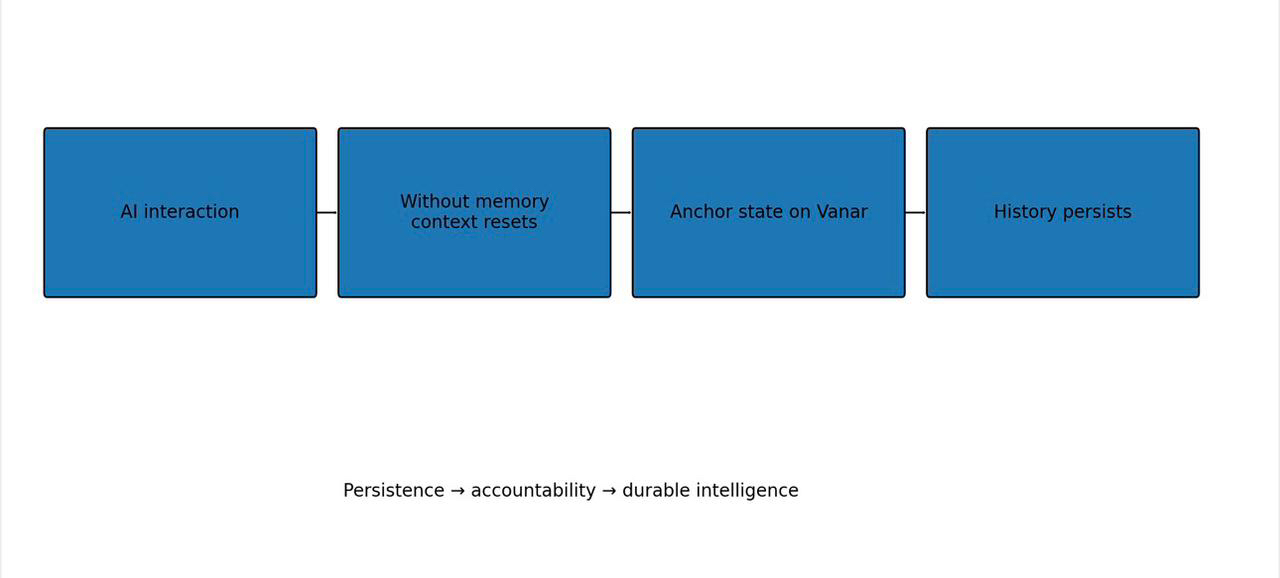
A system without memory must constantly reconstruct understanding from fragments. It depends on prompts, local caches, or temporary histories that may or may not survive between sessions. If those elements vanish, the AI restarts from abstraction. Prior commitments fade. Explanations become inconsistent. Accountability becomes difficult.
This limitation is subtle, yet it shapes everything.
Imagine financial software that could not remember previous transactions. Or governance processes that erased past votes. Or identity systems that reset relationships every time a user logged out. We would not call these systems intelligent. We would call them unreliable.
Memory is what converts computation into responsibility.
This is where infrastructure begins to matter. Durable memory requires more than storage. It requires verifiability, resistance to tampering, accessibility across applications, and continuity over time. It must exist outside individual programs so that different services can reference the same history.
Otherwise, coordination breaks.
What becomes interesting about Vanar Chain is how strongly it seems aligned with this requirement. The network is not merely offering execution capacity; it is positioning itself as an environment where AI systems can anchor long-term state.
Anchoring changes behavior.
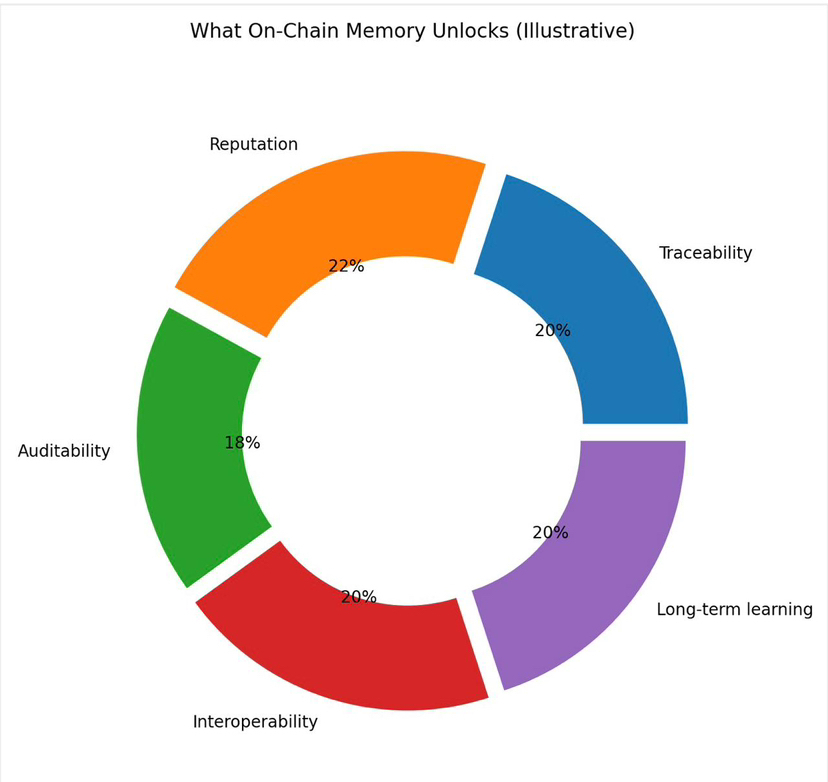
When actions persist, models can be evaluated. Predictions can be compared to outcomes. Reputation can accumulate. Errors can be traced. Improvement becomes measurable rather than theatrical.
Without memory, learning is performance. With memory, learning becomes evolution.
There is also an interoperability dimension. AI agents interacting across multiple services need shared reference points. They must know what has already happened, who authorized it, and what constraints exist. Fragmented histories create duplication and disagreement.
Unified memory simplifies collaboration.
Traditional databases can provide continuity, but they rely on central administrators. That works in limited contexts, yet it struggles when participants require neutrality or when records must survive beyond individual organizations.
Distributed systems attempt to solve this.
Vanar’s architecture increasingly reads as an effort to give intelligent applications a substrate where state can persist independently of any single operator. If one service disappears, the memory remains. If agents migrate, the history follows.
Durability becomes portable.
This has consequences for trust. Users interacting with AI want assurance that commitments will not evaporate. Enterprises want audit trails. Regulators want transparency. Developers want referenceable events.
All of these expectations depend on memory.
A stateless environment may be efficient for experimentation, but it is fragile at scale. The more decisions matter, the more permanence becomes necessary. Temporary awareness is insufficient when outcomes affect real resources.
Persistence underwrites seriousness.
From this perspective, the conversation around AI infrastructure is less about model size and more about state management. Intelligence becomes credible when it can stand on recorded history.
Vanar appears to be preparing for that phase.
Of course, implementation is difficult. Storing data responsibly while preserving privacy and performance requires careful design. Skepticism is healthy. But recognizing the importance of durable state is already a step toward maturity.
If AI adoption accelerates, systems that provide reliable memory will become increasingly attractive. They allow participants to build layered logic, long-term incentives, and shared governance. They reduce ambiguity.
Ambiguity is the enemy of scale.
The industry sometimes treats memory as a technical detail. In reality, it is foundational. Without it, intelligence resets too easily. With it, intelligence becomes accountable.
That transformation is profound.
Whether Vanar can fulfill this promise will depend on execution, yet the orientation is visible. The chain is not merely facilitating transactions; it is preparing to host continuity.
And continuity is what turns capability into reliability.
