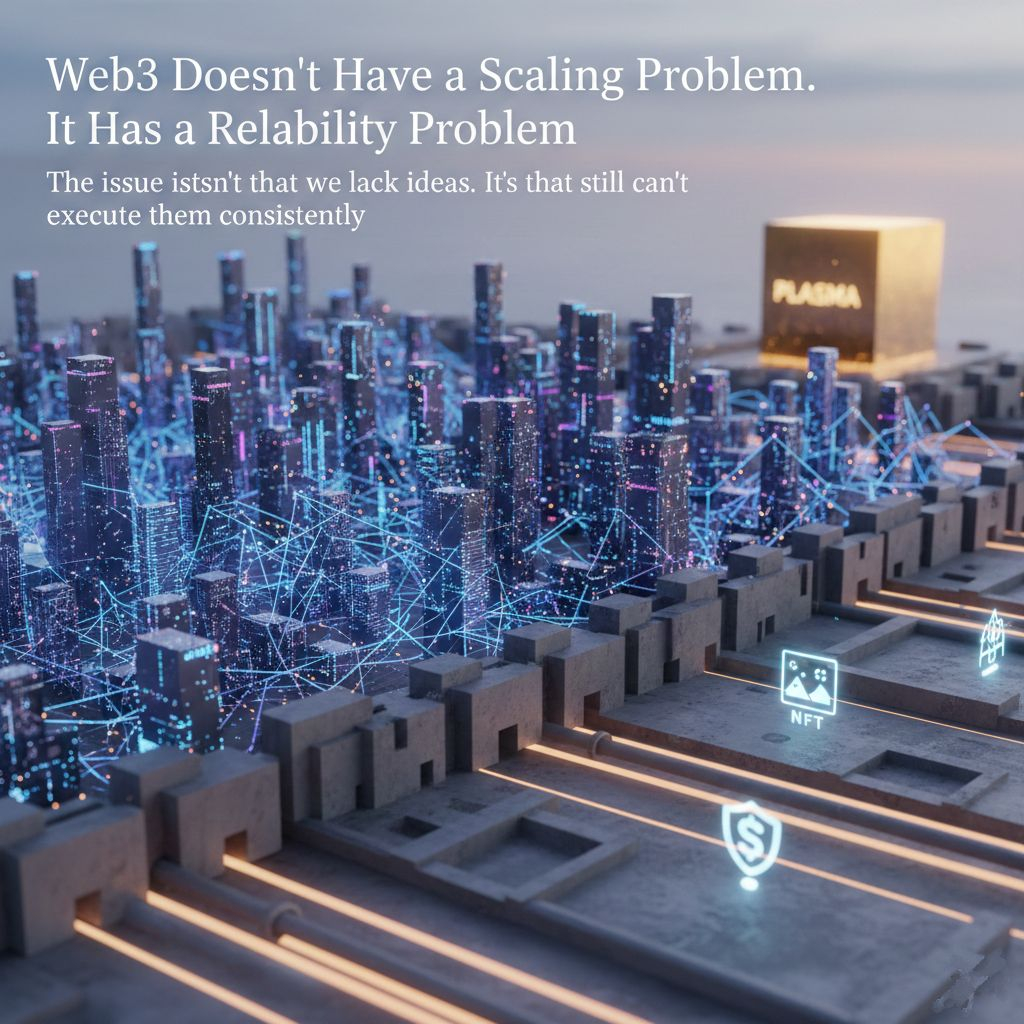
There’s a hard truth we tend to circle around in crypto.
The issue isn’t that we lack ideas. It’s that we still can’t execute them consistently.
We’ve built an industry around big promises. Decentralization will fix trust. Ownership will fix incentives. Open networks will fix gatekeeping. These ideas are not wrong. Many of us still believe in them. But belief doesn’t make a system dependable.
And dependability is where things still fall apart.
Scaling was supposed to solve this. Faster networks. Lower fees. More throughput. We’ve made real progress on paper. But in practice, the experience remains uneven. Transactions stall under pressure. Apps freeze when traffic spikes. Fees behave unpredictably. Bridges pause. Interfaces disappear. Projects go quiet without clear communication.
It’s rarely catastrophic. It’s worse than that. It’s inconsistent.
And inconsistency changes behavior.
NFT creators hedge expectations because royalties don’t always settle smoothly. DAOs extend voting windows because they don’t trust the network to stay stable. Games avoid putting core logic onchain because execution timing isn’t reliable enough. Stablecoins, which are supposed to be the most straightforward use case in crypto, sometimes feel less predictable than traditional payment systems.
None of this leads to dramatic exits anymore. It leads to quiet disengagement. Builders simplify their ideas. Users reduce their exposure. Capital sits idle because moving it feels uncertain.
We’ve learned to normalize this fragility. We call it early-stage volatility. We call it experimentation. We call it the cost of decentralization. But at some point, if something is meant to be infrastructure, it has to behave like infrastructure.
That means boring reliability.
The industry’s response has often been to add more layers. More networks. More abstractions. Each promising to smooth over the rough edges of the last one. But many of these solutions depend on trust in places we pretend not to have it. Trust that operators behave. Trust that incentives align under stress. Trust that governance will act in time.
That’s not eliminating trust. It’s redistributing it.
And when trust rests on assumptions instead of enforced consequences, the system becomes fragile. Not because people are malicious, but because incentives shift. Pressure builds. Shortcuts get taken.
What’s missing isn’t innovation. It’s discipline.
Execution layers need to be designed around accountability. Clear incentives. Clear consequences. Systems that assume stress, not cooperation. That assume self-interest, not goodwill.
This is where some projects are trying a different approach, not by expanding scope, but by narrowing it.
Plasma is a Layer 1 built specifically for stablecoin settlement. That focus alone feels like a quiet correction. Stablecoins are already the backbone of actual Web3 activity. They move value daily. They are used by individuals in high-adoption markets and by institutions exploring payment rails. They don’t get to fail quietly.
Plasma is designed around that reality. Stablecoin-first gas so users aren’t juggling volatile assets just to pay fees. Gasless USDT transfers to remove friction where it serves no purpose. Fast finality treated as a baseline expectation, not a headline. Compatibility with Ethereum tools so developers can build without rewriting their entire stack. Security anchored to Bitcoin to reinforce neutrality and reduce discretionary control.
None of this sounds dramatic. That’s intentional.
Plasma is not framed as a revolution. It’s a focused attempt to strengthen a weak point: unreliable execution for value transfer. The goal is not to be everything. The goal is to make one critical layer dependable.
That focus on mechanics changes the conversation.
Accountability becomes structural. Incentives are aligned toward consistent performance instead of rapid expansion. Consequences for failure are not just reputational, they are embedded in how the network operates. Reliability stops being a marketing claim and becomes a design constraint.
For NFTs, this matters more than it seems. When settlement is stable, creators can trust payouts. Marketplaces don’t need caveats. Economic flows feel predictable. The art can remain the focus instead of the infrastructure.
For DAOs, dependable execution lowers the cost of coordination. Treasury movements don’t feel risky. Governance timelines don’t need artificial buffers. Accountability becomes clearer when network instability isn’t distorting outcomes.
For games, reliable execution is non-negotiable. Players expect actions to resolve immediately. Anything less breaks immersion. A stable settlement layer allows onchain elements to feel seamless instead of experimental.
And for long-term Web3 use, especially where stablecoins already function as everyday financial tools, predictability is everything. If value transfer can’t be trusted, the rest of the stack becomes theory.
The role of $XPL within Plasma is not about spectacle. It’s about aligning the network’s incentives with its purpose. Encouraging consistent behavior. Penalizing fragility. Making stability economically rational, not just aspirational.
This kind of progress rarely trends. It doesn’t inspire slogans. It doesn’t promise overnight transformation. It focuses on the mechanics most people ignore until they break.
That may be exactly what Web3 needs.
Growing up as an industry doesn’t mean abandoning ideals. It means supporting them with systems that don’t wobble under pressure. It means choosing reliability over expansion for its own sake. It means building layers that feel boring because they work.
We don’t need louder narratives. We need fewer excuses.
If Web3 is going to mature, it won’t be because we said decentralization often enough. It will be because execution became dependable. Because settlement became predictable. Because accountability stopped being optional.
That future won’t feel revolutionary.
It will feel stable.
And that, more than anything, would be real progress.