
I’ve been thinking about something simple.
Most blockchain tokens only feel important when the market is excited.
When people are trading, when charts are moving, when attention is high — the token has demand.
But when things slow down?
You quickly find out whether the token was needed… or just wanted.
That’s why Vanar’s recent direction caught my attention.
It’s not loud.
It’s not dramatic.
It’s actually kind of practical.
And that’s exactly why it matters.
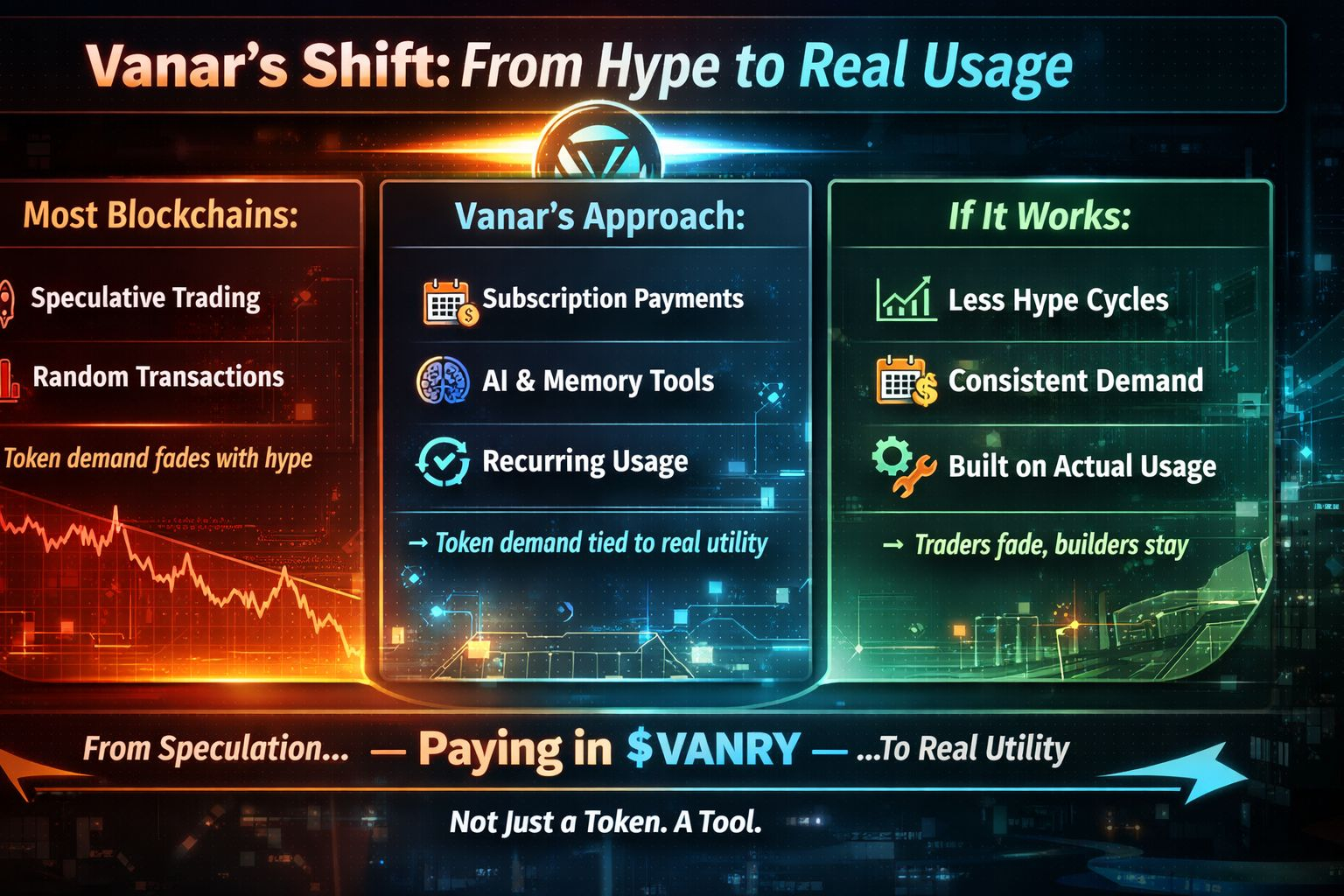
The real shift isn’t tech. It’s behaviour.
Instead of depending on random transactions or speculative interest, Vanar seems to be pushing toward something more stable:
Recurring usage.
With products like myNeutron and its AI stack, the idea isn’t “pay once when you transact.”
It’s closer to:
If you’re using the memory layer…
If you’re running reasoning workflows…
If your app depends on this infrastructure…
Then you’re paying regularly in $VANRY.
That changes the psychology completely.
Now the token isn’t just gas.
It becomes part of the cost of operating.
And costs of operating are predictable.
Why that matters more than people think
In Web2, companies don’t wake up and decide whether they “feel bullish” on their cloud provider.
They pay because their product stops working if they don’t.
That’s powerful.
If Vanar can make its AI tools genuinely useful — tools that save time, improve automation, reduce friction — then paying in $VANRY becomes routine.
Not emotional.
Not speculative.
Routine.
And routine demand is what builds stability.
But this only works if the tools are truly valuable
Here’s the honest part.
Subscriptions are unforgiving.
If the product isn’t worth it, people cancel.
So this strategy only succeeds if:
Developers actually rely on the AI layer
The documentation is clean
The UX doesn’t feel experimental
The billing is clear
The value is obvious
Because builders don’t care about narratives.
They care about whether something makes their job easier.
The bigger vision
If Vanar’s memory + reasoning layer becomes useful beyond its own ecosystem, something interesting happens.
It stops being “just another L1.”
It becomes infrastructure.
And infrastructure doesn’t depend on hype cycles.
It depends on whether people are building on top of it.
Final thought
Most tokens rise and fall with sentiment.
Vanar seems to be trying something more grounded:
Tie the token to repeated, real usage — the way software platforms survive through paying customers, not traders.
If they execute well, $VANRY won’t need noise to justify itself.
It will have users who simply need it.
And that’s a much stronger foundation than hype.