
Bitcoin $BTC trading around the mid-$60,000s might look calm on the surface.
The candles are smaller, volatility has cooled, and the market isn’t panicking the way it does during sharp liquidations.
But after watching enough cycles, I’ve learned something uncomfortable:
Calm price action after a major drop is often not strength — it’s exhaustion.
And right now, Bitcoin doesn’t feel strong.
It feels fragile.
The Problem With “Sideways” After a Big Fall
When an asset loses a large portion of its value and then moves sideways, many traders interpret that as stabilization. They assume the worst is over simply because the chart stopped falling fast.
Historically, that assumption is dangerous.
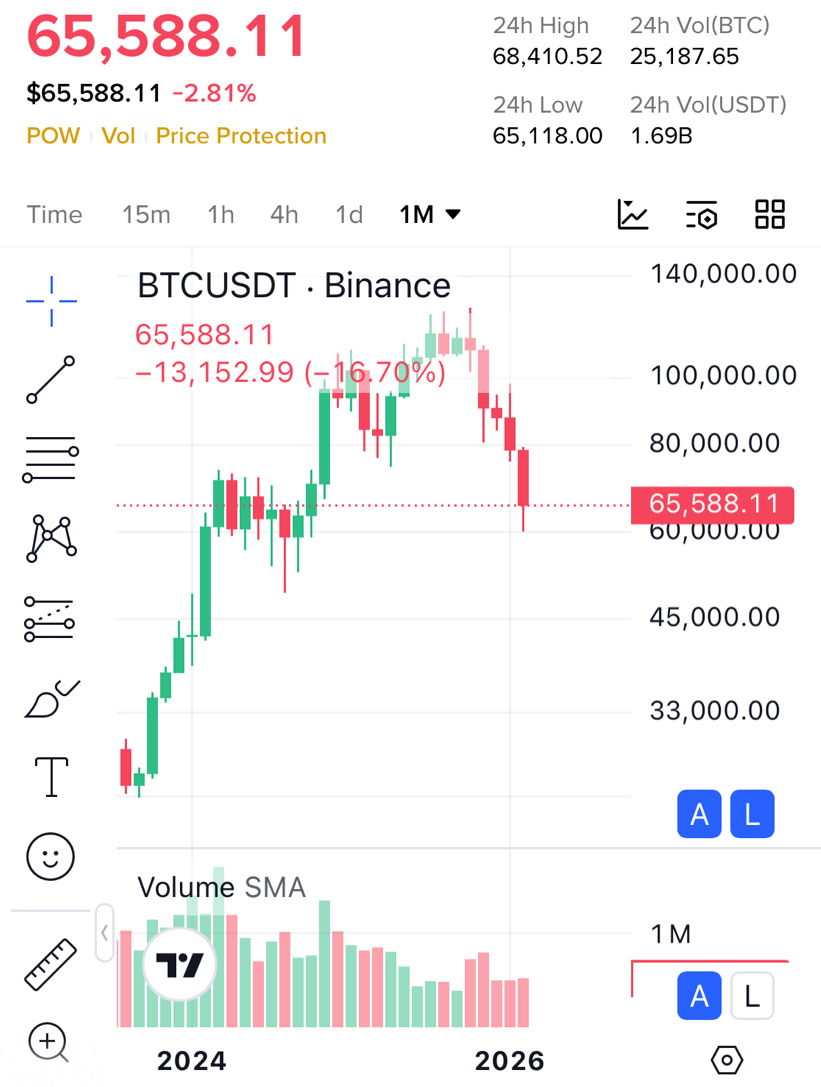
Real bottoms usually show aggressive demand, expanding volume, and sharp reclaim of lost levels. What we’re seeing instead is muted activity, thinner participation, and repeated failure to push convincingly higher.
That isn’t how strong reversals typically begin.
It’s how distributions and continuation phases often look before the next leg down.
Volume Is Quiet — And Quiet Volume Rarely Saves Markets
One of the most concerning signals in the current structure is declining trading volume during consolidation.
Low volume during sideways movement suggests:
Buyers are not rushing in
Confidence is weak
Large players may be waiting for lower prices
In previous crypto cycles, similar low-energy consolidations frequently resolved in the direction of the prior trend — which, in this case, is still downward.
Silence in markets is not always peace.
Sometimes it’s just absence of demand.
Macro Pressure Hasn’t Disappeared
Another bearish reality many traders want to ignore is that Bitcoin is still reacting strongly to macro data and liquidity conditions.
Strong economic signals that delay rate cuts tend to:
Strengthen the dollar
Pressure risk assets
Reduce speculative flows into crypto
As long as Bitcoin trades like a liquidity-sensitive risk asset, sustained upside becomes structurally harder without supportive macro shifts.
And right now, those supportive shifts are not obvious.
The Psychological Trap of “It’s Already Down So Much”
One of the most common mistakes in bear phases is believing an asset can’t fall further simply because it already dropped a lot.
Crypto history repeatedly proves the opposite.
Large declines often come in multiple waves, not one clean move.
Each pause convinces traders the bottom is in.
Each next drop forces new capitulation.
If Bitcoin loses firm support in the mid-$60K region, the market could quickly start discussing much lower psychological zones — levels that currently feel unrealistic, but always do before they happen.
What Would Invalidate the Bearish View?
A strong downside thesis should always include its own failure condition.
For this structure to turn convincingly bullish, Bitcoin would likely need:
A decisive reclaim of higher resistance zones
Expanding volume, not shrinking activity
Clear evidence of real demand, not just passive holding
Until those appear, downside risk remains structurally dominant.
Final Thought
Bitcoin at $66K looks calm.
But calm after weakness is not the same as strength.
Right now, the chart shows:
Fading momentum
Thin participation
Ongoing macro pressure
Those are not ingredients of a powerful recovery.
They are often the early signs of another downward phase forming quietly.
I could be wrong — markets always allow surprises.
But if history is any guide, this kind of fragile stability is exactly where the next leg lower tends to begin.
Your view matters here:
Do you think Bitcoin is building a base…
or simply pausing before a deeper drop?
#CZAMAonBinanceSquare #USTechFundFlows #BTC $BTC
