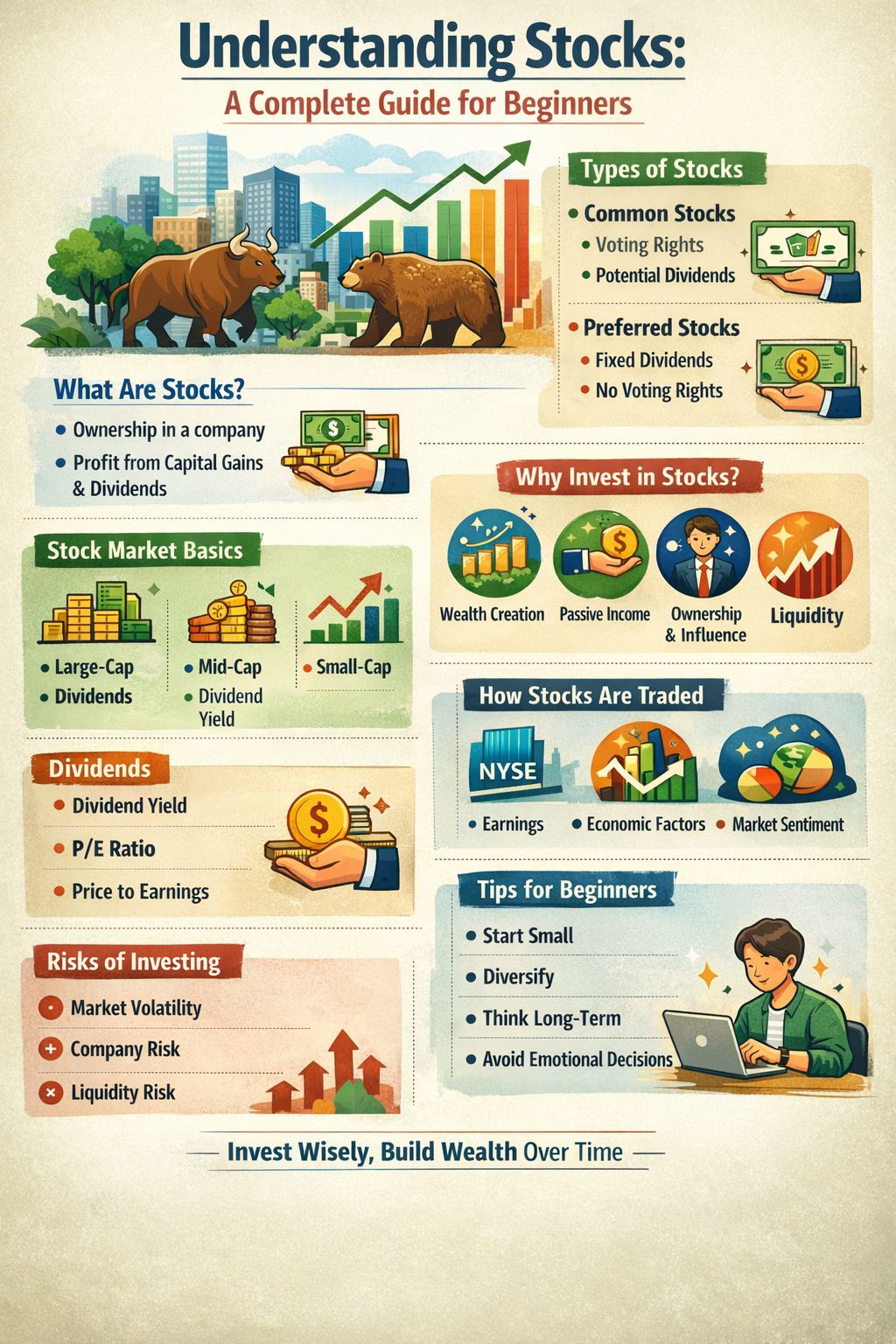
Understanding Stocks: A Complete Guide for Beginners
Stocks are one of the most popular ways to invest and build wealth. Whether you’re looking at individual companies or the broader market, understanding stocks is crucial for making informed financial decisions.
What Are Stocks?
A stock represents ownership in a company. When you buy a share of a company, you own a small piece of that business. Stocks are also called equities because shareholders have a claim on the company’s earnings and assets.
Companies issue stocks to raise money for expansion, operations, or other projects. In return, investors hope to earn money through capital gains (increase in share price) and dividends (a portion of profits paid to shareholders).
Types of Stocks
1. Common Stocks
. Gives voting rights at shareholder meetings
. Potential for dividends
. Returns depend on company performance
2. Preferred Stocks
. Fixed dividend payments
. No voting rights
. Higher claim on company assets in case of bankruptcy
Why People Invest in Stocks?
. Wealth Creation: Historically, stocks have provided higher returns than other asset classes like bonds or savings accounts.
. Passive Income: Dividends can provide a steady income stream.
. Ownership & Influence: Shareholders can vote on company decisions (common stock only).
. Liquidity: Stocks are easy to buy and sell through stock exchanges.
How Stocks Are Traded?
Stocks are bought and sold on stock exchanges, such as the New York Stock Exchange (NYSE) or NASDAQ. Prices change based on supply and demand, influenced by:
. Company performance (earnings reports, growth prospects)
. Economic conditions (interest rates, inflation, GDP growth)
. Market sentiment (fear, optimism, news)
Stock Market Basics
1 Market Capitalization
Total value of a company’s outstanding shares.
. Large-cap: $10B+ (stable, less risky)
. Mid-cap: $2B–$10B (growth potential, moderate risk)
. Small-cap: <$2B (high growth, higher risk)
2 Dividends
A portion of profits distributed to shareholders
. Yield = Annual dividend ÷ Stock price
3 Price-to-Earnings (P/E) Ratio
Measures company valuation relative to earnings.
. P/E = Stock price ÷ Earnings per share (EPS)
Risks of Investing in Stocks
Stocks can provide high returns, but they also carry risks:
. Market Risk: Prices fluctuate due to economic and market conditions
. Company Risk: Poor management or business failures
. Liquidity Risk: Some stocks may be hard to sell quickly
. Volatility: Prices can swing dramatically in short periods
Tips for Beginner Investors
. Start with companies you understand
. Diversify your portfolio to reduce risk
. Invest for the long term, not quick gains
. Keep emotions out of decisions; avoid panic selling
. Learn to read financial statements and market trends
Final Thoughts
Investing in stocks is not just about buying and selling. It’s about understanding businesses, market cycles, and your own financial goals. With patience, research, and discipline, stocks can be one of the most effective tools for building wealth over time.
#CPIWatch #CZAMAonBinanceSquare