
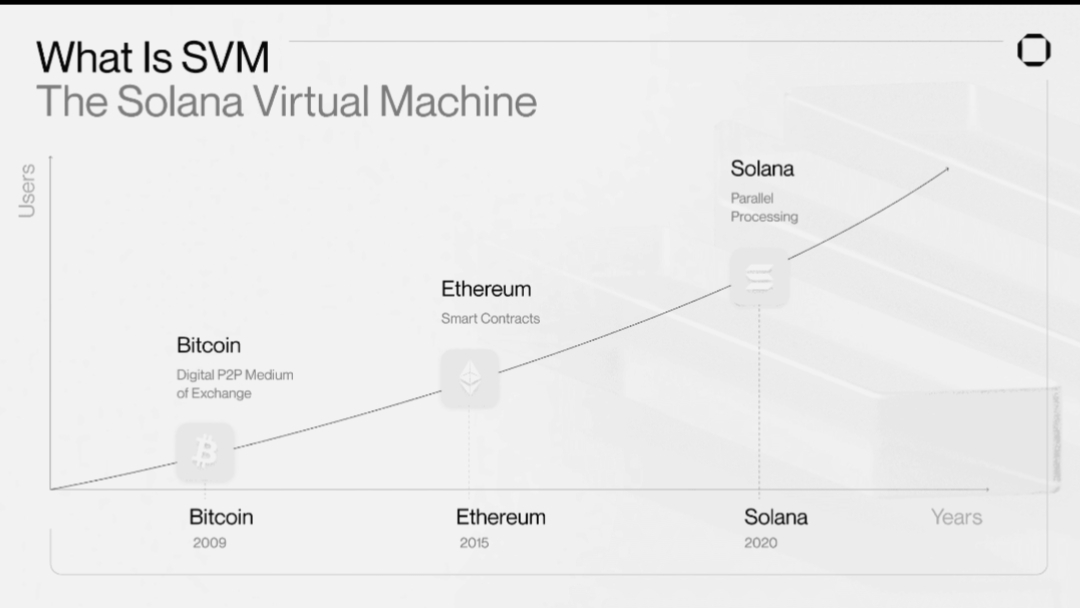
Most blockchains compete on speed. They promise faster transactions, lower fees, and higher throughput. But in reality, raw speed alone does not solve the deeper problem. The real bottleneck in blockchain systems is execution efficiency — how transactions are processed, verified, and finalized without creating congestion or inefficiencies.
This is where Fogo introduces a fundamentally important shift. Instead of simply increasing block size or reducing block time, Fogo focuses on optimizing execution itself. Built on the Solana Virtual Machine (SVM), Fogo leverages one of the most advanced execution environments in crypto to deliver scalable, predictable, and efficient performance.
This article explains what execution efficiency means, why it matters, and how Fogo’s SVM-based architecture positions it as part of the next generation of blockchain infrastructure.
The Core Problem: Inefficient Transaction Execution
To understand Fogo’s importance, we first need to understand the core limitation of traditional blockchains.
Most early blockchains process transactions sequentially. This means each transaction must wait for the previous one to complete before being executed.
This creates several problems:
• Network congestion during high demand
• Increased transaction fees
• Delays in transaction confirmation
• Limited scalability
Think of it like a single cashier handling hundreds of customers. Even if the cashier works faster, the system still slows down as more customers arrive.
This sequential model is fundamentally inefficient for modern applications like decentralized finance, gaming, and real-time systems.
The future requires parallel execution.
What Is Execution Efficiency?
Execution efficiency refers to how effectively a blockchain processes multiple transactions simultaneously without conflicts, delays, or wasted resources.
An efficient execution environment achieves three key goals:
• Parallel transaction processing
• Predictable execution outcomes
• Maximum utilization of hardware resources
Instead of processing transactions one-by-one, an efficient system processes many transactions at the same time.
This dramatically improves throughput and reduces latency.
This is the design philosophy behind the Solana Virtual Machine — and the foundation of Fogo.
Understanding the Solana Virtual Machine (SVM)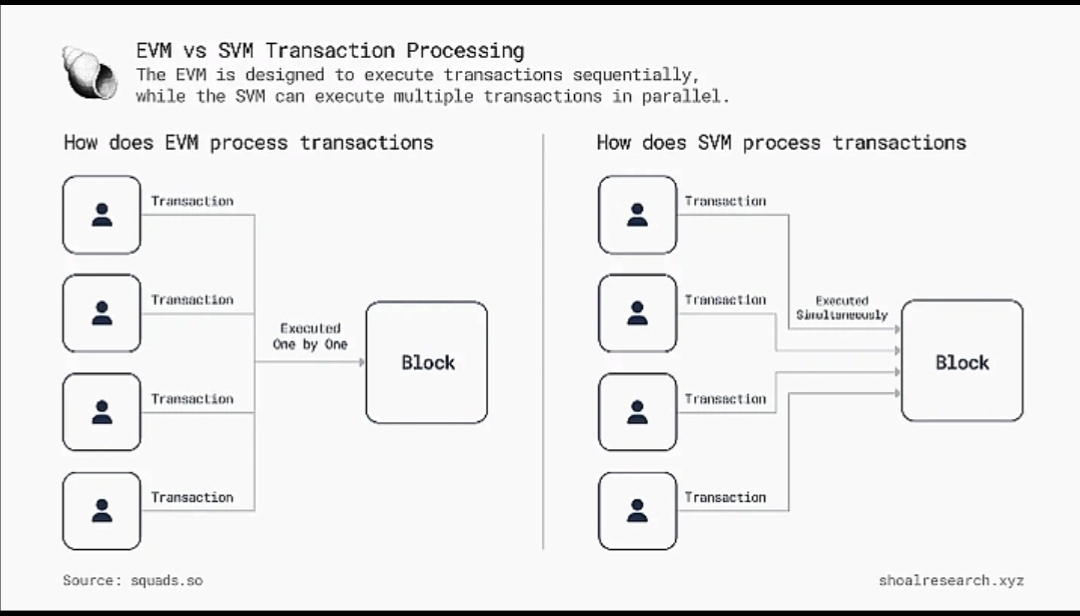
The Solana Virtual Machine is a specialized execution engine designed for high-performance blockchains.
Unlike traditional virtual machines, SVM allows parallel execution of independent transactions.
This means:
Multiple transactions can execute simultaneously without waiting for each other.
This dramatically increases performance and efficiency.
SVM achieves this through a mechanism called state access tracking.
Each transaction specifies which data it will access. If two transactions do not access the same data, they can execute in parallel.
This avoids conflicts and allows maximum concurrency.
This is one of the key reasons Solana achieved industry-leading performance — and Fogo inherits this advantage.
Why Fogo’s SVM Integration Is Important
Fogo does not reinvent execution. It adopts and builds on a proven execution model.
This provides several major advantages.
First, high throughput.
Because transactions execute in parallel, the network can process far more transactions per second compared to sequential blockchains.
Second, low latency.
Parallel execution reduces waiting time, enabling faster confirmations.
Third, deterministic execution.
Deterministic execution means transactions produce predictable results regardless of network conditions.
This is critical for financial systems and complex applications.
Fourth, efficient hardware utilization.
Instead of leaving CPU resources idle, parallel execution uses hardware efficiently, improving overall network performance.
This creates a more scalable and reliable blockchain environment.
Why Execution Efficiency Matters for Real-World Applications
Execution efficiency is not just a technical improvement. It directly affects real-world usability.
Applications that benefit include:
Decentralized finance (DeFi) platforms that require fast and reliable transaction processing.
Blockchain gaming applications that need real-time interaction.
Payment systems that require low latency.
AI-driven applications that rely on fast and predictable execution.
Without efficient execution, these applications cannot scale effectively.
Fogo’s architecture makes these use cases practical.
Sequential vs Parallel Execution: A Simple Example
Imagine two systems:
System A processes 1 transaction per second sequentially.
System B processes 100 transactions simultaneously in parallel.
Even if System A improves speed, System B will always outperform it because of parallelism.
This is the advantage of execution-optimized blockchains like Fogo.
Parallel execution scales naturally as hardware improves.
Sequential execution always faces bottlenecks.
Why Execution Efficiency Is the Future of Blockchain Scaling
Early blockchain scaling focused on increasing block size or reducing block time.
But these approaches have limitations.
Execution efficiency solves the problem at a deeper level.
Instead of forcing more transactions into blocks, it improves how transactions are executed.
This leads to sustainable scalability.
This is why execution-optimized architectures are becoming the new standard.
Fogo represents this shift.
Fogo’s Role in the Evolution of Blockchain Infrastructure
Fogo is part of a broader evolution in blockchain design.
The industry is moving from:
Speed-focused blockchains
to
Execution-optimized blockchains
This shift enables:
Better scalability
Better reliability
Better performance
Better user experience
Execution efficiency is becoming the defining factor for next-generation networks.
Fogo aligns directly with this trend.
Why This Matters for Builders and Users
For developers, execution efficiency means they can build more advanced applications without worrying about performance limitations.
For users, it means faster transactions, lower fees, and smoother experiences.
For the ecosystem, it means blockchains can support real-world scale.
Execution efficiency is not just a technical upgrade. It is a foundation for mass adoption.
The Bigger Picture: Infrastructure Determines the Future
Blockchain adoption depends on infrastructure quality.
Networks that execute efficiently will support more applications, attract more developers, and scale more effectively.
Execution-optimized systems represent the next phase of blockchain evolution.
Fogo, powered by the Solana Virtual Machine, positions itself within this new generation of infrastructure.
It focuses not on promises, but on execution itself.
And in blockchain, execution efficiency determines everything.
Final Thoughts
The blockchain industry is transitioning from experimental systems to performance-optimized infrastructure.
Execution efficiency is becoming the most critical factor.
Fogo’s adoption of the Solana Virtual Machine places it within a proven execution model designed for scalability and performance.
Instead of relying on theoretical improvements, Fogo builds on a practical and efficient execution foundation.
This makes it part of a broader shift toward execution-optimized blockchain architecture.
The future of blockchain will not be defined by chains that simply claim to be faster.
It will be defined by chains that execute efficiently.
And execution efficiency is exactly where Fogo is focused.