If you’ve traded crypto long enough, you start to notice a pattern: most “new L1s” don’t fail because the tech is hopeless. They fail because the product experience is. Fees spike, confirmations drag, wallets don’t connect cleanly, and developers end up building workarounds instead of features. That’s the lane Vanar is aiming at making blockchain feel less like a science project and more like something you can actually ship to everyday users without apologizing for it.
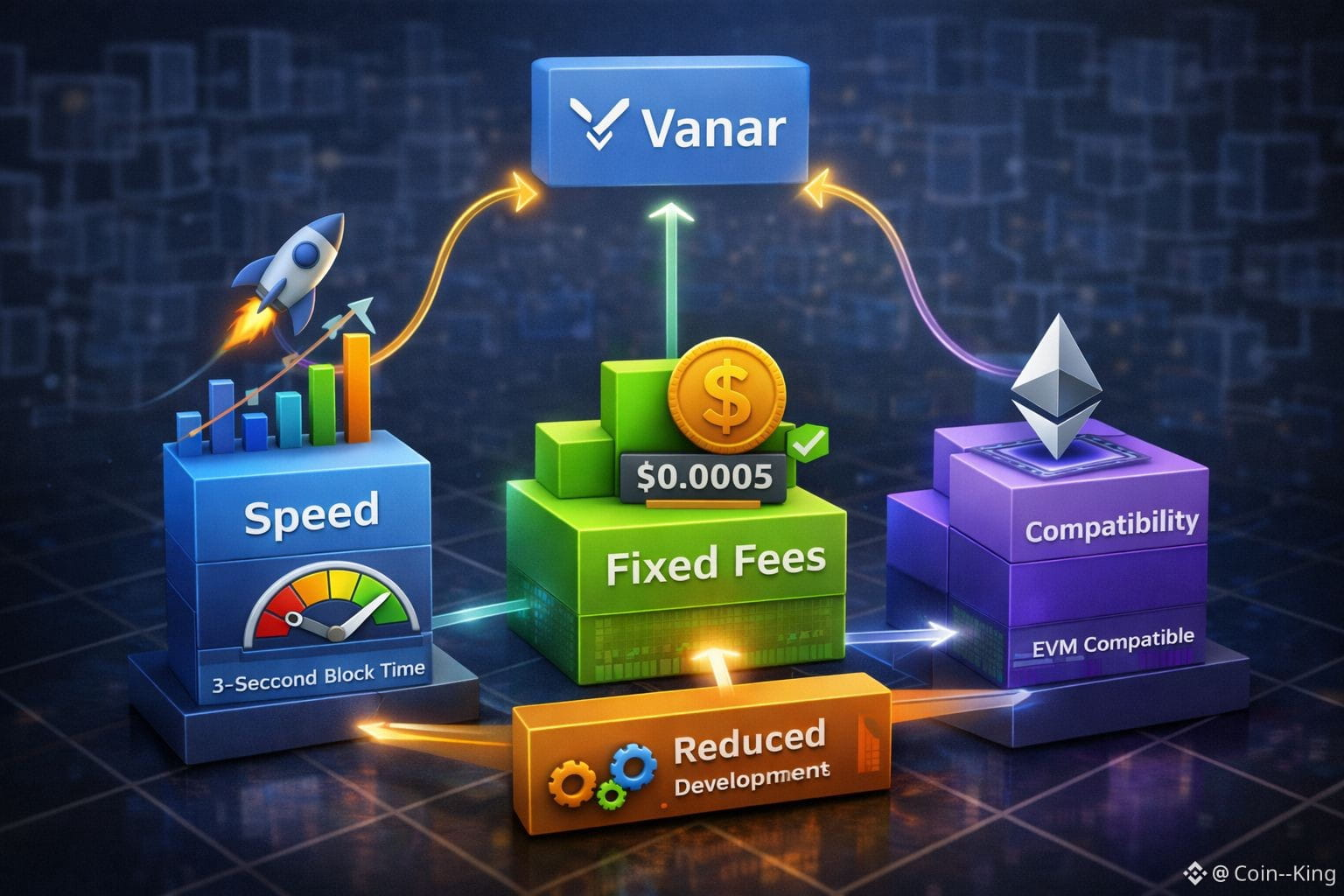
Start with speed, because that’s still the first thing users feel. Vanar’s own documentation says its block time is capped at a maximum of 3 seconds. In trader terms, that’s the difference between a swap that feels instant and one that feels like it might fail. And it’s not just “fast blocks” as a marketing line Vanar also describes a 30 million gas limit per block, which is basically the capacity lever that helps throughput when activity picks up. Faster blocks plus roomier blocks is the straightforward recipe for “less waiting, fewer stuck transactions,” which is what normal users care about long before they care about consensus philosophy.
The second lever is simplicity, and here Vanar’s approach is pretty specific: fees that are predictable. In its overview docs, Vanar points to transaction fees as low as $0.0005. More importantly, it leans into a fixed fee model fees expressed in dollar terms to keep costs predictable even when the token price and demand move around. If you’ve ever tried to onboard a Web2 team, you know why that matters. Nobody wants to budget a consumer app when the per action cost can jump 10x in a week because the chain got busy or the token rallied.
There’s also a subtle developer benefit here that traders sometimes miss: fixed fees change the game around transaction ordering wars. Vanar documents a “first in, first out” transaction ordering model first come, first served rather than everyone bidding gas like it’s an auction. That can reduce the mental overhead for developers (and arguably the user frustration) because you’re not constantly tuning gas strategies or dealing with users asking, “Why did my transaction sit there when I paid more?” It’s not a magic shield against every form of MEV behavior, but it does aim to remove one common friction point: the fee market turning into UX chaos.
Then you get to the big one for builder adoption: compatibility. Vanar is explicit about being EVM compatible “What works on Ethereum, works on Vanar.” It’s also open about its roots: an EVM chain aligned with Ethereum’s stack, implemented as a fork of Geth. That matters because “developer adoption” isn’t mostly about ideology; it’s about whether existing tools, libraries, and audit patterns carry over. The fastest way to reduce development friction is to let teams keep their existing mental model Solidity, familiar RPC patterns, familiar debugging and just change the network endpoint.
On consensus, Vanar describes a hybrid approach: Proof of Authority (PoA) governed by a Proof of Reputation (PoR) mechanism, with the Foundation initially running validator nodes and onboarding external validators based on reputation. Whether you like PoA or not, the practical angle is clear: it’s optimized for operational stability and fast finality rather than maximum permissionlessness from day one. For everyday use cases payments, gaming, consumer apps projects often pick “works reliably” before they pick “perfectly decentralized,” at least early on.
So why is Vanar trending now, instead of being filed away as “another chain”? A lot of the recent conversation has shifted toward Vanar framing itself as an “AI native” stack, not just an execution layer. Vanar’s own January 2026 posts lean into that narrative shift arguing that execution is no longer the bottleneck and that “intelligence” and memory layers are where differentiation will happen. And in August 2025, Metaverse Post covered “Neutron Personal,” describing it as an on-chain memory system and positioning it within a five-layer stack (Vanar Chain, Neutron, plus upcoming Kayon, Axon, and Flows). You don’t have to buy the whole thesis to see why traders latch onto it: narratives that connect crypto to AI tend to get attention, especially when the market is looking for the next theme.
From a market watcher perspective, I treat this kind of project like a checklist. Does it reduce the real frictions speed, fee unpredictability, tooling pain? On paper, Vanar’s 3 second blocks, higher per block gas capacity, fixed fee design, FIFO ordering, and EVM compatibility all point in that direction. The next question is always the hard one: does usage follow? The interesting part is that Vanar’s public story is moving from “we’re fast” (which everyone says) to “we make building and shipping simpler” (which fewer chains actually deliver). If that translates into smoother consumer apps and less developer time spent fighting the chain, that’s when “practical for everyday use” stops being a slogan and starts being observable on-chain.