
 I’ll be honest—when I first heard about another Layer 1 blockchain launching in early 2026, my initial reaction was a bit of eye-rolling. Do we really need another one?
But after digging into what the team behind @Fogo Official has actually built, I changed my tune. Fast.
What makes Fogo stand out isn't just the insane tech specs (we'll get to those), but the vibe of the launch. This wasn't a typical VC-backed mega-presale where insiders get rich while retail chases tiny scraps. Fogo took a different path.
The Community-First Gamble
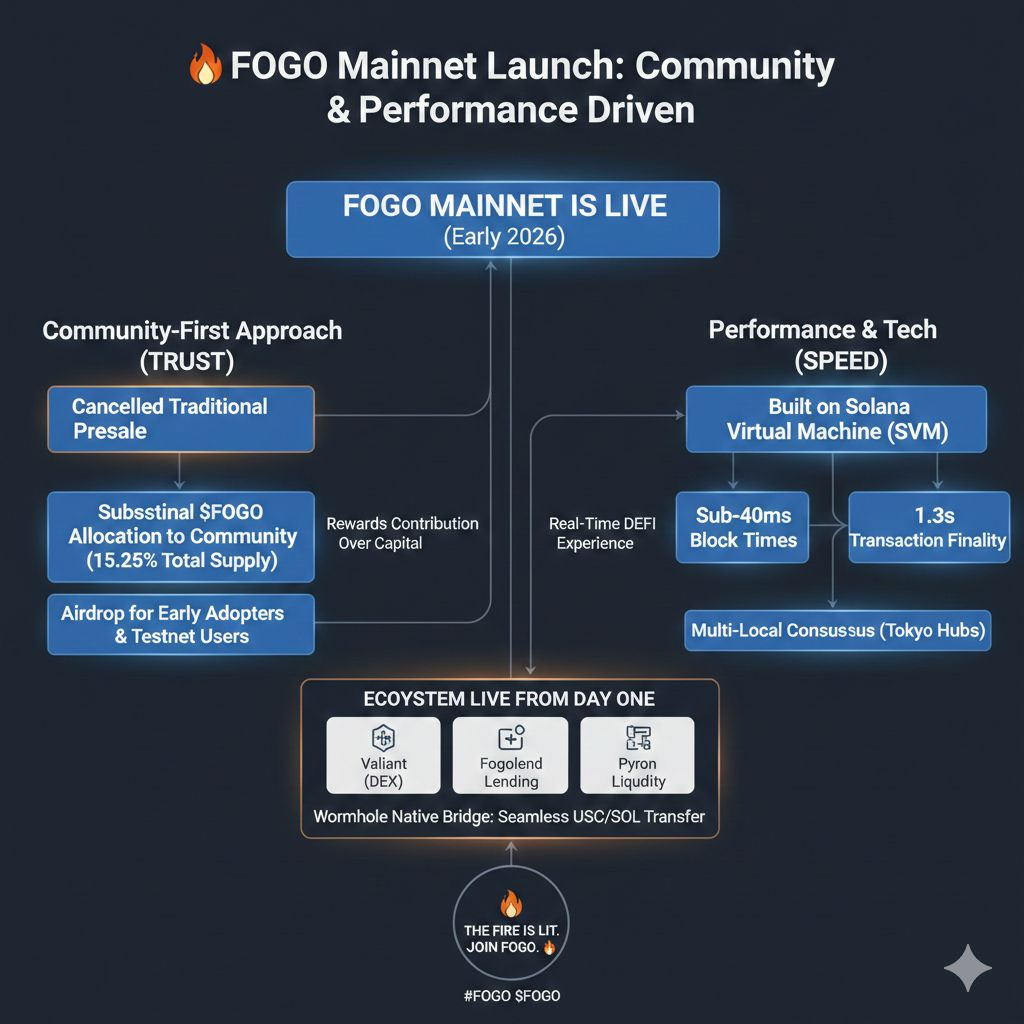
Earlier in their journey, the team made a decision that turned heads in the crypto space: they reportedly canceled a significant traditional presale . Instead of prioritizing institutional capital, they doubled down on the community. They allocated a substantial portion of the $FOGO supply directly to the people who actually showed up and used the testnet .
In a world where "community" is often just a buzzword in a whitepaper, this felt genuine. Around 15.25% of the total supply went to the community, with a chunk of that reserved specifically for an airdrop to early adopters and active users . It’s a model that rewards contribution over capital, and honestly, that’s the Web3 spirit we’ve been missing.
But Is It Fast?
Okay, let's talk about the tech, because the numbers are genuinely wild. Fogo is purpose-built for one thing: speed. We're talking sub-40 millisecond block times and transaction finality in about 1.3 seconds . For context, that’s significantly faster than most general-purpose L1s out there.
They achieved this by building on the Solana Virtual Machine (SVM) and integrating a pure version of the high-performance Firedancer client . They also implemented a "multi-local consensus" model, co-locating validators in key hubs like Tokyo to minimize physical distance and latency .
This isn't just about flexing numbers. This speed matters for real-world applications. It means on-chain order books that don't suck. It means liquidation engines that can actually keep up during volatile markets. It means a DeFi experience that finally rivals the centralized exchanges we all secretly wish we didn't have to use .
The Ecosystem is Already Moving
What impressed me most? The mainnet didn't launch into an empty void. From day one, the ecosystem was live. Protocols like Valiant, FogoLend, and Pyron went live simultaneously, giving users immediate utility for their assets . You aren't just holding a speculative token; you can actually do things with it. You can lend, trade, and provide liquidity right out of the gate.
And with Wormhole integrated as the native bridge, moving assets like USDC or SOL into the Fogo ecosystem feels seamless . The friction is gone.
The Bottom Line
Fogo is still young and carries a "Seed Tag" on exchanges for a reason—it’s high-risk, high-reward . But it represents something I want to root for: a specialized, performance-driven chain that put its users first from the jump.
If you're tired of laggy DEXs and want to see what "real-time" DeFi actually feels like, I’d suggest taking a look. The fire is lit. Now let's see what we build with it. #fogo $FOGO