
Retail participants often approach markets by searching for signals.
Professional operators begin with context.
Before any position is initiated, capital must be allocated within a defined risk architecture,one that accounts for market regime, volatility state, and liquidity behavior. Without this structure, strategy selection becomes arbitrary and outcomes rely on luck rather than repeatability.
Crypto markets typically oscillate between 3 Dominant Regimes:
• Expansion : Rising liquidity, suppressed volatility, momentum persistence
• Compression : Range-bound price, declining participation, false signals
• Distribution : Selective liquidity withdrawal, volatility fragmentation
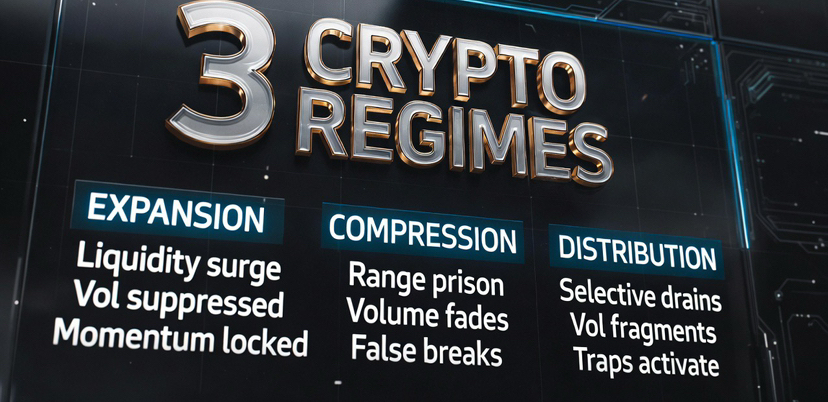
Most losses occur when traders apply expansion strategies inside compression or distribution regimes.
Candlestick patterns do not fail.
Misclassification of regime does.
Risk management, therefore, is not a defensive tool, but a real classification system. Position sizing must contract as uncertainty increases and expand only when structural clarity improves.
Institutional traders do not aim to be active.
They aim to be appropriately exposed.
The defining edge is not prediction accuracy, but capital durability.
Survival allows optionality. Optionality enables compounding.
Markets do not reward intelligence in isolation.
They reward alignment between strategy and environment.