

Every market cycle eventually comes back to the same quiet test. When things get busy and everyone tries to act at once, does the infrastructure hold up, or does it start to feel fragile? Most chains look impressive during calm periods. Transactions go through, dashboards look smooth, and nobody questions the limits. The real character of a network shows up during stress. That’s the environment Fogo is built for. It isn’t trying to impress with abstract architecture diagrams. It’s trying to answer a practical trader question: when timing matters, can the chain behave in a way that feels dependable?
This matters more in the current cycle than people like to admit. Crypto has matured into something closer to financial infrastructure than experimental software. On-chain markets are not niche playgrounds anymore. They’re hosting leverage, automated strategies, liquidations, auctions, and constant arbitrage flows. Users don’t compare these experiences to other blockchains; they compare them to centralized exchanges. If execution feels delayed or unpredictable, trust disappears quickly. That gap between expectation and reality is the problem Fogo is targeting. The project starts from a simple observation: speed is not just about bragging rights, it’s about removing friction that users actually feel.
Fogo builds on the Solana Virtual Machine, which already has a reputation for parallel execution and performance. The key decision is not reinventing the environment developers know, but tightening how execution behaves under pressure. By focusing on localized consensus paths and performance enforcement at the validator level, Fogo is trying to reduce the long-tail delays that make fast systems suddenly feel slow. In plain terms, the goal is consistency. Traders care less about theoretical maximum speed and more about whether confirmations behave the same way during a quiet afternoon and during a liquidation cascade. Predictability is what turns speed into trust.
One of the more practical aspects of Fogo’s design is compatibility. Developers can work with familiar SVM tooling instead of learning a completely new stack. That lowers migration friction and gives the ecosystem a chance to grow without demanding ideological loyalty. Builders are pragmatic. They go where deployment is easier and performance aligns with their product needs. If an order book or derivatives platform can move over without rewriting its core logic, the decision becomes about user experience rather than engineering pride. That’s an underrated advantage in a landscape where fragmentation often slows adoption more than technology does.
The token model sits in the background but still shapes the economic reality of the network. The token is used for gas and staking in a proof-of-stake framework, which ties network security directly to participation. From a trader’s perspective, what matters is whether the token has structural demand and predictable supply behavior. Infrastructure tokens tend to perform best when they are quietly necessary rather than loudly marketed. Fees, validator rewards, and staking incentives create a baseline economy that doesn’t depend entirely on speculation. It doesn’t guarantee price performance, but it gives the asset a reason to exist beyond narrative cycles.
Ecosystem growth is where performance projects are tested. A fast chain without meaningful applications is just an engineering exercise. Fogo’s positioning leans heavily toward trading-sensitive DeFi, where milliseconds translate into real economic outcomes. Order books, high-frequency strategies, and liquidation engines all amplify small inefficiencies. If the chain reduces those inefficiencies in practice, it creates a natural home for apps that want to operate at financial speed. The goal is not to host every possible Web3 category. It’s to become the place where on-chain trading feels normal instead of experimental. Routine usage is what converts infrastructure from an idea into a habit.
Market positioning is complicated because the performance narrative is crowded. Solana continues to improve, and several networks claim exchange-like throughput. Fogo’s edge has to come from how execution behaves under load rather than headline benchmarks. The distinction is subtle but important. Many systems are fast in demos. Fewer are stable during chaos. If Fogo can build a reputation around predictable execution when volatility spikes, that becomes a brand traders understand instinctively. Reliability during stress is remembered longer than synthetic speed tests.
The risks are real and worth stating clearly. Optimizing for low latency often increases centralization pressure. If peak performance depends on tightly clustered validator infrastructure, the network has to balance speed with resilience. There is also competitive risk. The broader SVM ecosystem continues to evolve, and improvements upstream can narrow Fogo’s differentiation over time. Technology advantages rarely stay exclusive. Adoption psychology is another challenge. Traders do not move capital because a whitepaper promises efficiency. They move when liquidity feels safe, exits work, and the venue earns confidence through repeated use.
Here’s the contrarian angle that sits quietly behind all performance discussions: being the fastest network is less important than being the one traders trust during failure scenarios. Markets forgive average speed. They do not forgive breakdowns. If Fogo becomes known as the chain that behaves cleanly when others stutter, that reputation compounds. It shifts the conversation from marketing metrics to risk management. In trading culture, that kind of reputation is currency.
From a trader’s lens, infrastructure plays demand patience. The signals to watch are behavioral rather than promotional. Is liquidity deepening over time? Are spreads tightening? Do apps remain usable on volatile days? Those details reveal whether the network is earning organic confidence. Accumulation thinking tends to favor zones where price stabilizes while fundamentals quietly improve. Unlock schedules, validator participation, and ecosystem traction matter more than sudden spikes. Infrastructure trades reward observation more than excitement.
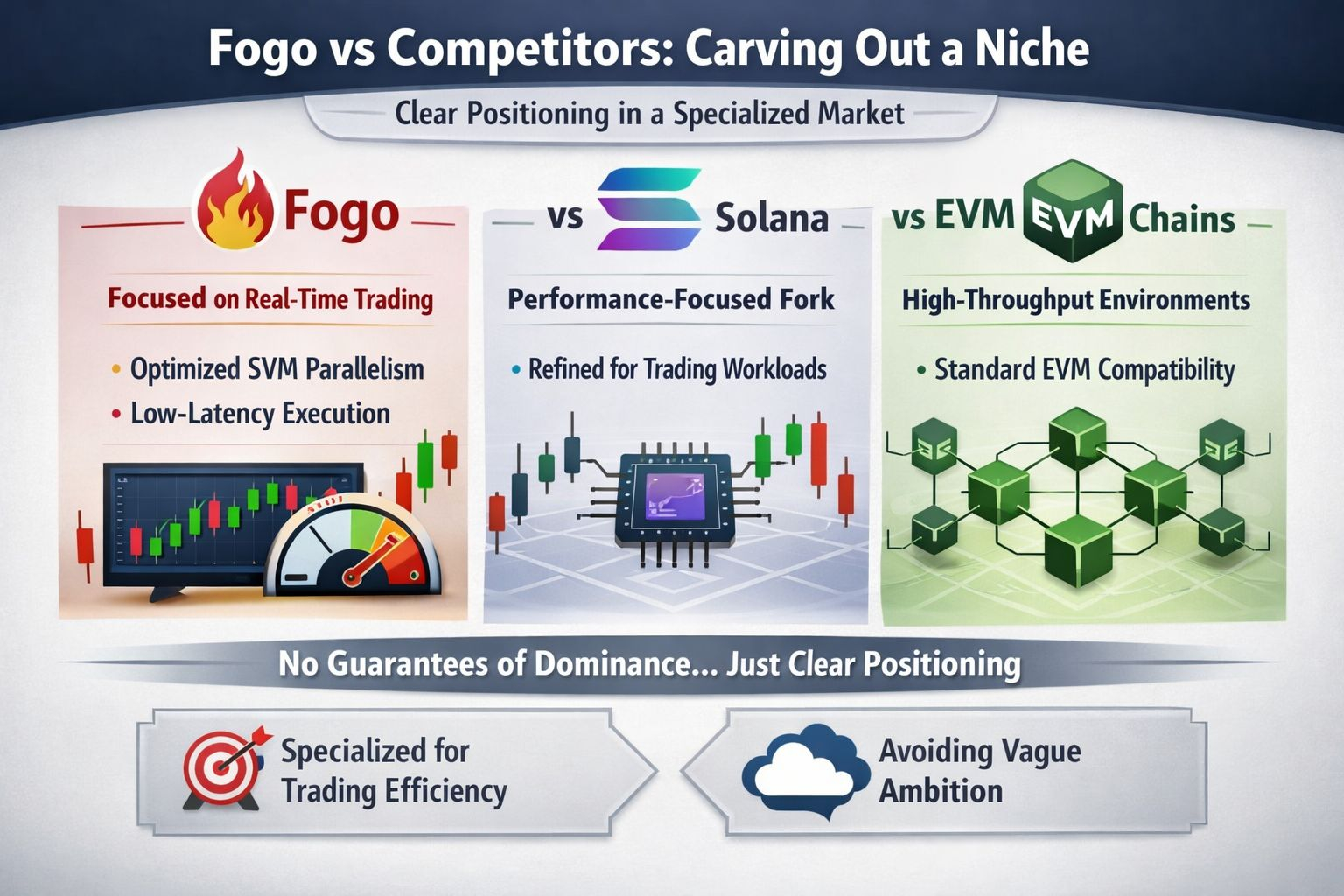
Comparing Fogo to competitors highlights its specialization. Against Solana, the bet is that a performance-focused fork can refine execution for trading-heavy workloads. Against high-throughput EVM environments, the argument is that SVM parallelism paired with latency optimization better suits real-time markets. None of these comparisons guarantee dominance. They simply clarify the niche Fogo is trying to own. Clear positioning is healthier than vague ambition.
In the long view, Fogo represents a thesis about where on-chain finance is heading. As markets mature, tolerance for unreliable infrastructure shrinks. Users stop celebrating experimentation and start demanding consistency. If Fogo succeeds, it will be because traders quietly decide the network behaves like a serious venue. That decision won’t come from slogans. It will come from repeated interaction where nothing breaks.
A final reflection from a trader’s perspective: the strongest infrastructure positions rarely feel dramatic at entry. They feel almost boring. The excitement appears later, after the system survives stress and activity becomes routine. Fogo is chasing that kind of credibility. Not spectacle, not noise, but the slow accumulation of trust that turns a chain into part of the background machinery of markets. When infrastructure disappears into reliability, that’s when it has done its job.
