

Every cycle eventually circles back to the same quiet realization: technology alone doesn’t create adoption. People don’t wake up wanting to use a blockchain. They want to play a game, collect something meaningful, join a digital world, or interact with a brand in a way that feels natural. The infrastructure only matters if it disappears into the background and lets the experience take center stage. Vanar stands out to me because it’s built around that simple but difficult idea. Instead of chasing abstract performance metrics, it’s trying to become a base layer where consumer experiences can live without constantly reminding users they’re inside a crypto system.
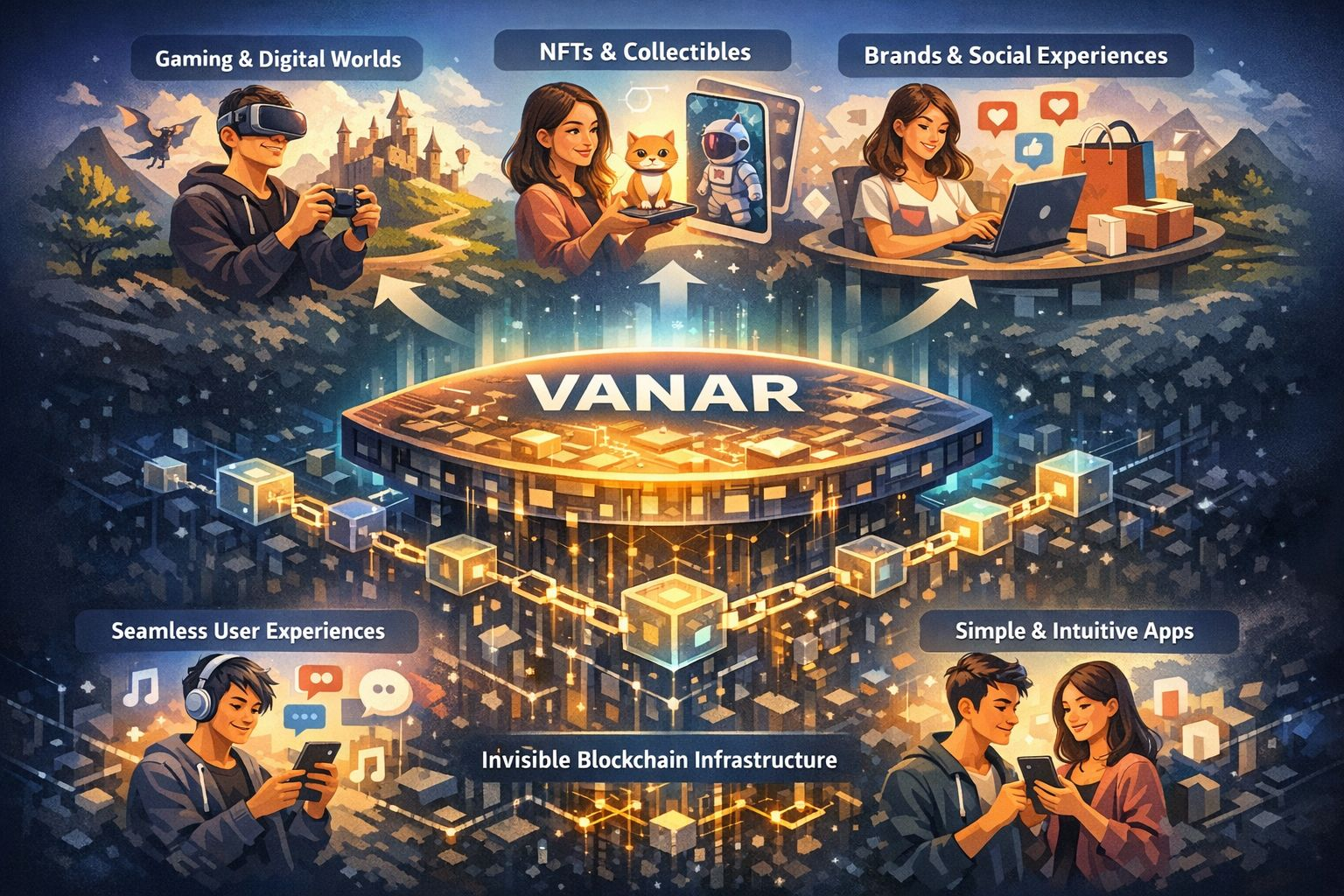
The problem Vanar is addressing is one the current cycle has exposed very clearly. Crypto has matured technically, but mainstream usability still feels fragile. Wallet friction, unpredictable fees, slow onboarding, and inconsistent performance quietly push away the very audience Web3 claims to want. Builders often design for crypto-native users who tolerate complexity, not for everyday people who expect apps to work instantly. In a market where attention is expensive and patience is thin, friction isn’t a minor inconvenience; it’s a growth killer. Vanar’s focus on gaming, entertainment, AI-driven experiences, and brand integrations is essentially a response to that reality. It’s a recognition that adoption will come from environments people already enjoy, not from forcing them to learn blockchain first.
From an infrastructure perspective, what matters most is reliability under real usage. A consumer-focused chain has to behave like stable digital plumbing. It must keep costs predictable, confirmations fast, and performance steady even when an application suddenly scales. Vanar’s design philosophy suggests a preference for usability and consistency over ideological purity. That choice is practical. In entertainment ecosystems, users don’t debate decentralization models; they notice lag, broken flows, and hidden costs. If the infrastructure feels invisible and dependable, people stay. If it doesn’t, they leave quietly and rarely come back.
The ecosystem products give useful context to that strategy. Virtua Metaverse and the VGN games network aren’t just marketing anchors; they represent environments where repeat behavior can actually form. Gaming and digital worlds naturally generate economies: items, identity, status, marketplaces, and social interaction. These systems align well with blockchain mechanics when execution is smooth. The opportunity isn’t about hype around the word “metaverse,” it’s about whether digital ownership and persistent environments can feel normal enough that users stop thinking about the technology behind them. If Vanar can support those experiences at scale, it builds something more durable than short-term speculation.
Token design plays a quiet but critical role in that equation. A consumer ecosystem token has to support the network without becoming a barrier. VANRY functions as infrastructure fuel and an alignment mechanism between the chain and its participants. The balance is delicate. If every action feels like a toll booth, onboarding suffers. If the token has no meaningful role, long-term alignment weakens. The healthiest networks treat their token as part of the operating system rather than the headline attraction. When the economics are structured to keep usage affordable and developer incentives clear, adoption has room to breathe.
Ecosystem growth in consumer crypto isn’t measured by announcement volume; it’s measured by whether teams can ship products that survive contact with real users. Builders need tools that don’t collapse under pressure and an environment where iteration is possible without catastrophic risk. Vanar operates in a crowded landscape where competitors already have distribution advantages. Polygon offers familiarity and enterprise access, Immutable has strong gaming specialization, Ronin has proven game-native infrastructure, and Solana brings raw performance plus cultural momentum. Vanar’s opportunity isn’t to outshout them. It’s to create a coherent stack where infrastructure, developer tooling, and consumer strategy feel intentionally connected. Coherence often beats fragmentation in the long run.
From a market standpoint, Vanar sits inside a narrative that is attractive but easy to misunderstand. Consumer adoption stories don’t usually move in straight lines. They build quietly, then accelerate when the product layer reaches a tipping point. Traders tend to chase loud narratives, but infrastructure aimed at real usage often compounds in silence before it reprices. Liquidity, developer traction, and ecosystem retention matter more than headlines. If flagship applications show repeat engagement and consistent improvement, the market eventually notices. If activity depends entirely on announcements, attention fades quickly.
The risks deserve equal weight. Execution is the biggest one. Consumer ecosystems demand long timelines, and markets rarely reward patience in the early stages. Differentiation is another challenge. If Vanar feels interchangeable with other L1s targeting gaming and brands, builders will default to ecosystems that already hold liquidity and users. There’s also the balancing act between crypto-native culture and enterprise partnerships. Brands want stability and predictable environments; crypto communities want openness and credible decentralization paths. Managing both without alienating either side requires discipline.
There’s a quieter structural risk too. Consumer-focused networks sometimes grow in ways that reduce speculative intensity. Stability and usability are not always exciting narratives, even though they’re exactly what long-term adoption requires. Traders who expect constant volatility may overlook projects prioritizing durability. Ironically, that restraint can become a strength if the ecosystem compounds while attention is elsewhere.
A contrarian insight worth considering is that consumer crypto rarely rewards the chain with the flashiest technology alone. Distribution, product taste, and ecosystem design tend to matter more. The winner is often the network that makes onboarding invisible and embeds itself into experiences people already value. If Vanar’s team understands entertainment and brand dynamics deeply, that cultural fluency could matter more than incremental performance gains.
From a trader’s lens, Vanar reads less like a short-term momentum vehicle and more like an adoption thesis that develops in phases. I watch for slow structural signals: consistent shipping, stable community growth, improving liquidity, and products that attract users without forced incentives. Accumulation in these kinds of networks tends to reward patience rather than precision. Scaling exposure over time makes more sense than trying to capture a perfect entry, because adoption curves are uneven by nature. Macro conditions still matter; consumer narratives strengthen in risk-on environments, but they survive longer when grounded in real utility.
Looking forward, Vanar doesn’t need to dominate headlines to justify its existence. Its success depends on something quieter and harder: becoming dependable infrastructure for consumer-facing experiences that people return to voluntarily. If the ecosystem continues to ship, refine onboarding, and maintain performance, it builds credibility the slow way. Networks that survive multiple cycles rarely do so through hype. They survive by becoming useful enough that users forget to question them.
From a personal trading reflection, I’m drawn to projects that can be evaluated through behavior rather than promises. Vanar’s thesis is measurable. Either consumer products grow and retain users, or they don’t. That clarity makes it easier to monitor without emotional attachment. If execution holds, the market eventually prices in reliability. If it doesn’t, the weakness becomes visible early. In a space where narratives shift quickly, having something concrete to observe is an advantage. And in the end, adoption is less about loud moments and more about quiet consistency.
