

Fogo feels like it was made by people who actually use on-chain apps under pressure, not just people who benchmark TPS on a quiet testnet.
If you’ve ever tried trading or even just doing a few actions in a DeFi app, you know the pain: the wallet keeps interrupting you. Sign. Approve. Confirm. Sign again. And if the market is moving, those extra seconds don’t feel like “UX friction,” they feel like money leaking out of your pocket.
Fogo’s whole direction is to kill that interruption loop. The chain is built on the SVM approach (Solana Virtual Machine style), which is already known for speed-oriented execution, but Fogo isn’t stopping at “fast blocks.” It’s trying to make the experience continuous—more like how a normal app behaves—especially for trading-style use cases.
That’s where your line fits perfectly: gasless UX plus “less signatures,” with Sessions as a primitive.
Most chains can only do “gasless” and “fewer signatures” as a hack. A dApp builds a relayer, the wallet has weird custom flows, permissions are messy, and every app does it differently. Fogo’s idea is to standardize that behavior at the chain level through something called Fogo Sessions. In plain language, a Session is like granting a controlled “permission window” so you don’t have to prove yourself with a fresh signature for every single step. You sign once—an intent—and then you can interact within that scope without being interrupted repeatedly.
The most human way to picture it is this: normally your wallet acts like a security guard who asks for your ID every time you open a door. Fogo Sessions tries to make it more like a wristband at an event—still secure, still controlled, but you don’t have to stop and show your ID at every hallway. The chain treats “I’m here to do this set of actions for this period of time” as a first-class thing, not an afterthought.
Now about “gasless.” Nothing is truly free—fees are always paid by someone. What Fogo is doing is shifting the burden away from the user by supporting paymasters, where the app (or an infrastructure provider) can sponsor the fees so the user can just use the product without juggling a native gas token balance. This is a big deal for onboarding and for trading. New users don’t have to buy a token just to start clicking. Traders don’t get stuck because they forgot to keep gas topped up. And from the user’s perspective, it feels like the app is simply working the way modern apps should.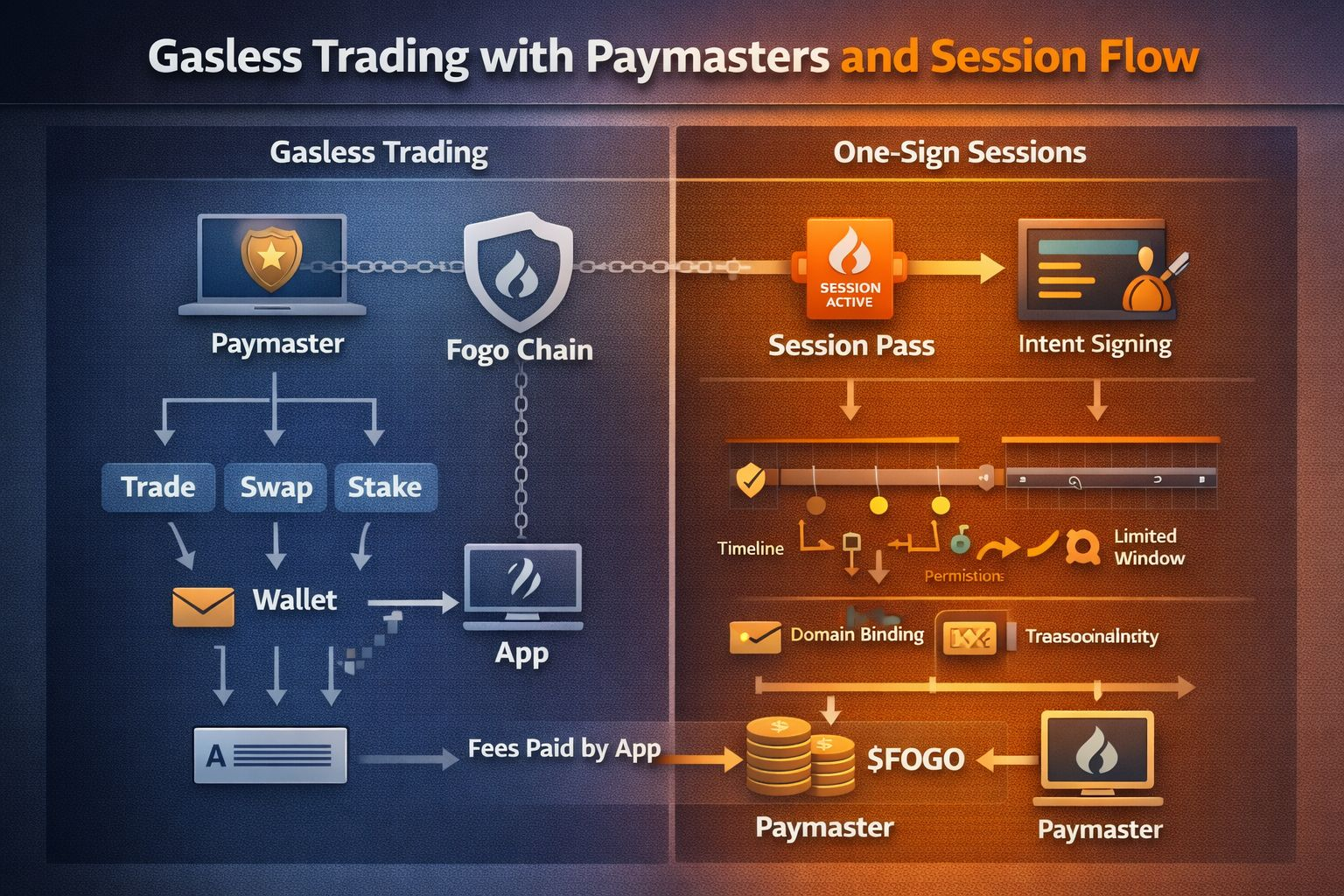
This is also why Sessions matter specifically for trading. In a trading flow, you aren’t doing one transaction and walking away. You’re adjusting, reacting, placing multiple actions quickly. The “wallet pop-up tax” becomes unbearable. Fogo’s Sessions are basically trying to bring a CEX-like flow to an on-chain environment: one approval, then smooth action, without constant interruptions. That’s exactly the kind of UX traders will notice instantly.
Underneath that UX, Fogo is still aiming hard at performance on the infrastructure side. It publicly describes using a custom Firedancer-based client and frames itself as a latency-focused network design. That’s part of why you see discussion around validator design choices that emphasize performance, including ideas like colocation and structured regional operation concepts. Whether you love or hate those choices, they clearly signal that Fogo is prioritizing “market speed” as a core product feature, not a nice-to-have.
Where does $FOGO fit into a world where users might not even feel gas? Think of $FOGO as the engine token. Even if the driver doesn’t touch the engine, the car still needs it. The token is framed around network gas (even if apps sponsor it), staking/security incentives, and ecosystem economics. So $FOGO can be essential even if the user mostly trades using SPL tokens and barely thinks about the native token day-to-day.
The part that makes this credible (and not just “smooth UX promises”) is that Sessions are not meant to be blind trust. Fogo’s docs describe guardrails like domain binding (so a session is tied to the correct app domain) and the ability to have limited sessions with scoped permissions and expiry. So the goal isn’t “approve once and pray.” The goal is “approve once, with clear boundaries, and keep the experience flowing.”
