
@Vanarchain I was on a late call last week, laptop balanced on the edge of my kitchen table, when an alert popped up about yet another Layer 1 launch. The kettle clicked off behind me and my notebook was already full of chain names I’d forgotten to follow up on. I felt a familiar frustration: more rails, less ride. Is this really what progress looks like?
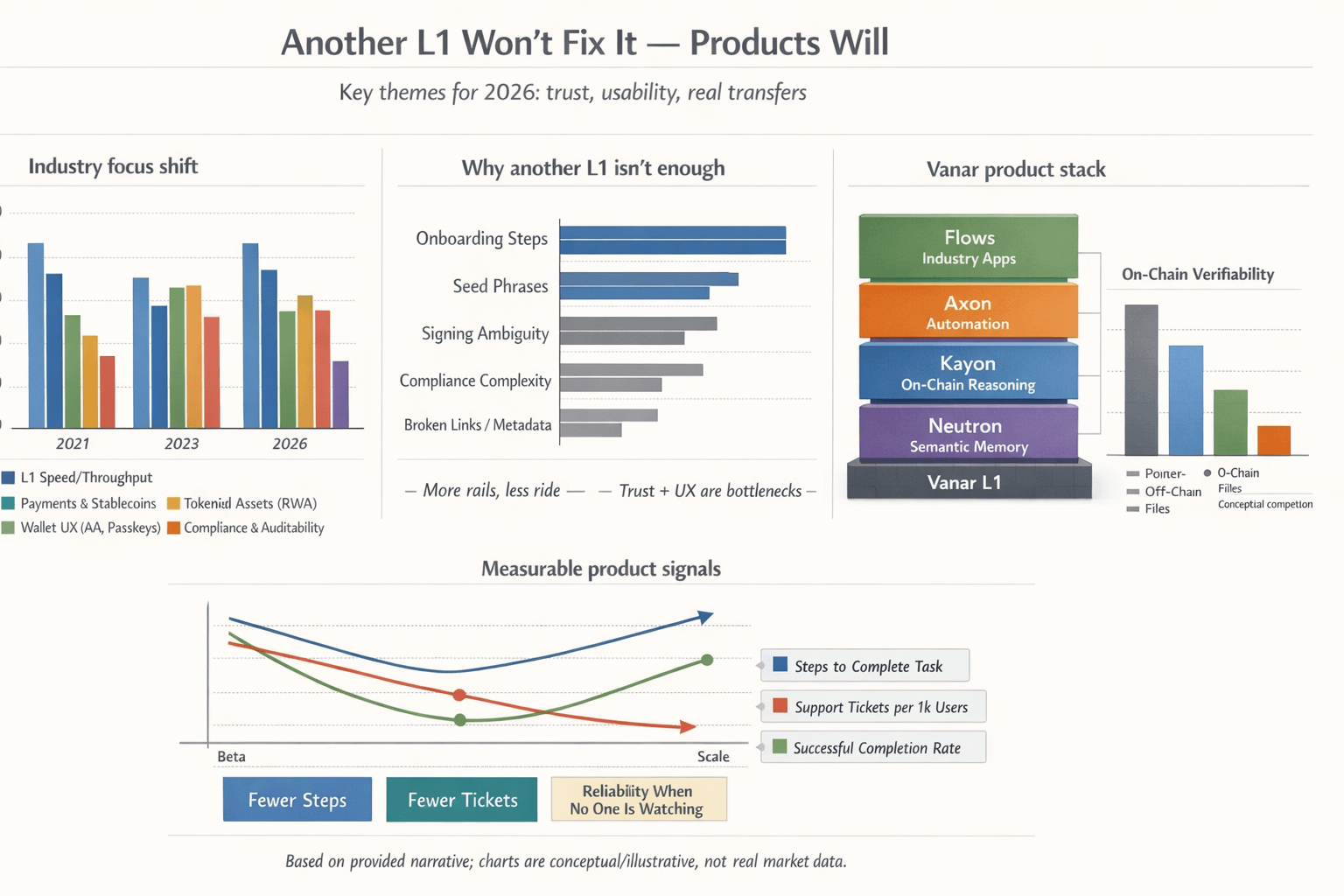
The timing matters. As we head into 2026, I notice the conversations I take seriously aren’t about speed anymore—they’re about outcomes. Can you send money easily? Can assets move without drama? Can a beginner use a wallet without feeling like they’re one typo away from disaster? Most of what I’m reading points to the same set of themes: stablecoins being used for real transfers, real-world assets coming on-chain, and wallets moving toward passkeys and account abstraction so they feel like normal logins. The underlying truth is blunt: there’s no shortage of infrastructure. There’s a shortage of trust and smooth UX.
That’s why “another L1 won’t fix it” lands for me. A faster base layer doesn’t make onboarding calm, doesn’t make compliance readable, and doesn’t make a consumer trust what they’re signing. Most people don’t wake up wanting a new settlement layer. They want a game that doesn’t glitch, a payment that clears, a receipt they can find, a ticket that doesn’t get forged, and an app that doesn’t ask them to memorize a seed phrase.
Vanar has been showing up in that conversation with a pointed claim: the work now is products, not more chain theater. Under the hood, it still includes an L1, but it describes a stack that tries to make applications remember and reason as part of the system. On its site and in its documentation, Vanar lays out Neutron as semantic memory, Kayon as an on-chain reasoning layer, Axon as automation, and Flows as the place where industry applications live. I don’t take architectures as proof, but I do like that it names the missing pieces plainly. And when I see the line “not another L1” repeated by its community, I treat it as a promise that can be tested, not a slogan to admire.
I’ve watched enough “AI plus blockchain” demos to stay cautious. The hard part is not generating an answer; it’s anchoring that answer to something verifiable and auditable. In practice, many teams still push the important files off-chain and keep only a pointer. Vanar argues that documents can be compressed into on-chain, queryable objects, so contracts and agents can reference data without relying on a brittle link. That design choice, if it holds up, could reduce the quiet fraud risk that lives in mismatched records and dead metadata.
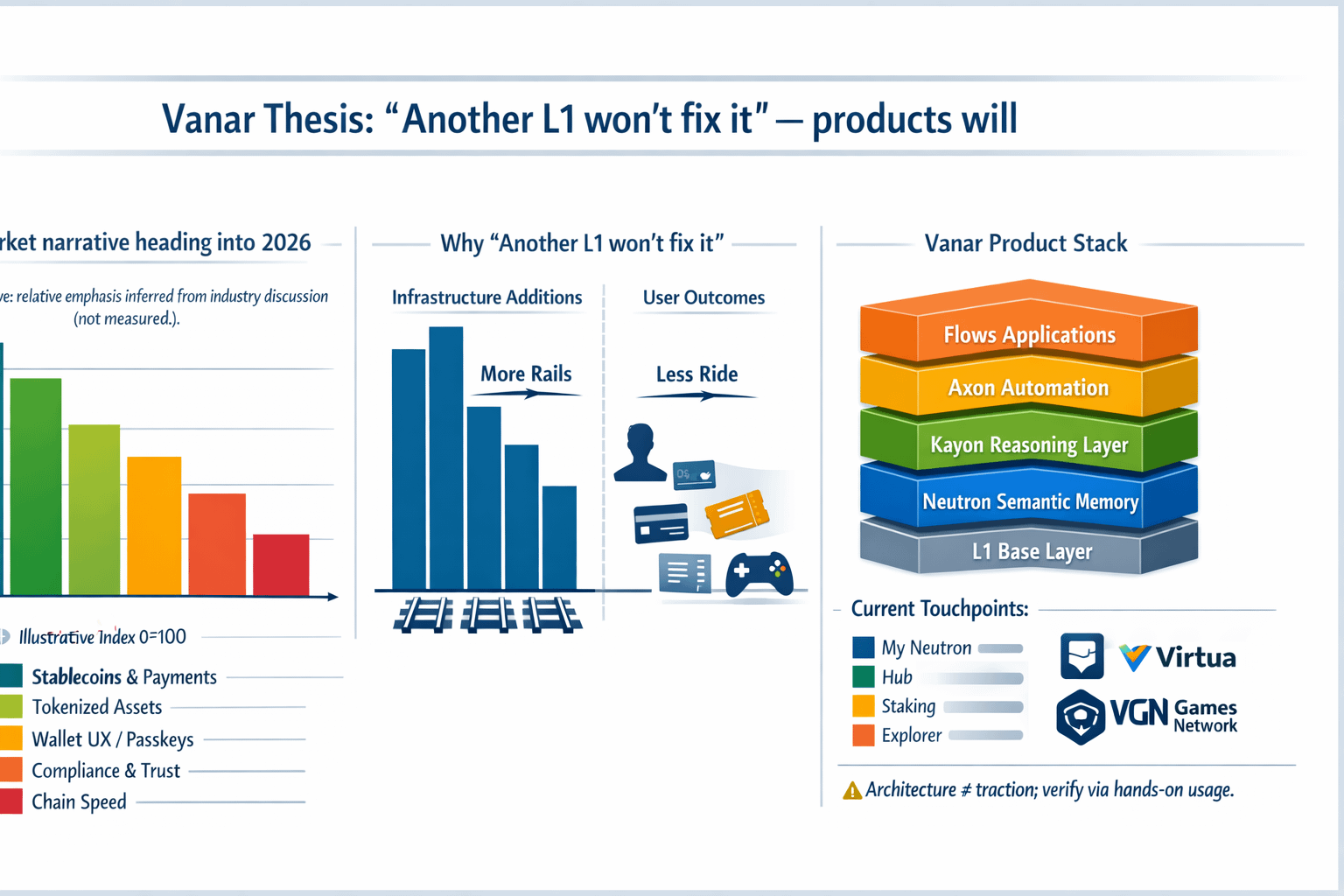
This is where the “products will” part becomes measurable. I’m less interested in a roadmap than in what exists today and what it feels like to use. Vanar lists end-user touchpoints like My Neutron, a hub, staking, and an explorer. It also points to consumer-facing entertainment and gaming projects in its ecosystem. External write-ups have highlighted Virtua and the VGN games network as examples of applications already built on the chain. None of that guarantees traction, but it does move the conversation from promises to hands-on usage.
I also think the product-first angle fits the moment we’re in. Regulators and institutions don’t get excited by flashy demos—they reward clean records, repeatable controls, and systems that just work day after day. Even the optimistic takes on 2026 keep coming back to the same things: stablecoins, payments rails, and tokenization that’s useful—not just novel. If tokenization doesn’t make distribution cleaner, settlement faster, or risk easier to manage, it won’t stick. And in that world, “good enough tech” with a calm, well-designed product usually beats “best tech” wrapped in a confusing experience.
Still, I’m not ready to declare that Vanar has solved anything permanent. I’ve learned that infrastructure teams can ship quickly, but product teams earn trust slowly, one support chat and one refund at a time. I’m watching for the unglamorous signals: fewer steps to complete a task, fewer support tickets, fewer moments where a user has to understand crypto to finish what they started. If Vanar can keep dragging attention from infrastructure bragging to usable products, that alone would be progress. The real test is whether those products keep working when nobody is paying attention.