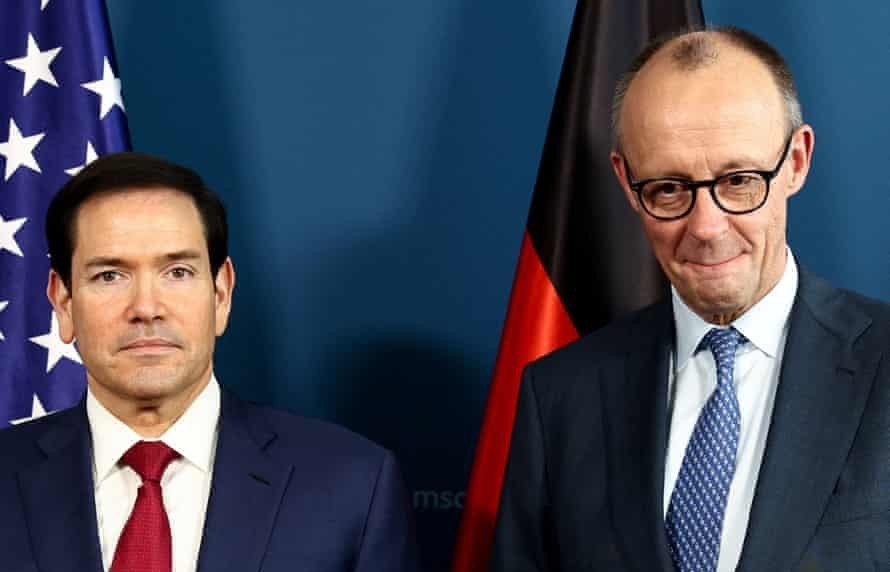
The geopolitical tectonic plates are shifting, and the 62nd Munich Security Conference has become the epicenter of this transformation. In a defining moment for transatlantic relations, German Chancellor Friedrich Merz delivered a speech this Friday that was as much a declaration of European independence as it was a diplomatic olive branch. Facing a US delegation in a climate of heightened tension, the message from Berlin was unmistakable: the era of unquestioned American unilateralism is meeting the hard limits of a multipolar world. 🛑🇺🇸🇩🇪
As the world approaches the grim fourth anniversary of the war in Ukraine, the comfortable assumptions of the past have evaporated. Chancellor Merz’s address to an audience that included US Secretary of State Marco Rubio was a profound articulation of a new European posture—one that prioritizes partnership over dependency and dignity over submission. 🇪🇺🛡️
The Limits of "Going It Alone" 🚫🦅
The core of Chancellor Merz’s argument was a direct, albeit diplomatic, rebuttal to the isolationist currents defining the current US administration under President Donald Trump. With the memory of Vice-President JD Vance’s lecture on "democracy" at last year's conference still fresh, Merz sought to redefine the power dynamic. Switching to English to ensure his words landed with precision, he warned: “In the era of great power rivalry, even the United States will not be powerful enough to go it alone.” 🗣️📢
This statement acknowledges a painful truth: the "rules-based international order" that the West has championed for decades is fractured, perhaps irreparably. Merz conceded that this order "no longer exists in that form." In this volatile new landscape, where autocracies demand submission, democracies must operate differently. Merz’s distinction was sharp and necessary: “Autocracies may have followers, democracies have partners and allies.” 🤝🌐
The strategic implication is profound. The United States’ true competitive advantage isn't just its military might or economic leverage; it is its network of alliances, specifically NATO. Merz suggested that by treating allies as subordinates—or worse, as targets for tariffs and territorial acquisition schemes like the recent pressure on Denmark regarding Greenland—the US undermines the very structure that amplifies its own power. 📉🔗
Strategic Autonomy: The European Nuclear Umbrella ☢️🇫🇷
In what may be the most significant strategic pivot of the decade, the conference shed light on concrete steps toward European self-reliance. Merz disclosed that initial talks have begun with French President Emmanuel Macron regarding Germany’s potential inclusion in France’s nuclear umbrella. ⚛️🔐
For generations, European security has been underwritten by American guarantees. But the winds have changed. With tensions rising over trade and the questioning of Article 5 commitments, Europe is being forced to "return from a vacation from world history." This isn't a rejection of NATO; rather, Merz and Macron are advocating for a "strong, self-sustaining pillar" within the alliance. A sovereign Europe with its own deterrent capabilities is the only insurance policy against an increasingly unpredictable American foreign policy. 🏗️🇪🇺
Rejecting the "Culture War" and Protectionism 🚫📦
The divergence between the US and Europe is no longer just strategic; it has become ideological. Merz drew arguably the strongest applause of the day when he drew a firm red line against the importation of divisive American political rhetoric. “The culture war of the Maga movement is not ours,” he declared. 🙅♂️📜
He emphasized that in Germany and Europe, freedom of speech is not absolute when it violates human dignity. Furthermore, the economic philosophies are drifting apart. While the US administration leans into protectionism and transactional diplomacy—viewing supply chains and resources as bargaining chips—Europe remains committed to free trade, climate agreements, and international bodies like the WHO. This rejection of a purely transactional worldview highlights a fundamental split in how the two powers envision the future of global governance. 🌍🌱
Macron’s Warning: The "Sugar High" of War 🍬⚠️
Adding to the chorus of European assertiveness, French President Emmanuel Macron offered a sobering analysis of the Russian threat. He warned that even if a settlement is reached in Ukraine, Europe faces the long-term challenge of coexisting with an "unreconstructed aggressive Russia" possessing a "bloated army and a defence industry on a sugar high." 🇷🇺🍭
Macron insisted that Europe must be at the table for any future arms control negotiations. The days when Washington and Moscow could decide the fate of European security over the heads of Europeans are over. He called for a new security architecture, distinct from the Cold War relics, that reflects the reality of Europe as a geopolitical power in its own right. 📝⚔️
Conclusion: A Partnership of Equals 🤝⚖️
The 2026 Munich Security Conference will likely be remembered as the moment Europe stopped asking for permission. The continent is no longer content to be lectured or sidelined. Leaders like Merz and Macron are outlining a future where Europe is a capable, sovereign entity—one that negotiates from a position of strength. 🇪🇺🚀
The message to Washington is an invitation disguised as a warning: Let’s revive transatlantic trust, but let’s do it as equals. In a world of "big-power politics" and "harsh, unpredictable rules," standing together is the only way to survive—but only if that stance is built on mutual respect, not subordination. 🌟👫
#MunichSecurityConference #Geopolitics #EuropeanSovereignty #TransatlanticRelations #NATOAlliance