
There’s a quiet pattern in crypto that most people don’t notice at first. A new trend appears – DeFi, NFTs, gaming, AI – and blockchains rush to support it. They add integrations, partnerships, toolkits. The base chain stays mostly the same. The new thing gets attached like an expansion pack.
AI is following that same path on many networks right now.
Vanar stepped sideways instead of forward. Rather than asking, “How do we plug AI into this?” the team asked something more structural. What would a chain look like if intelligence wasn’t an add-on at all? What if it was assumed from day one?
It’s a small shift in wording. But it changes the design conversation entirely.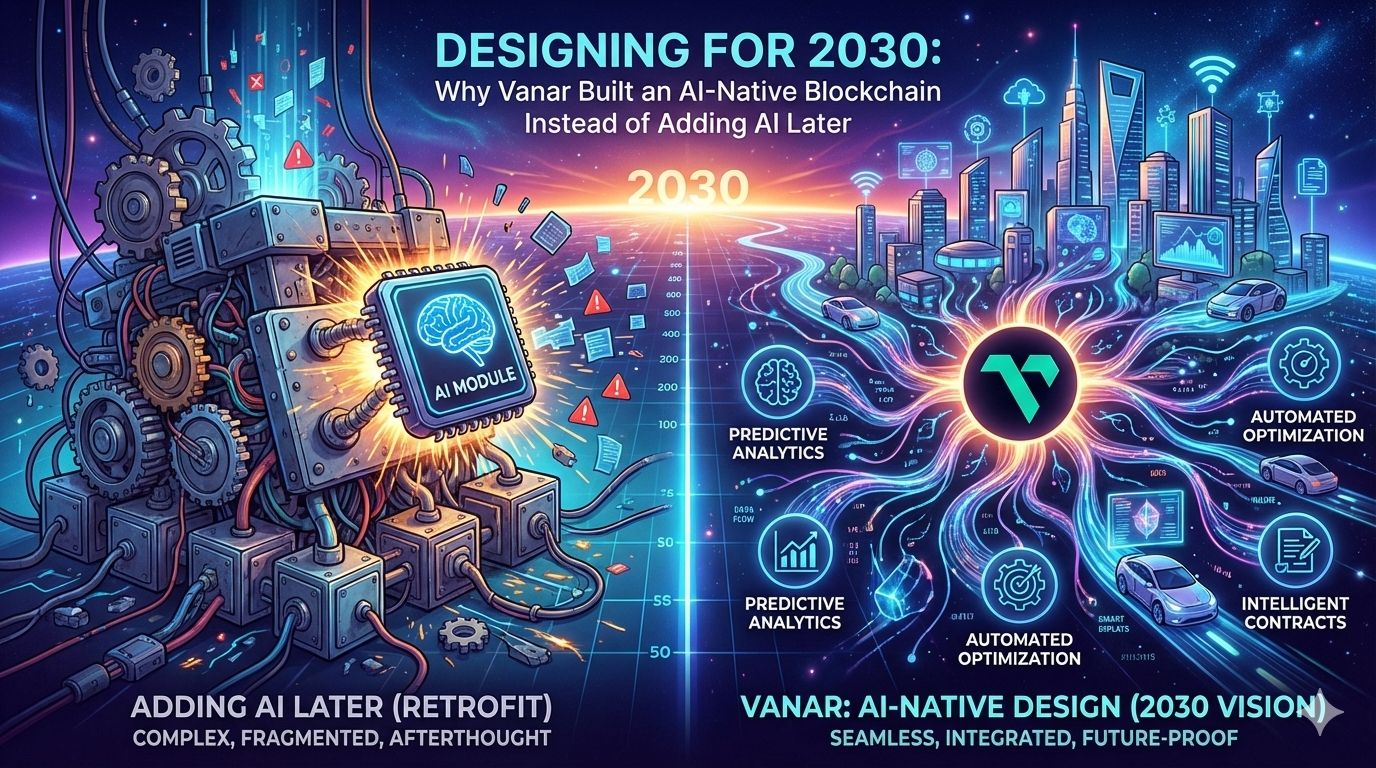
AI-Integrated Versus AI-Native:
When a blockchain integrates AI, the intelligence usually lives somewhere else. Off-chain servers handle model inference. APIs carry results back to smart contracts. The chain verifies outputs, but it doesn’t really understand how they were produced.
That setup works. In fact, it’s common because traditional blockchains were never designed to process complex computation internally. Ethereum, for instance, averages roughly 15 to 30 transactions per second depending on congestion. That figure sounds abstract until you realize AI workloads often demand far more computational effort than a simple token transfer.
So developers split the system in two. The chain does what it does best – maintain state and consensus. AI operates externally.
An AI-native chain starts from a different assumption. It treats intelligent computation as part of the system’s long-term role. That doesn’t mean the blockchain becomes a giant neural network. It means execution layers, validation logic, and architecture are designed with adaptive systems in mind.
There’s a difference in texture there. One feels bolted on. The other feels planned for.
Whether this architectural bet proves wise five years from now is uncertain. But it signals intent.
The Quiet Limits of Traditional Smart Contracts:
Smart contracts are deterministic. That word sounds technical, but it simply means this: given the same input, they always produce the same output.
That’s powerful. It creates trust. No surprises.
But it also locks behavior into predefined paths. A contract cannot interpret ambiguity. It cannot sense shifting conditions unless those conditions are already coded into its rules. If something new happens in the real world, the contract waits for a human to intervene.
I’ve always found that rigidity both reassuring and limiting. It’s like a calculator. Perfect for arithmetic. Useless for judgment.
As decentralized applications grow more complex – especially those that rely on pattern recognition, predictive models, or dynamic pricing – that rigidity starts to show. Developers compensate by leaning heavily on off-chain infrastructure. Which introduces new trust assumptions.
Vanar’s architecture seems to accept that tension rather than ignore it. Instead of forcing AI into deterministic molds, it separates layers carefully. Consensus stays stable. Adaptive logic lives where it can breathe.
At least, that’s the theory.
Inside Vanar’s Layered Design:
Vanar organizes its system so that AI-capable modules interact with the chain without overwhelming it. The base layer focuses on security and transaction ordering. Above it sits an execution environment that allows more flexible logic.
Recent network updates have emphasized transaction finality in the low-second range under normal conditions. That number needs context. Fast confirmation is meaningful only if it remains stable under increased demand. Throughput spikes can expose weaknesses quickly.
The layered model aims to preserve determinism where it matters while allowing intelligent automation to function without constant off-chain dependency. It’s a balancing act.
Still, complexity increases risk. More layers mean more integration points. Every integration point can become a vulnerability if not audited carefully. AI systems themselves introduce unpredictability, particularly if models evolve over time.
There’s also the cost question. AI computations are not light. If demand rises sharply, resource pricing must adjust. Otherwise, congestion builds. If fees rise too quickly, developers look elsewhere. That tension sits quietly underneath the design.
None of this guarantees failure. It just reminds us that architectural ambition carries trade-offs.
What This Means for Developers:
From a builder’s perspective, the difference shows up in workflow more than marketing language.
On a typical chain, creating an AI-powered application means stitching together separate systems. A smart contract handles on-chain logic. External servers process AI models. Data flows back and forth through APIs. It works, but the coordination layer becomes heavy.
With an AI-native approach, some of that coordination feels less improvised. Interfaces are designed intentionally. Execution assumptions align with intelligent automation from the start.
It doesn’t remove engineering difficulty. Machine learning pipelines still require training data, evaluation metrics, and monitoring. But the boundary between on-chain and adaptive logic feels more considered.
Early developers experimenting in this space appear interested in applications that go beyond static rules – dynamic marketplaces, AI-assisted governance filters, context-aware game logic. Whether those use cases gain real traction remains to be seen.
Adoption rarely moves in straight lines.
Future-Proofing or Premature Complexity:
Building for the future is always a gamble. If AI continues embedding itself into digital infrastructure – and current enterprise investment trends suggest it might – then blockchains that account for it structurally may have an advantage.
But timing matters. If decentralized AI use cases develop slower than expected, an AI-native architecture could feel heavier than necessary. Complexity without clear demand can slow ecosystems down.
There are regulatory questions too. AI governance frameworks are still forming globally. If compliance requirements tighten, blockchains interacting closely with adaptive models may face additional scrutiny.
And yet, there is something steady about designing with long-term assumptions in mind.
Instead of asking how to retrofit intelligence later, Vanar assumes intelligence will be part of decentralized systems by default. That assumption shapes the foundation.
Foundations are rarely flashy. They sit underneath, mostly unnoticed. But over time, they determine whether what’s built above them feels stable or fragile.
For now, Vanar’s choice signals patience more than hype. It suggests the team believes AI is not just another feature cycle, but part of the infrastructure layer that decentralized networks will eventually depend on.
If that belief holds, the architecture may age well. If not, adjustments will come.That’s the nature of building in public systems. The design decisions we make early tend to echo longer than we expect.
@Vanarchain $VANRY #Vanar