
In a market crowded with narratives slogans and endless next-generation blockchains attention has become more scarce than infrastructure.
There are chains promising infinite scalability.
There are chains promising zero fees.
There are chains promising revolutionary new programming languages and experimental architectures.
What is rare now is not another blockchain.
What is rare is purpose.
So when Fogo appears, the real question is not how many transactions per second it can theoretically process. The real question is simpler and sharper:
Why should it exist at all?
The Problem With Modern Blockchains
Today, infrastructure is abundant. New Layer 1s launch regularly. Many of them benchmark beautifully under lab conditions. They publish impressive TPS figures. They show colorful dashboards. They trend on social media.
But most networks are tested in quiet environments.
When traffic is low, everything looks fast.
When demand is light, everything feels scalable.
The real test is pressure.
When markets become volatile.
When bots begin executing thousands of transactions per second.
When on-chain games host thousands of simultaneous players.
When machine-driven systems operate non-stop, not occasionally.
Humans use applications sometimes.
Machines use them constantly.
That is where many blockchains reveal their limitations. Congestion rises. Fees spike. Throughput collapses. Finality slows. What looked smooth under light load begins to fracture under stress.
Fogo is positioning itself around a different philosophy:
Performance when it actually matters.
Not performance during quiet hours.
Performance during demand spikes.
Performance during machine-scale activity.
The Strategic Decision: Build on the Solana Virtual Machine
Instead of designing a completely new virtual machine from scratch, Fogo made a deliberate and arguably disciplined choice: it adopted the Solana Virtual Machine (SVM).
This decision immediately signals something important.
Fogo is not trying to reinvent everything.
It is trying to optimize what already works.
The SVM, originally pioneered by Solana, is widely recognized for one defining strength: parallel execution.
Most blockchains process transactions sequentially. One by one. Even if the hardware can handle more, the architecture becomes the bottleneck. As traffic increases, queues grow. Latency increases. Fees rise because users compete for limited block space.
Parallel execution changes that equation.
Instead of forcing every transaction into a single linear pipeline, the SVM processes independent transactions simultaneously. If two transactions do not touch the same state, they do not need to wait for each other.
The result is dramatically higher throughput under real-world workloads.
This is not marketing speed.
This is architectural speed.
Why Parallelism Matters More Than Headline TPS
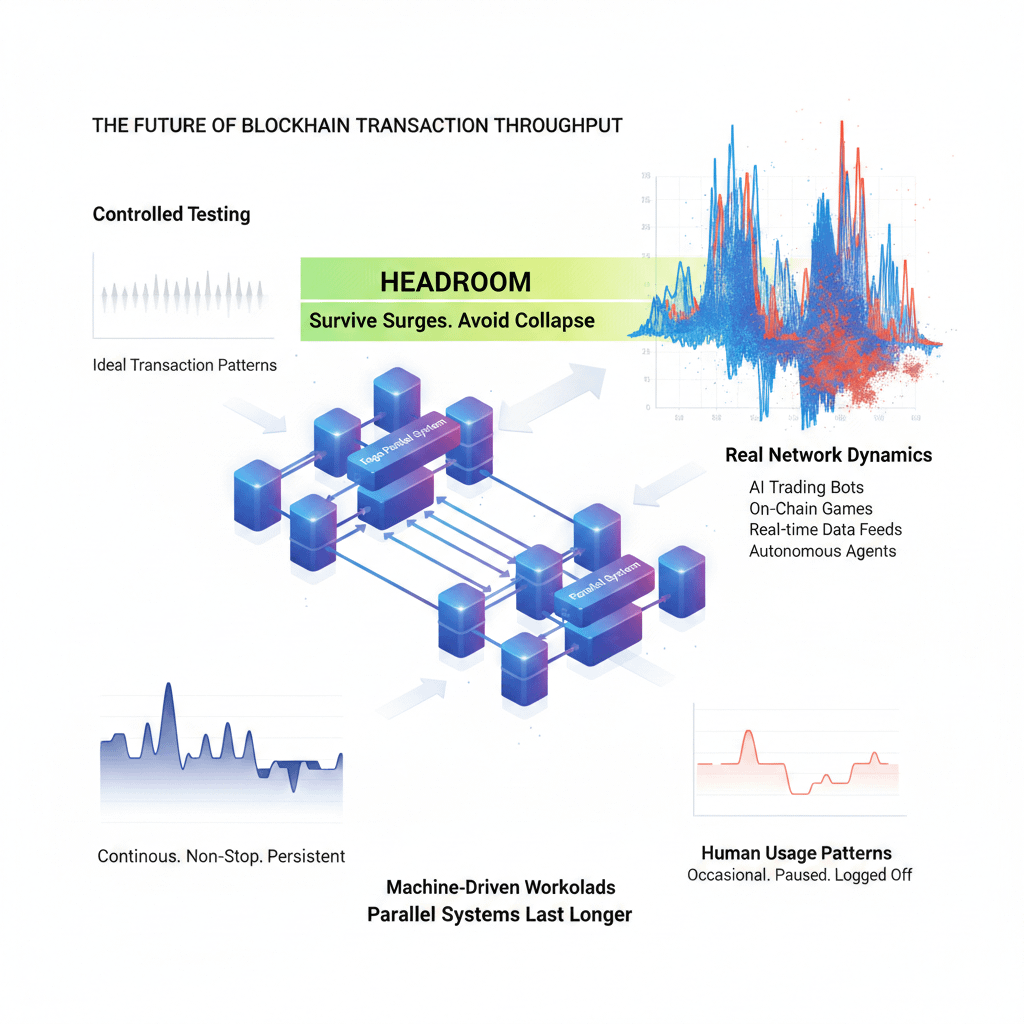
Headline TPS numbers can be misleading. They often represent controlled testing environments with ideal transaction patterns.
Real networks are messy.
Transactions interact with contracts in unpredictable ways. Markets spike unexpectedly. Activity clusters around certain applications. Demand comes in waves.
Parallel execution provides headroom.
Headroom is the difference between surviving a surge and collapsing under it.
• AI trading bots executing continuously
• On-chain games updating thousands of player states
• Real-time data feeds writing to contracts every second
• Autonomous agents interacting across protocols non-stop
These are not hypothetical use cases anymore. They are emerging realities.
Machine-driven workloads behave differently from human usage patterns. They do not sleep. They do not pause. They do not “log off.”
Blockchains built for occasional human interaction may struggle in that environment.
Parallel systems last longer.
Fogo appears engineered for that future.
The Hidden Cost of Reinventing Everything
Innovation sounds exciting. Many new chains launch with new programming languages, new runtime models, and new execution designs.
On paper, this feels bold.
In practice, it creates friction.
Developers must relearn tools.
Auditors must evaluate unfamiliar systems.
Security risks increase because environments are new and battle-testing is limited.
Bugs appear where patterns are not yet mature.
Switching tech stacks repeatedly exhausts builders. Every new architecture demands time, experimentation, and adaptation.
Fogo’s decision to remain compatible with the SVM lowers that friction significantly.
Developers already comfortable with Solana-style tooling can migrate more easily. The mental model is familiar. The ecosystem patterns are known. The execution assumptions are proven.
Instead of forcing the industry to adapt to Fogo, Fogo aligns with an existing developer culture.
That matters more than it seems.
Builders are not just looking for speed. They are looking for stability. Predictability. A platform where they can deploy and iterate without relearning fundamentals every year.
Not Competing With Philosophy — Competing With Performance
Fogo does not attempt to replace the philosophy of Solana.
It leverages it.
By adopting the SVM, Fogo aligns itself with a performance-oriented ecosystem while pushing optimization further at the network level.
This is where differentiation begins.
When people ask:
“If it uses the same virtual machine, what makes it special?”
The answer is not invention.
It is specialization.
Optimization at the network layer.
Fine-tuning for specific workload assumptions.
Designing the system around sustained performance rather than peak demos.
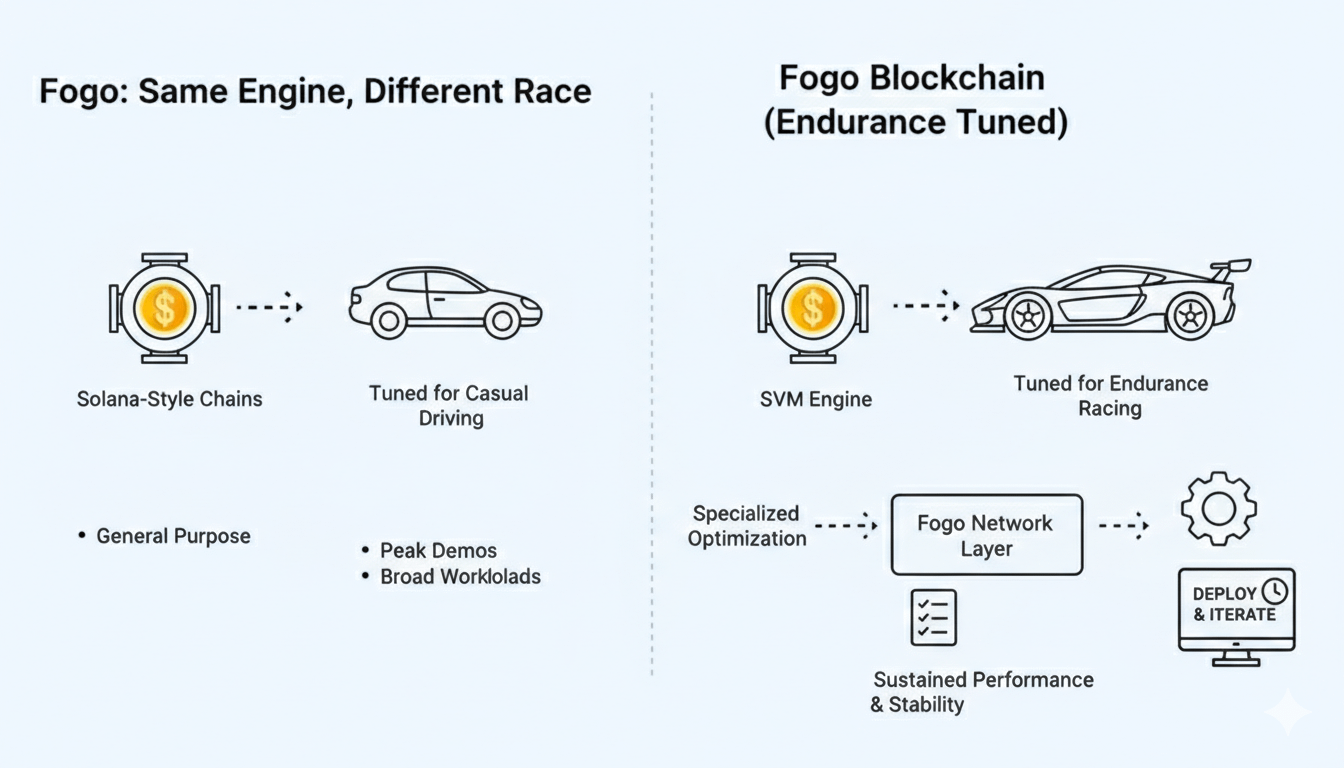
Think of it like this:
Two cars can use the same engine design.
One is tuned for casual driving.
The other is tuned for endurance racing.
The architecture might share DNA, but the purpose shapes the result.
Fogo appears to be tuning the SVM model for endurance.
Built for a Machine-First Era
We are moving into a world where on-chain interactions will increasingly be automated.
AI agents are no longer experimental toys. They are evolving into systems capable of:
• Executing trades
• Managing liquidity
• Interacting across DeFi protocols
• Triggering smart contract actions based on data feeds
• Running continuously without human supervision
When thousands of autonomous agents operate simultaneously, transaction volume does not grow linearly.
It compounds.
A chain built only for retail human usage patterns may perform adequately today.
But the next wave of demand will not come from manual wallet clicks.
It will come from code.
And code does not hesitate.
Parallel execution, efficient state management, and network-level optimization become essential in that context.
Fogo’s architecture suggests anticipation of that shift.
The Reality Test: Continuous Pressure
Many blockchains look impressive because they have not yet been tested continuously.
Short bursts of activity are manageable.
Sustained load is different.
Imagine a network where activity never meaningfully drops:
• Markets always active
• Bots always scanning
• Data always updating
• Games always running
• Services always communicating
In that scenario, the system’s ability to maintain throughput without dramatic fee spikes becomes critical.
Performance is no longer about peak numbers.
It is about consistency.
It is about resilience.
It is about surviving machine-level demand without degrading into chaos.
Fogo’s positioning suggests it is preparing for that stress environment, not just promotional benchmarks.
Aligning With an Ecosystem Instead of Fighting It
Another subtle but powerful strategic move is ecosystem alignment.
Solana already has:
• A mature developer base
• Established tooling
• High performance expectations
• A culture focused on execution efficiency
By aligning with the SVM ecosystem, Fogo does not isolate itself. It integrates into an existing performance narrative.
It respects what already works.
That reduces fragmentation.
Developers can experiment without abandoning familiar paradigms. Builders can leverage accumulated knowledge rather than starting from zero.
In crypto, fragmentation is expensive.
Every isolated ecosystem splits liquidity, talent, and tooling.
Fogo appears to be building bridges rather than walls.
Differentiation Through Focus
In a market obsessed with novelty, focus can be more powerful than invention.
Fogo does not position itself as the most experimental.
It positions itself as the most performance-committed.
The differentiation lies in:
• Network-level optimization
• Sustained throughput design
• Machine-driven workload readiness
• Leveraging parallel execution at scale
• Specializing rather than generalizing
It is a quieter strategy.
But quiet strategies often last longer.
Not Loud — Just Fast When It Counts
Marketing noise dominates crypto cycles.
Chains compete for trending status.
Communities compete for engagement.
Announcements compete for attention.
Fogo’s narrative feels different.
It is not shouting about infinite scalability.
It is not promising to replace everything.
It is emphasizing readiness.
Readiness for real demand.
Readiness for machine-scale usage.
Readiness for the moment when performance stops being theoretical.
In infrastructure, loudness is temporary.
Stability is permanent.
If the next phase of blockchain growth is driven by AI agents, automated services, real-time data systems, and non-stop interaction between protocols, then the chains that survive will not necessarily be the most innovative on paper.
They will be the ones that remain functional under pressure.
Parallel execution is not a marketing gimmick.
It is a structural advantage.
Optimization is not flashy.
It is foundational.
Fogo’s strategy appears rooted in a simple belief:
When demand arrives, speed must still exist.
Not just in benchmarks.
Not just in ideal scenarios.
But in reality.
That is a harder goal.
And perhaps a more meaningful one.
Fogo is not here to be loud.
It is here to be fast when it matters.