

Everyone in Web3 talks about speed.
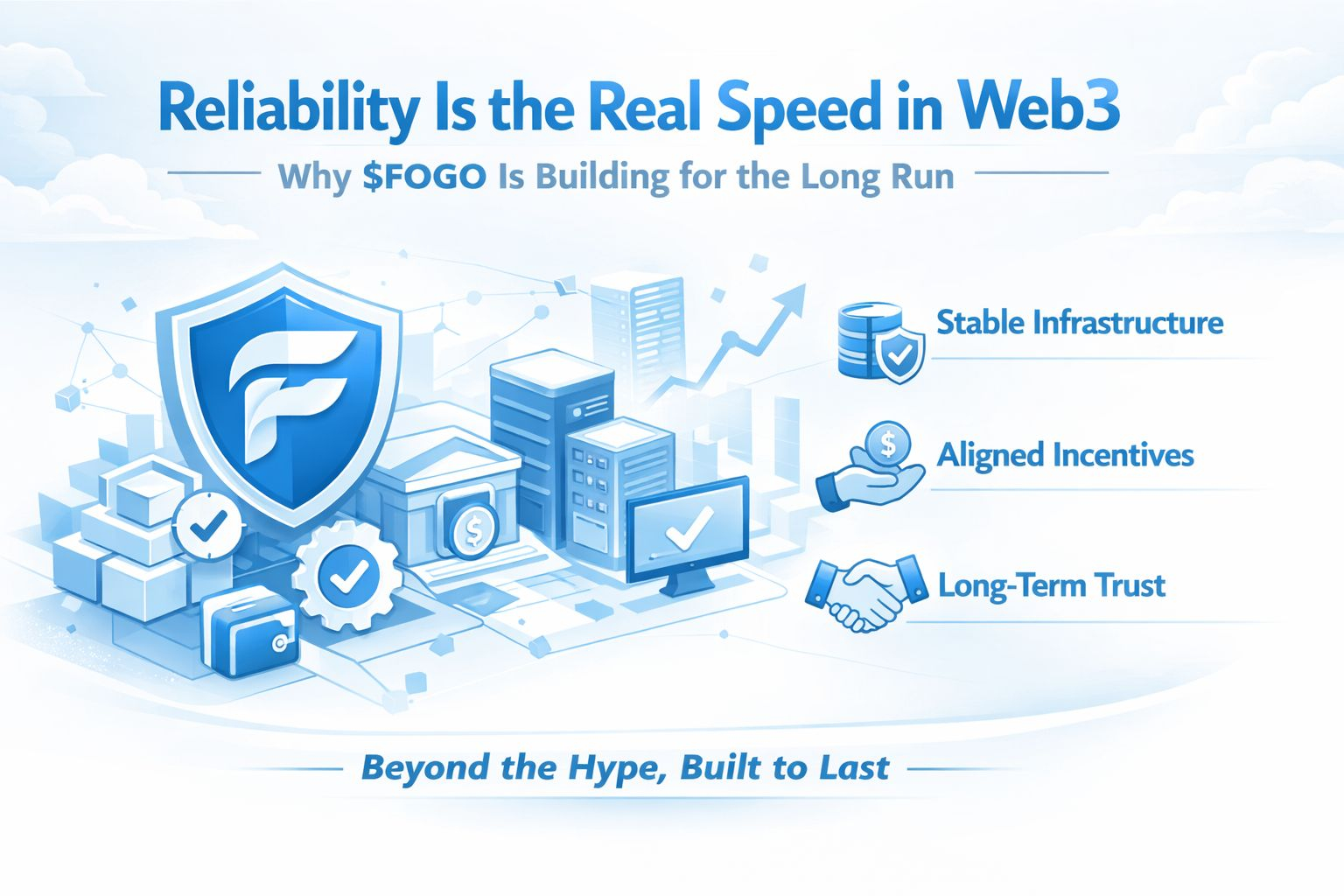 Faster blocks. Higher TPS. Lower latency. It sounds powerful. It sounds competitive. It sounds like progress.
But here’s a simple question we don’t ask enough: what good is speed if the system breaks when people actually use it?
Reliability is the real speed in Web3. And that mindset changes everything.
When we look at the systems we trust in everyday life — banks, payment networks, cloud providers — they are not impressive because they are flashy. They are trusted because they work. On busy days. During market stress. When millions of people log in at the same time.
They don’t just perform well in perfect conditions. They perform under pressure.
That’s the difference between technical speed and real speed.
In crypto, many networks optimize for performance metrics. They compete over transaction throughput and block times. But when usage spikes, cracks often appear. Congestion increases. Fees become unpredictable. Validators struggle. Transactions fail. Developers pause deployments. Users lose confidence.
A chain can be extremely fast in theory. But if it cannot stay stable when demand rises, that speed does not create adoption.
Real adoption requires reliability.
Reliability means something simple. The network works when people need it most. Transactions go through. Fees stay reasonable. Infrastructure remains consistent. Builders can plan without fearing sudden breakdowns.
It is not glamorous work. It does not generate daily headlines. But it builds something much stronger than hype: trust.
This is where $FOGO positions itself differently.
Instead of chasing temporary performance narratives, Fogo is built around steady, scalable infrastructure. The focus is not just on how fast the network can move, but how well it can endure.
Scalability is not about extreme numbers for marketing slides. It is about preparing for growth before it arrives. It means designing systems that can handle increasing users, applications, and transaction loads without collapsing under stress.
Because growth in Web3 is rarely smooth. It comes in waves. A new game launches. A new DeFi protocol trends. A market rally begins. Traffic surges quickly.
If the foundation is weak, everything feels unstable.
If the foundation is strong, growth feels natural.
$FOGO also reflects another important principle: aligned incentives. A token should not exist only for speculation. It should play a role inside the network itself.
When incentives are aligned, participants benefit from strengthening the ecosystem rather than extracting from it. Validators are rewarded for securing the chain. Builders are supported in deploying applications. Long-term holders are encouraged to contribute to stability rather than chase short-term volatility.
Incentives shape behavior.
If a system rewards only fast exits, the ecosystem becomes fragile. If it rewards participation, staking, governance, and long-term commitment, the culture shifts. Stability improves. Confidence grows.
This is how infrastructure matures.
Think about the early internet. Many platforms promised revolutionary speed and innovation. But over time, the systems that survived were not just the fastest. They were the most dependable. Developers built on them because they could trust them. Businesses integrated them because they were consistent.
Infrastructure wins quietly before it wins loudly.
Web3 is going through the same evolution.
If decentralized networks want to support gaming economies, AI applications, digital identities, and serious financial systems, they cannot rely on short bursts of performance. They need predictable execution.
A gaming platform cannot freeze during peak tournaments. A financial tool cannot fail during volatility. An AI system cannot depend on unstable processing.
Reliability becomes the hidden backbone of everything.
$FOGO’s approach reflects a long-term view. Instead of asking, “How do we trend this month?” the better question becomes, “Will this still work in five years?”
That mindset changes priorities.
It shifts focus from short-term hype cycles to durable architecture. It encourages thoughtful scaling rather than rushed expansion. It builds systems meant to last beyond one market cycle.
Of course, no blockchain is perfect. Every network faces technical upgrades, governance decisions, and external market pressures. But philosophy matters. If the core priority is stability and aligned incentives, decisions naturally lean toward sustainability.
Over time, that compounds.
Communities grow stronger when they trust the infrastructure. Developers commit deeper when they believe the system will support their work. Users stay when their experience remains consistent.
That is how ecosystems mature.
In crypto, speed gets attention. Big numbers spread fast on social media. But reliability earns adoption. It earns integration. It earns long-term value.
Fogo represents that quieter approach. Not the loudest promise. Not the most exaggerated claim. But a steady commitment to scalable design, aligned incentives, and infrastructure that can handle real-world demand.
And maybe the lesson is simple.
True speed is not about how fast you can sprint when conditions are perfect.
True speed is about how smoothly you can move forward, even when the pressure increases.
Because in the end, Web3 will not be defined by the chains that were briefly the fastest.
It will be defined by the ones that kept working when it mattered most.
#Fogo #fogo #TradeCryptosOnX #MarketRebound #LearnWithFatima $FOGO @Fogo Official