
Bitcoin is once again moving with strong price swings — sharp rises followed by sudden drops. Many investors are comparing the current behavior with the volatility seen in 2022. While the pattern may look similar on charts, the reasons behind today’s movement are a mix of market psychology, global economics, and trading structure.@BTC
Let’s understand what’s really happening.
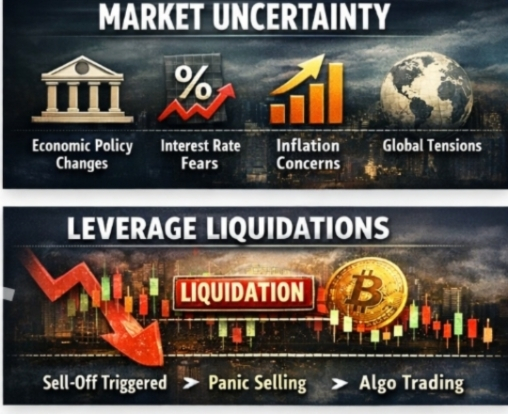
Market Uncertainty Is Driving Fast Reactions
Whenever financial markets face uncertainty, risk-based assets move more aggressively. Bitcoin is considered a high-volatility asset, so traders react quickly to:
Economic policy changes
Interest rate expectations
Inflation concerns
Global political tensions
When uncertainty rises, investors reduce risk. When confidence returns, they buy again. This push and pull creates repeated ups and downs.
Large Traders and Funds Create Bigger Swings
Compared to earlier years, bigger players now participate in crypto markets. Large buy or sell orders from funds and whales can move price quickly. When one side becomes too crowded:
Heavy buying pushes price up fast
Profit-taking triggers sudden drops
Stop-loss orders accelerate the fall
This chain reaction makes movements look dramatic — similar to past volatile periods.
Leverage Trading Increases Volatility
Many traders use leverage (borrowed money) to trade Bitcoin. Leverage magnifies both gains and losses. When price moves against leveraged traders:
Positions get liquidated automatically
Forced selling hits the market
Price drops faster than expected
Then bargain buyers step in — causing a sharp bounce. This creates the familiar “roller-coaster” pattern.
Technical Levels Are Being Tested Repeatedly
Bitcoin traders closely watch support and resistance levels. When price approaches these zones:
Breakouts trigger buying momentum
Breakdowns trigger panic selling
Bots and algorithmic systems add more trades
Because so many traders follow the same levels, reactions become stronger and faster.
Investor Psychology Is Repeating Old Patterns
Even though the market structure evolves, human behavior stays similar. Fear and greed still dominate short-term trading:
Fast rallies create FOMO (fear of missing out)
Quick drops create panic
Social media amplifies emotions
Short-term narratives change daily
This emotional cycle is one of the biggest reasons volatility feels like earlier crash years.
Is This Exactly Like 2022?
It looks similar — but it’s not identical.
In 2022, major declines were heavily linked to systemic failures, over-leveraged companies, and market shocks. Today’s swings are more connected to macroeconomics, trading structure, and fast capital rotation. The market is more mature now, but still highly reactive.
Final Thoughts
Bitcoin’s sharp ups and downs are not #BTC☀ unusual — they are part of how this market behaves, especially during uncertain economic periods. Volatility does not automatically mean collapse; often it reflects disagreement between buyers and sellers about fair value.
For investors and traders, the key is not to be surprised by volatility — but to plan for it.