
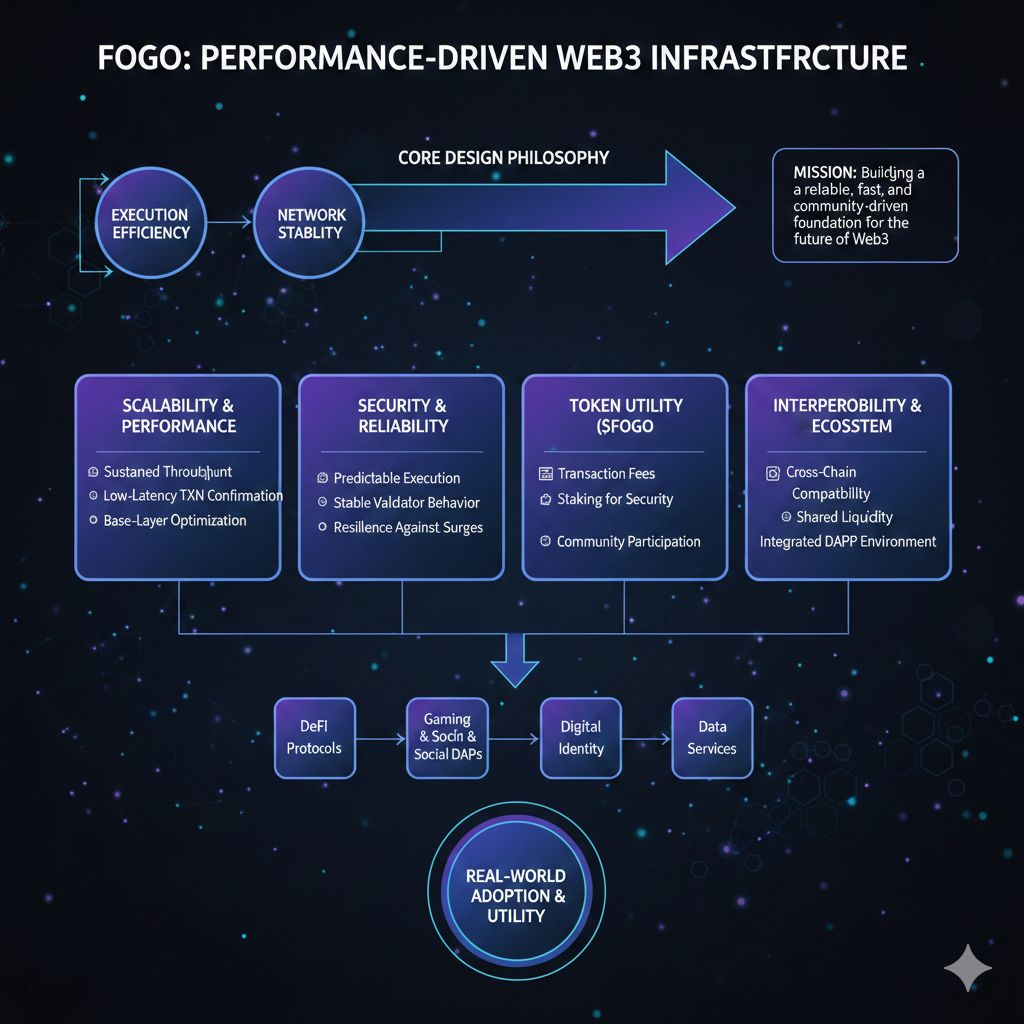
 Fogo is positioning itself as a modern blockchain infrastructure project built for today’s performance-driven Web3 environment. As the industry moves beyond experimentation and toward real usage, networks are now judged by how well they can handle speed, reliability, and cost efficiency at scale. Fogo’s design philosophy reflects this shift by focusing on execution efficiency and network stability, two qualities that are increasingly critical for decentralized applications serving real users.
In the current blockchain landscape, congestion and unpredictable fees remain major obstacles. Users expect instant confirmations and smooth interaction, especially in DeFi, gaming, and digital asset platforms. Fogo is built with the assumption that blockchains must behave more like high-performance systems rather than slow settlement layers. By optimizing transaction handling and block production, Fogo aims to deliver consistent performance even when activity increases, helping avoid the spikes and slowdowns that damage user trust.
Scalability is no longer just about theoretical throughput. It is about sustaining performance over time while maintaining decentralization and security. Fogo’s architecture emphasizes balanced scaling at the base layer instead of relying entirely on external solutions. This approach allows applications to grow naturally without forcing users into fragmented environments or complicated bridges. For developers, this means they can design products knowing the network itself is prepared for growth rather than struggling under it.
Security remains a foundational requirement for infrastructure projects, especially those supporting financial and data-driven applications. Fogo focuses on predictable execution and stable validator behavior, reducing risks associated with sudden traffic surges. In modern markets, even short periods of instability can lead to loss of capital or trust. A chain that prioritizes operational consistency becomes more attractive not only to retail users but also to institutions and long-term builders.
The Fogo ecosystem is structured to support a wide range of use cases. DeFi protocols require fast execution and low latency to remain competitive with centralized platforms. Gaming and social applications need high throughput to support continuous user interaction. Digital identity and data systems need reliability and cost control. Fogo’s design aims to serve all these sectors by providing a base layer that does not sacrifice user experience for decentralization or vice versa.
Token utility is a central element of how the Fogo network functions. The $FOGO token is not only a medium of exchange for transaction fees but also a core part of network security and participation. Through staking mechanisms, holders can contribute to validator operations and network stability. This ties the economic value of $FOGO directly to the health and activity of the network. When usage increases, token demand is naturally reinforced by utility rather than speculation alone.
Staking also encourages community involvement. By giving participants a role in securing the network, Fogo supports a decentralized structure where power is not concentrated in a small group. Over time, this strengthens resilience and ensures that decision-making reflects the interests of a broader user base. This model aligns with the current industry trend toward community-driven infrastructure rather than corporate-controlled systems.
Interoperability is increasingly important as the blockchain ecosystem expands into multiple specialized networks. Fogo is designed with compatibility in mind, allowing developers to connect their applications to external services and chains. This enables cross-chain asset movement, shared liquidity, and hybrid applications that combine on-chain logic with off-chain data. In a multi-chain world, networks that remain isolated risk losing relevance, while those that integrate effectively gain long-term utility.
From a developer standpoint, Fogo aims to lower barriers to entry by offering an environment that is predictable and efficient. Stable execution, consistent fees, and clear network behavior reduce uncertainty when deploying applications. This predictability is crucial for teams building long-term products rather than short-term experiments. As more developers choose reliable infrastructure, ecosystems naturally expand through network effects.
In today’s market, blockchain adoption is no longer driven solely by novelty. It is driven by usability and economic logic. Users stay where systems work smoothly, and developers stay where infrastructure supports growth. Fogo’s emphasis on performance and stability reflects these modern requirements. Instead of competing only on branding, the project competes on functional value, which is becoming the main differentiator among Layer 1 networks.
The long-term role of Fogo can be understood as a foundational execution layer for digital economies. Whether it supports decentralized trading platforms, immersive virtual environments, or data-driven services, its purpose is to provide a reliable and fast environment for computation and settlement. By preparing for high-activity use cases from the beginning, Fogo positions itself for relevance as blockchain usage increases globally.
Community participation is another pillar of the project’s growth. Through staking, governance, and ecosystem incentives, users are encouraged to become stakeholders rather than passive observers. This strengthens loyalty and fosters organic development. A strong community not only promotes the network but also contributes to innovation through applications, tools, and integrations.
As the Web3 industry matures, infrastructure projects are expected to deliver tangible performance improvements rather than promises alone. Networks that fail to adapt to real usage demands will gradually lose attention. Fogo’s strategy reflects an understanding of this shift. By prioritizing execution speed, network consistency, and utility-driven token economics, it aligns with what modern blockchain users and builders actually need.
In conclusion, Fogo represents a performance-oriented blockchain project designed for current and future Web3 applications. Its focus on scalable execution, predictable behavior, and functional token utility makes it suitable for real-world deployment rather than experimental use only. The $FOGO token connects network growth with economic incentives, while the broader ecosystem strategy supports sustainable expansion.
Follow @fogo, track $FOGO , and explore how #fogo is building blockchain infrastructure for a performance-driven Web3 era.@Fogo Official #fogo