

Speed is loud.
Noise is easy to measure.
Infrastructure is harder to live without.
Peak numbers impress.
Consistency pays the bills.
When I look at any Layer 1 as an operator, I start with the boring questions. Can I set up a wallet without friction? Can I submit transactions repeatedly without weird edge cases?Do confirmations stay consistent late at night and during busy hours? Do fees stay predictable enough that finance teams can approve budgets and support teams can answer users without improvising?
That framing matters here because Vanar’s “intelligent” narrative only becomes meaningful if the chain behaves like disciplined infrastructure first. If reliability isn’t there, “intelligence” becomes another layer of uncertainty to babysit.
Predictability Over Peak Performance
The core thesis I keep coming back to is simple: infrastructure is measured by reliability, not noise or peak TPS.
Real businesses don’t run on best-case throughput. Brands, fintech platforms, and gaming ecosystems run on the average day, the messy day, and the day something breaks. They need cost certainty and repeatable behavior more than they need headline speed. If fees swing unpredictably, you get hidden costs: emergency buffers, awkward pricing models, constant monitoring, and the kind of internal approvals that slow shipping to a crawl.
In my own testing mindset, predictable fees and consistent confirmations are not “nice to have.” They’re the difference between an app that can offer a stable user promise and an app that needs disclaimers everywhere. If Vanar wants to feel intelligent in production, it has to feel steady first—stable network behavior, confirmations that don’t turn into a guessing game, and fee behavior that doesn’t punish normal usage patterns.
Deterministic State And Clear Execution
Determinism sounds abstract until you’ve had to reconcile it.
Ambiguity in state handling creates a tax that shows up everywhere except the marketing page. Teams build buffers because they don’t trust what will happen next. They add reconciliation jobs because results aren’t clean. They build dashboards to detect anomalies that shouldn’t exist in the first place. They staff on-call rotations for problems that are really just “the chain behaved differently this time.”
This is why deterministic handling of state and execution matters more than it gets credit for. When execution is clear, developers ship with confidence. Support teams can explain outcomes. Compliance teams can trace what happened without a week of forensic work. Finance teams can model cost. In enterprise settings, that clarity is often the difference between “approved” and “come back next quarter.”
The questions businesses ask are consistent across industries. Are fees stable enough to price products simply? Is finality predictable enough to treat confirmations as real settlement?Will regulators and compliance teams be okay with how the system stores and uses data, and how it creates audit records?
Can a normal engineering team build and release updates without being crypto experts, or do they need a blockchain specialist involved every time?
If Vanar can reduce ambiguity at the base layer, it’s not just a technical win. It’s an operational release valve.
Native Data Layers As The Foundation For “Intelligence”
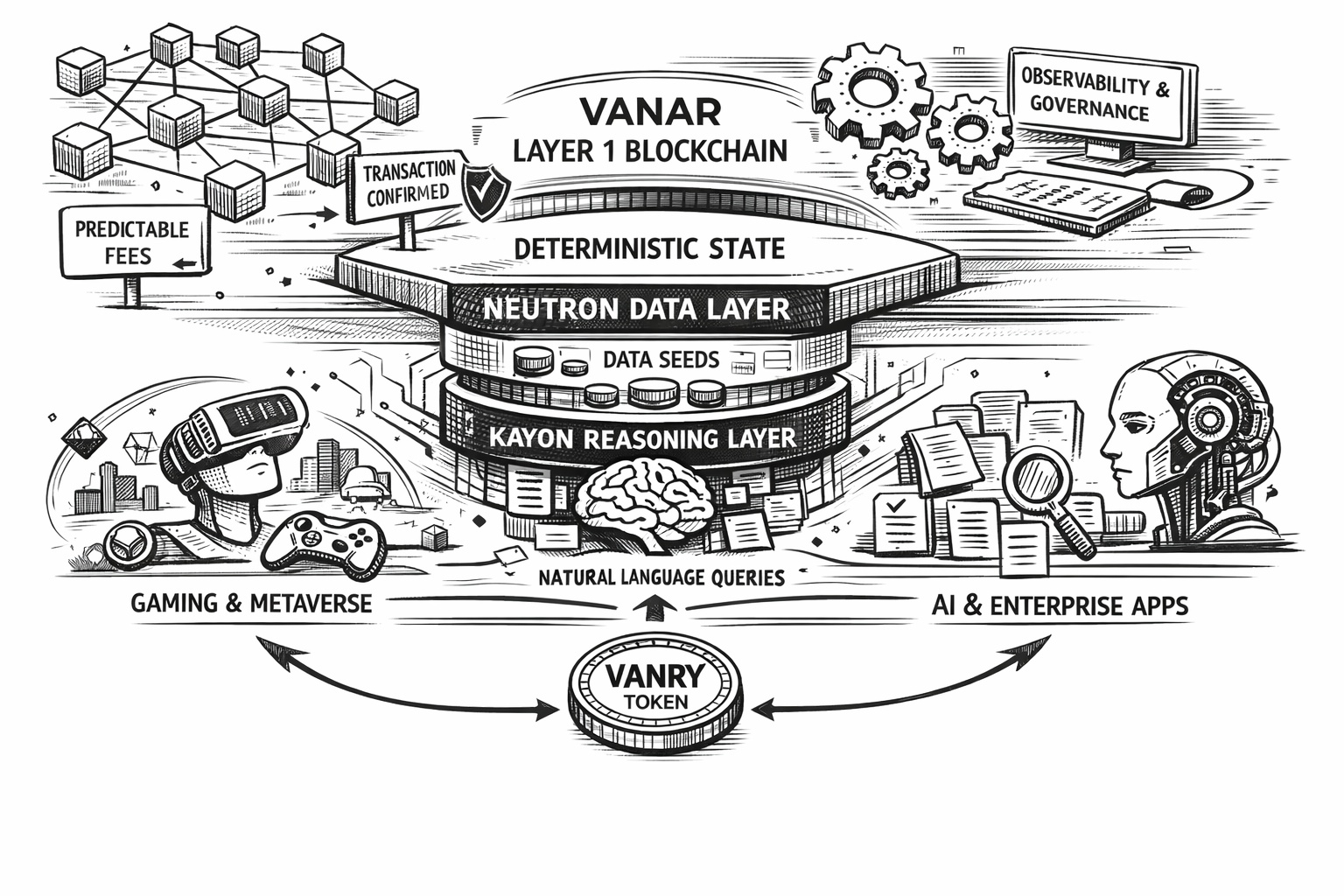
Here’s where Vanar’s stack approach becomes interesting: the “intelligent” feeling isn’t supposed to come from magical contracts. It’s supposed to come from treating data as first-class on-chain material, not as an off-chain afterthought.
Vanar positions Neutron as a data layer that compresses raw files into compact, queryable, “AI-readable” objects stored on-chain, described as “Seeds.”The idea, in plain operator language, is that the chain doesn’t just point at information—it tries to keep structured, usable versions of it close to execution.
I care about that for a practical reason: most real applications are not just balances and swaps. Gaming economies, metaverse apps, and brand-focused experiences depend on evolving state, assets, permissions, and user history. Fintech workflows depend on invoices, proofs, compliance artifacts, and settlement metadata. When those things live entirely off-chain, your app becomes a patchwork of databases, indexers, storage links, and reconciliation logic. It works—until it doesn’t. And when it doesn’t, users blame the product, not the architecture.
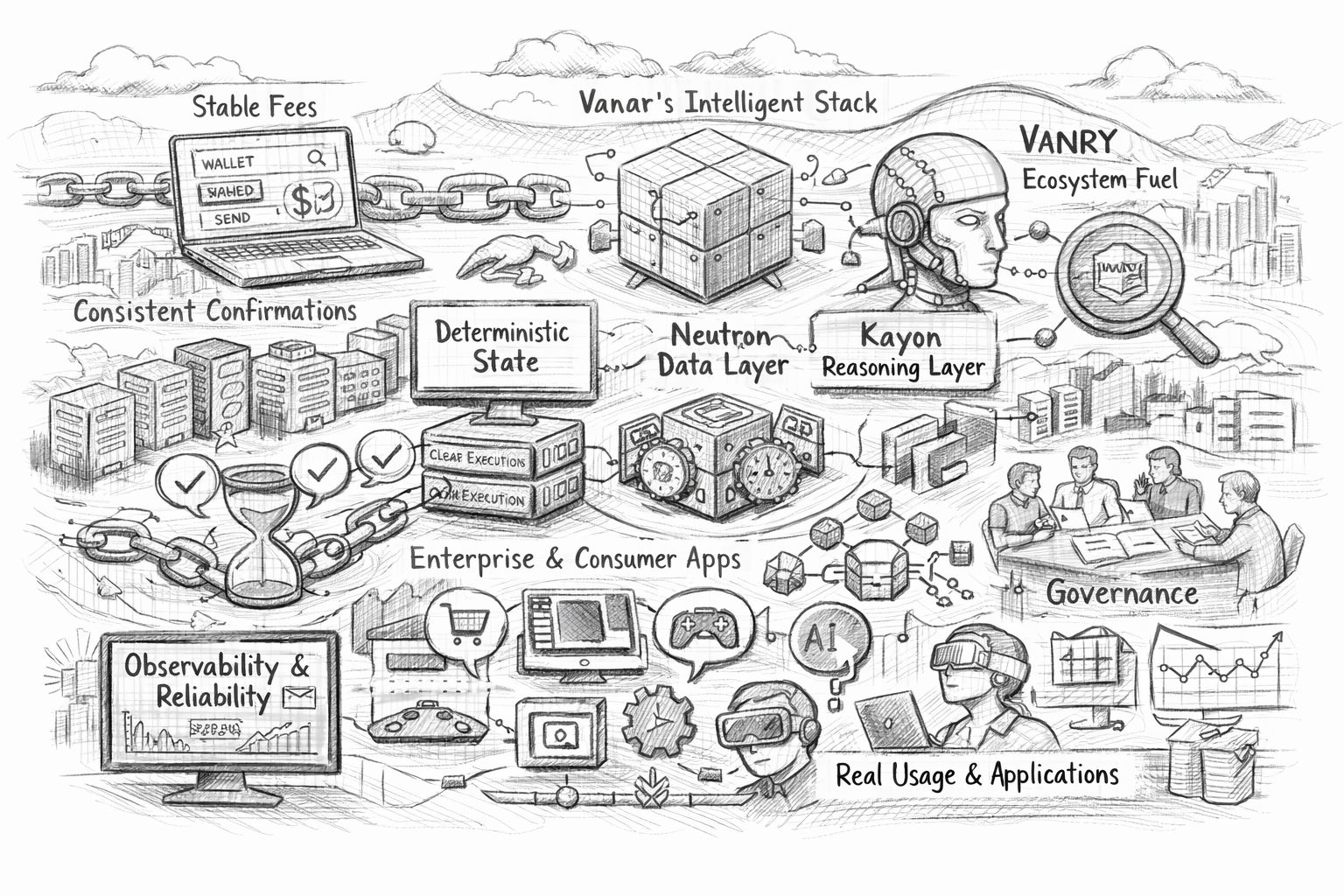
Vanar’s claim is that by making data more “active” and structurally present in the stack, you reduce the surface area where off-chain systems can drift from on-chain reality.If that’s executed well, the chain can start to feel “intelligent” in the only way that matters: fewer missing pieces, fewer brittle links, fewer silent mismatches between what the app thinks and what the ledger can prove
Making Queries Human Without Making Results Fuzzy
Vanar also describes Kayon as a reasoning layer that supports natural-language queries and contextual insights across Neutron, blockchains, and enterprise backends.I’m cautious about anything that adds interpretation on top of a system that should be deterministic. But I also understand the enterprise reality: decision-makers don’t want raw logs, and consumer teams don’t want to build custom analytics stacks for every product surface.
If Kayon works as an interface layer—making it easier to ask consistent questions of consistent data—it can reduce operational friction. The danger is obvious: if “reasoning” turns into fuzzy outputs, you’ve traded one kind of complexity for another. In production systems, “helpful” is only helpful when it’s explainable and reproducible.
So the operator test is straightforward. Can the system answer: “Why did this transaction fail?” in a way that maps to deterministic facts? Can it show compliance-relevant trails without hallucinating context? Can it support support teams and auditors with consistent outputs, not vibes?If that’s true, then “intelligence” is just a helpful layer on top of a reliable network, not something that replaces reliability.
I judge chains by how they treat upgrades. Upgrades are risk events. They are the moment when “roadmaps” collide with real user balances.
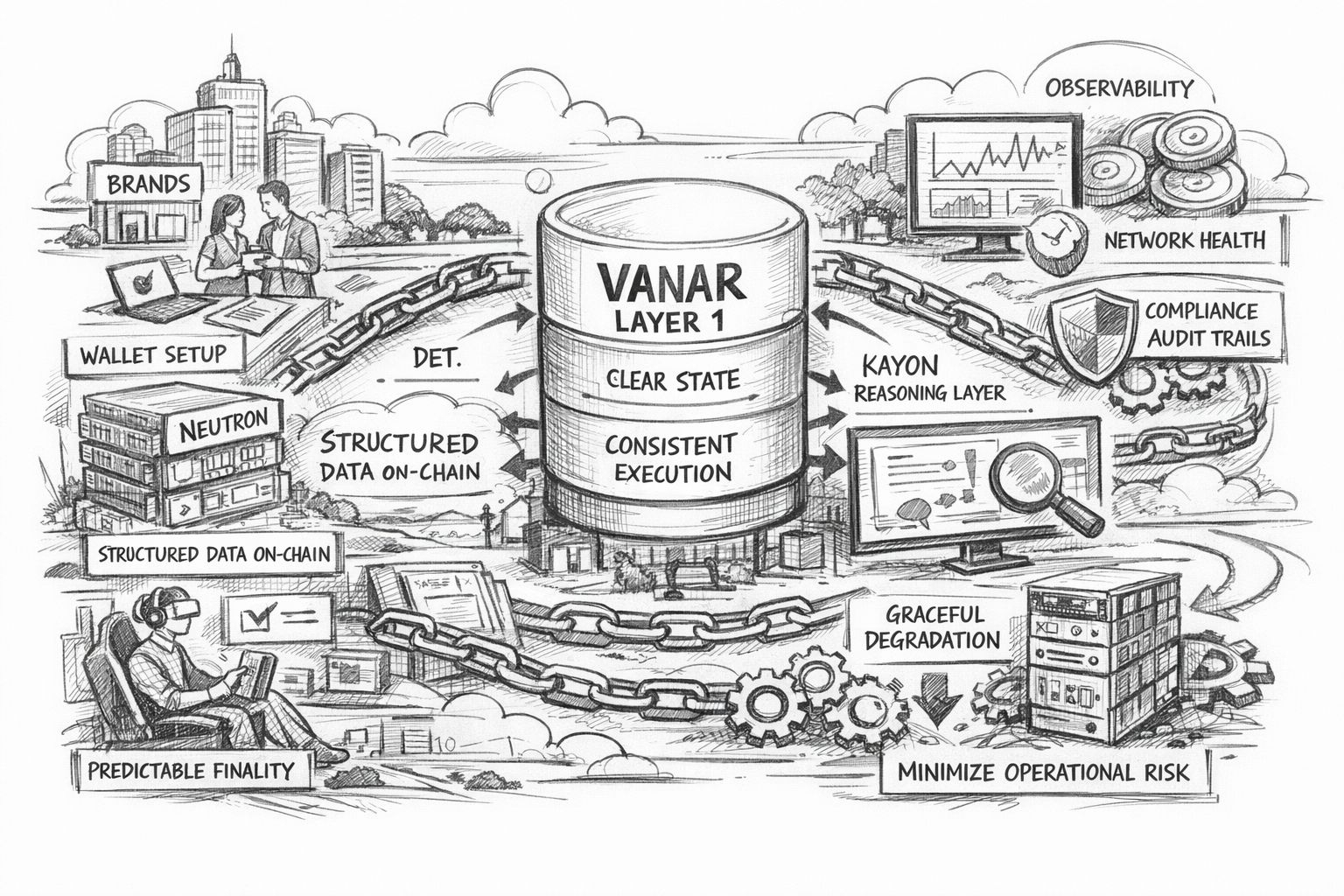
This is where observability and network health become central. In healthy infrastructure, you can see what’s happening before users feel it. You get clear signals about congestion, confirmation variance, error rates, and node health. And when stress hits, you want graceful degradation—not mystery behavior. Slower confirmations are annoying. Unpredictable execution is expensive.
Vanar’s direction—building a stack that spans execution, native data handling, and higher-level query/reasoning—only works if the operational foundation stays disciplined. Otherwise, every added layer becomes another place where incidents can hide.
For enterprise and consumer applications, that discipline is the product. Brands want experiences that don’t embarrass them. Fintech platforms want risk they can quantify. Gaming ecosystems want economies that don’t glitch under load. Metaverse apps and AI integrations want state continuity without constantly reconstructing context from scattered systems.
Where VANRY Fits In A Non-Speculative Way
I also watch how a network frames its token, because it reveals whether the system expects to be used or merely traded.
VANRY is positioned as ecosystem fuel tied to usage, participation, and governance—not just speculation. In practical terms, the token story only matters if the network’s day-to-day behavior supports real application loops: predictable costs, consistent confirmations, stable network behavior, and a developer surface that teams can ship on without building a parallel reliability layer off-chain.
If Vanar’s stack actually reduces operational overhead—fewer brittle integrations, fewer reconciliation systems, fewer “why did this change” incidents—then usage can become the anchor, and governance can be about steering a system people depend on, not debating abstractions.
A Cautious Closing
I’m not treating any of this as guaranteed.
It’s still early, and adoption is never automatic. Building native data layers that are genuinely useful is hard. Building reasoning interfaces that stay explainable is even harder. And markets don’t reward good infrastructure on a clean schedule.
But I take the direction seriously because it targets real inefficiencies I see repeatedly: cost volatility that breaks pricing, ambiguous state handling that forces expensive buffers, and operational instability that turns every product launch into an incident waiting to happen. If Vanar can keep its base reliable while making data more native and more usable, then “intelligent” won’t mean flashy.It means fewer surprises, less fragile “glue” code, and fewer hours spent turning messy problems into clear answers.
In the end, good infrastructure stays in the background and doesn’t demand your attention.
.