
The blockchain space has entered a phase where bold promises are no longer enough. Speed claims and large transaction numbers might capture attention for a moment, but long term survival depends on something deeper. Stability under stress. Predictable behavior during chaos. Confidence when demand rises unexpectedly. This is the lens through which Fogo can be understood. It is not presenting itself as noise in a crowded market. It is positioning itself as infrastructure built with pressure in mind.
Many new Layer 1 networks begin with a clean slate. At first, that sounds exciting. Total freedom. Fresh design. Unlimited possibilities. But that freedom also comes with risk. Developers must learn unfamiliar execution rules. Performance behavior is uncertain. The smallest design mistake can echo through the entire system once real usage begins. It often takes a long time before the network feels mature enough to handle serious demand.
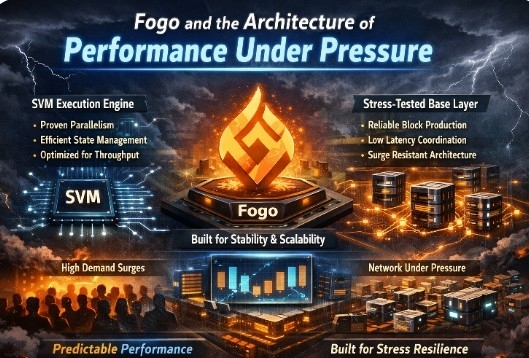
Fogo approaches this challenge differently. Instead of inventing a completely new execution environment, it builds around the Solana Virtual Machine model. SVM is not just a technical label. It is a structure that shapes how programs are written and how transactions are processed. It encourages parallel execution. It rewards thoughtful state management. It reduces the chances of unnecessary contention between operations. Over time, this kind of runtime influences developer habits and architectural discipline.
The real value of choosing SVM is not about repeating a headline performance number. It is about starting from a position that already understands high throughput design. Developers who are familiar with this execution style already think in terms of concurrency. They design systems that separate data carefully. They avoid patterns that create bottlenecks. This means the chain does not need to spend years teaching basic performance lessons to its builders.
However, execution is only one layer of a blockchain. The deeper identity of a network is shaped by its base layer decisions. These decisions determine how blocks are produced, how validators coordinate, how latency behaves, and how transactions are prioritized when demand becomes intense. In calm conditions, almost any modern network can look efficient. The real test comes when activity surges.
Imagine a sudden wave of activity. Thousands of users interacting at once. Complex transactions flowing through the system. This is where architecture either proves itself or reveals hidden weaknesses. If the base layer is not designed for stress, latency becomes unpredictable. Transaction inclusion becomes inconsistent. User experience suffers. Trust weakens.
Fogo appears to recognize that these moments define reputation. Instead of focusing only on peak benchmarks, it places emphasis on structural resilience. How does the network behave when traffic multiplies. Does performance remain steady. Does confirmation time stay consistent. Does the system degrade gracefully instead of collapsing. These are the questions that matter for long term credibility.
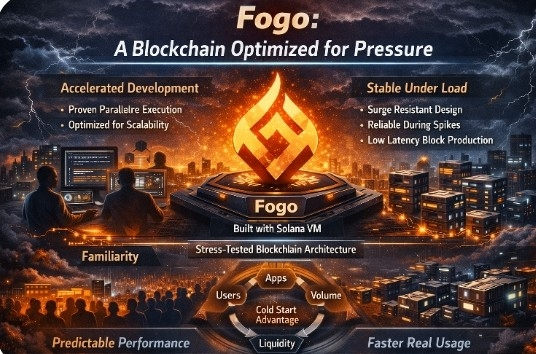
Another silent challenge for new networks is the early phase of adoption. Even if technology is strong, progress can feel slow. Developers hesitate to deploy serious projects without confidence in the environment. This hesitation can delay meaningful usage. By using an execution model that already promotes performance discipline, Fogo reduces some of that hesitation. The learning curve becomes smoother. The design philosophy feels familiar. Builders can focus more on creating value and less on understanding basic runtime behavior.
It is important to understand that familiarity does not equal imitation. Two networks can share an execution model yet differ greatly in how their base layers are structured. The execution layer defines how programs run. The base layer defines how the chain lives and breathes under pressure. Fogo’s differentiation lies in how these foundational choices are arranged to prioritize predictability and stability.
Performance without reliability is fragile. High speed without consistency creates doubt. In financial systems and data driven applications, predictability is often more valuable than extreme peak numbers. Users want to know that when they submit a transaction during heavy demand, it will behave as expected. Developers want to know that their applications will not break when traffic increases.
Fogo’s architecture suggests a focus on controlled scalability rather than chaotic expansion. Stress testing is not an afterthought. It becomes part of the design philosophy. Every structural decision influences how the network handles spikes. Every optimization must be evaluated not only for speed but also for stability.
From a broader perspective, this approach reflects maturity. The blockchain industry has seen enough cycles to understand that hype fades quickly. What remains is infrastructure that consistently performs. By combining a performance oriented execution engine with carefully considered base layer choices, Fogo positions itself as a network that values endurance over noise.
In simple terms, Fogo is not trying to shout the loudest. It is trying to stand firm when pressure rises. The real measure of any Layer 1 is not how impressive it looks in ideal conditions. It is how dependable it remains when demand becomes unpredictable and intense.
In my opinion, this stress first philosophy could define the next phase of blockchain evolution. Users and builders are becoming more selective. They look beyond marketing and examine architecture. If Fogo continues to prioritize resilience, predictability, and disciplined performance, it may build trust slowly but steadily. In a world where volatility is normal, will the networks built for stress become the ones that truly last?