

The dominant narrative in blockchain gaming still revolves around throughput. How many transactions per second? How fast is block finality? How close to real time can it get? The assumption is simple: higher TPS equals better infrastructure.
In operational reality, that assumption rarely survives contact with production systems. Games do not collapse because a chain failed to hit a benchmark. They collapse because transactions behave unpredictably under load, because fees spike without warning, because nodes desynchronize, because upgrades introduce breaking changes at the wrong time. In other words, they fail because infrastructure was treated like a marketing surface instead of a reliability system.
If you treat a gaming Layer 1 as critical infrastructure, the priorities shift immediately. The question is no longer How fast can it go? It becomes How does it behave during peak concurrency, validator churn, or a messy upgrade?
If confirmation timing becomes inconsistent during congestion, gameplay experiences degrade. Vanar’s decision to anchor around fixed, dollar denominated fee logic is less about being cheap and more about being predictable. In gaming infrastructure, predictability reduces economic noise and simplifies system design.

Consensus design follows a similar philosophy. Rather than optimizing purely for experimental decentralization models or exotic execution patterns, a more controlled validator structure prioritizes operational competence and reputation. That choice may not satisfy maximalist narratives, but it reflects a production mindset: validator quality often matters more than validator quantity in early infrastructure phases.
In aviation, airlines do not select pilots based on enthusiasm. They select for training, experience, and procedural discipline. Block production in a gaming Layer 1 is not fundamentally different. It demands consistency, coordination, and the ability to maintain liveness during network partitions or abnormal load.
Equally important is execution scope. Constraining the virtual machine environment and aligning with familiar semantics reduces ambiguity in state transitions. The fewer unexpected execution paths available, the fewer edge cases emerge during high concurrency. Distributed systems do not fail gracefully when ambiguity compounds. They fail abruptly.
Network hygiene often goes uncelebrated but determines survival. Node performance standards, peer discovery stability, latency management, resource isolation, and spam mitigation form the invisible scaffolding of any serious chain. A gaming environment amplifies stress because activity can spike unpredictably around events, launches, or in-game milestones.
Healthy infrastructure anticipates this. Rate limiting mechanisms, confirmation depth rules, and mempool management policies are not glamorous. They are preventative measures. Like fire suppression systems in data centers, they exist so that operators rarely need to talk about them.
Upgrade discipline is another overlooked axis. Crypto culture often frames upgrades as feature releases,new capabilities, bold roadmap milestones. In infrastructure, upgrades resemble surgical procedures. You simulate failure modes. You test backward compatibility. You define rollback paths before touching production.
For a gaming chain, abrupt semantic shifts are destabilizing. Wallet integrations, marketplace logic, and contract assumptions depend on execution continuity. Mature systems treat backward compatibility as a default assumption and deprecate slowly. Risk is reduced incrementally rather than reintroduced aggressively.
Trust in gaming infrastructure is not earned during bull cycles. It is earned during congestion, during validator misbehavior, during unexpected traffic bursts. Does the system degrade gracefully? Do blocks continue? Is state integrity preserved? Are operators informed clearly and promptly?
Consider online multiplayer game servers. They are judged by uptime and latency stability, not by architectural novelty. When load increases, they scale predictably. When a patch rolls out, it is staged carefully to avoid corrupting player data. Blockchain infrastructure for gaming must meet similar expectations.
All of this challenges the assumption that innovation is the primary driver of adoption. In practice, adoption follows operational confidence. Developers integrate infrastructure that behaves predictably. Studios commit to platforms that minimize unknowns.
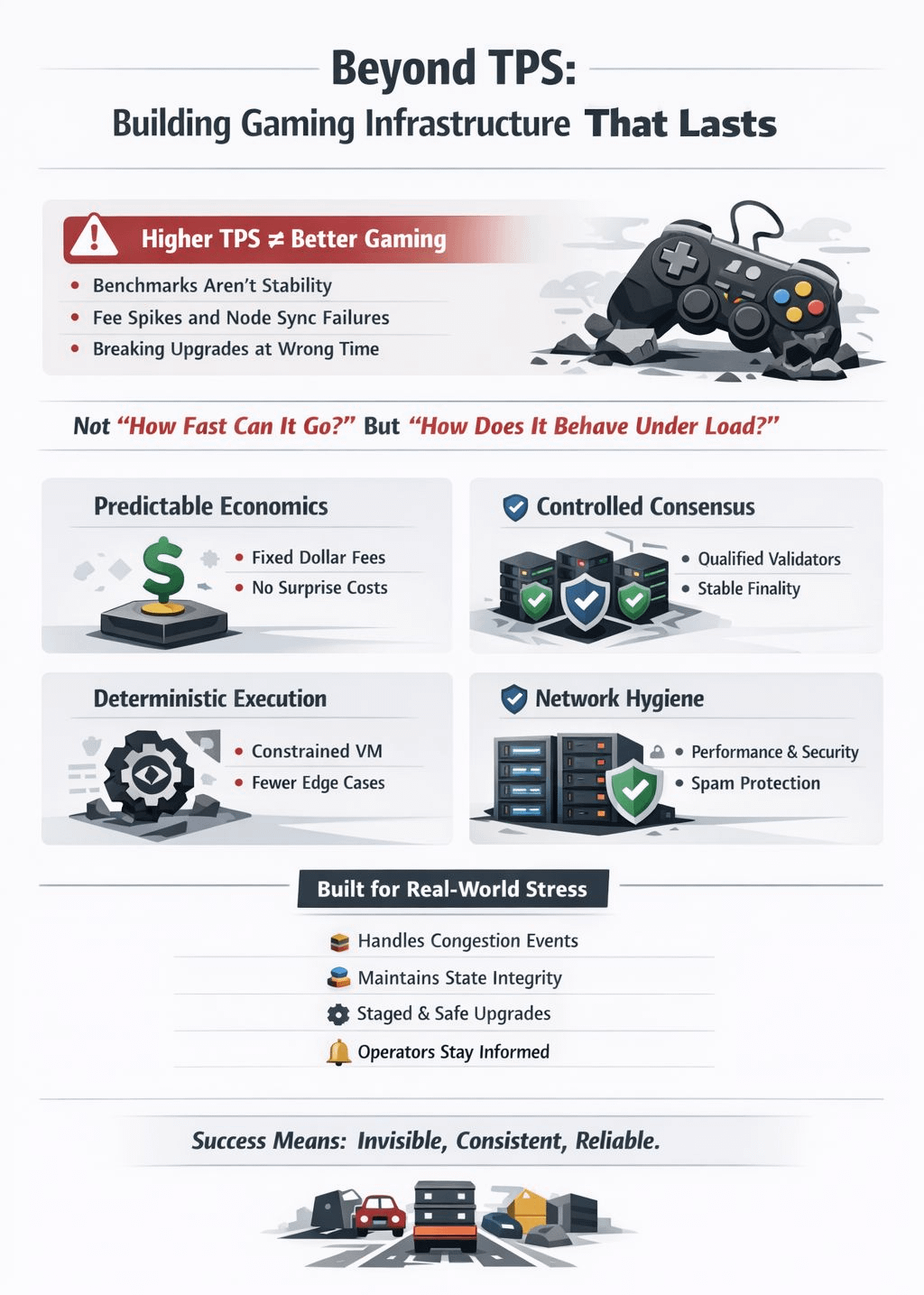
The protocol level decisions powering Vanar’s gaming ambition are therefore less about peak speed and more about variance reduction. Fixed economic assumptions. Deterministic execution. Controlled consensus participation. Conservative upgrades. They are structural commitments.
If executed correctly, success will not look dramatic. It will look like in-game transactions confirming without drama. Like validators producing blocks without incident. Like upgrades rolling out without breaking assumptions. Like congestion events bending the system but not breaking trust.
The highest compliment for infrastructure is invisibility.
When players do not think about the chain, when developers stop hedging against unpredictable behavior, when operators sleep through peak traffic events, that is when a network transitions from speculative experiment to foundational layer.
In the end, the most valuable gaming blockchain may not be the one that feels revolutionary. It may be the one that fades quietly into the background of gameplay and simply works. A system designed not to demand attention, but to sustain it. That is what serious infrastructure becomes: a confidence machine. Software that reduces variance, absorbs stress, and enables builders to focus on creating experiences rather than firefighting systems.
