
In the ever-changing world of blockchain innovation, new projects constantly attempt to improve scalability, efficiency, and real-world usability. One of the latest entrants attracting serious attention is Fogo, a next-generation Layer-1 blockchain built around high-speed execution and strong developer accessibility. Since its mainnet launch and listing on Binance, Fogo has steadily gained interest from traders, developers, and decentralized finance enthusiasts who are searching for faster and more efficient blockchain infrastructure. The project aims to deliver a network that blends institutional-grade trading performance with decentralized transparency, something that many blockchain networks have attempted but few have successfully delivered.
Fogo was designed with a clear vision in mind. The project focuses on solving one of the biggest challenges in blockchain technology: execution quality. While many blockchain networks emphasize security and decentralization, execution speed often suffers. Fogo approaches this problem differently by prioritizing low latency, high throughput, and user-friendly transaction flow. The team behind the project believes that decentralized applications must match the performance of traditional financial systems if blockchain technology is ever going to reach mass adoption.
At the heart of Fogo’s architecture is the Solana Virtual Machine, often referred to as SVM. This environment allows Fogo to execute smart contracts at extremely high speeds while maintaining compatibility with the growing ecosystem of tools originally designed for Solana developers. By building around SVM, Fogo offers developers an easy migration path, allowing them to create or port applications without rewriting large sections of code. This compatibility reduces barriers to entry and accelerates ecosystem growth, which is often a critical factor for new blockchain platforms.
One of the most impressive aspects of Fogo’s technical infrastructure is its block speed and finality. The network is engineered to process blocks in extremely short intervals, allowing transactions to confirm in milliseconds rather than seconds or minutes. This level of speed is essential for decentralized trading platforms, where timing can significantly impact profits and user experience. The architecture also supports parallel transaction processing, which allows multiple transactions to execute simultaneously instead of sequentially. This dramatically increases throughput and ensures that network congestion remains minimal even during peak demand.
Another major contributor to Fogo’s performance is its use of advanced validator infrastructure inspired by high-performance blockchain clients. This infrastructure is optimized to handle heavy workloads while maintaining network stability. The system also includes efficient data propagation and execution logic that helps validators maintain synchronization without requiring excessive computing resources. As a result, the network is designed to scale efficiently as more users and applications join the ecosystem.
Beyond raw speed, Fogo introduces a unique user interaction system often referred to as session-based transaction flow. This design allows users to interact with decentralized applications without constantly approving transactions or paying repetitive gas fees for each action. For active traders or users interacting with complex decentralized applications, this significantly improves usability. By reducing friction, Fogo aims to make blockchain applications feel as smooth as traditional online platforms, which is crucial for onboarding mainstream users.
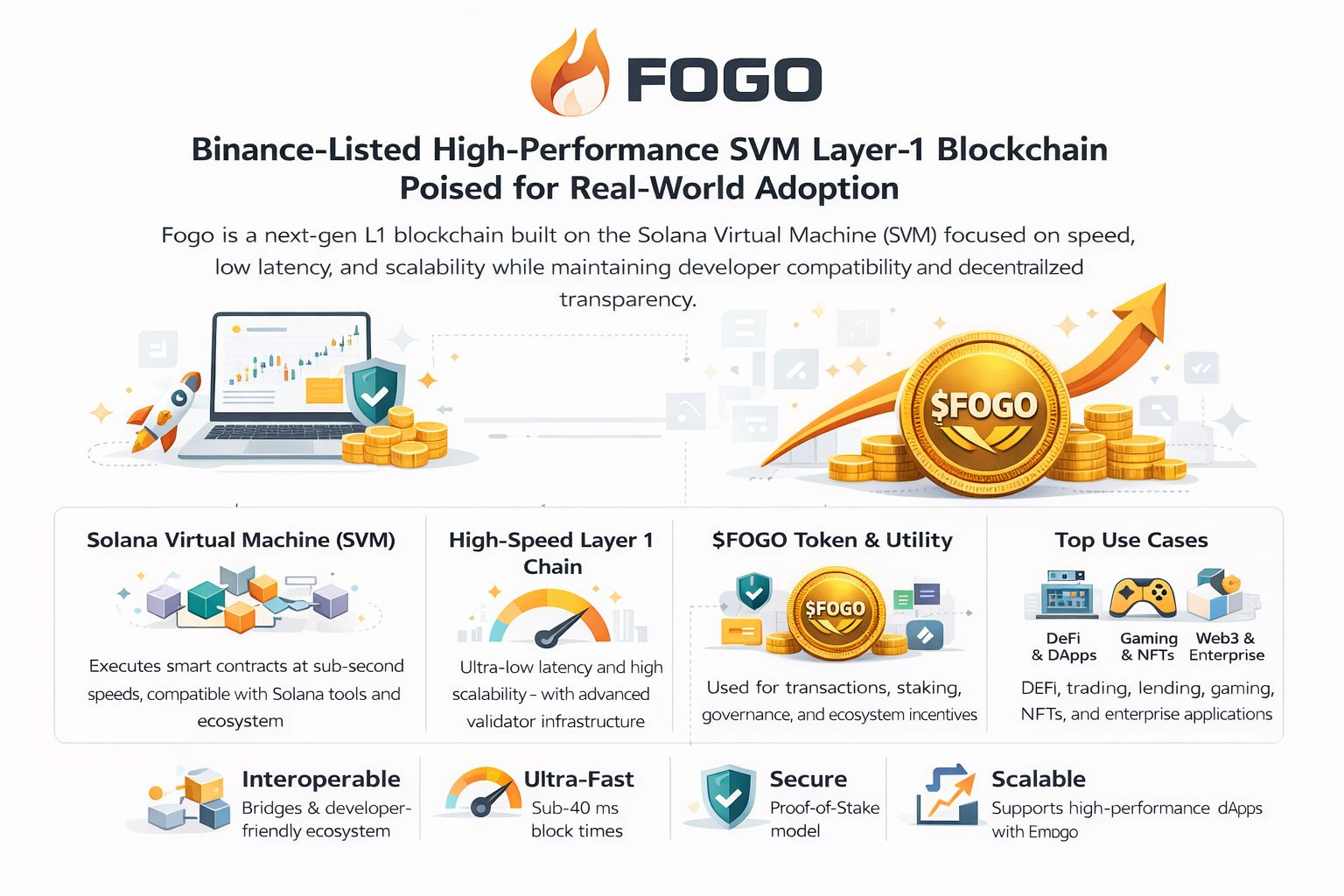
The FOGO token serves as the backbone of the network’s economic and operational structure. Like most Layer-1 blockchain tokens, it functions as the primary medium for paying transaction fees and executing smart contracts. However, the token’s utility extends far beyond basic transaction usage. It also plays a critical role in staking and network security. Validators must stake FOGO tokens to participate in transaction validation, while delegators can stake tokens with validators to earn rewards. This system ensures that participants are financially incentivized to maintain network integrity.
Governance is another essential component of the FOGO token’s functionality. Token holders are granted voting rights that allow them to influence protocol upgrades, network parameter changes, and ecosystem funding initiatives. This decentralized governance model helps ensure that the network evolves in alignment with community interests rather than being controlled by a single organization. Additionally, the token supports ecosystem incentive programs, which encourage developers to build applications and contribute to network expansion.
Fogo’s tokenomics model is structured to balance long-term sustainability with early ecosystem growth. The network has a maximum supply cap designed to prevent excessive inflation. A significant portion of tokens is allocated to community rewards, ecosystem incentives, and development funding. Team and advisor allocations are typically locked with long-term vesting schedules, ensuring that project insiders remain aligned with the network’s success over time. Liquidity allocations and early adoption programs were also implemented to support trading stability and community engagement during the early stages of the project’s growth.
The real-world applications of Fogo extend across multiple industries, although decentralized finance remains the most immediate and natural use case. The network’s high-speed transaction capabilities make it ideal for decentralized exchanges that require rapid order execution and minimal slippage. Several early projects launched on Fogo focus on trading, lending, and liquidity management, demonstrating the network’s commitment to delivering functional DeFi infrastructure rather than theoretical experimentation.
One of the most exciting possibilities enabled by Fogo’s performance is the development of real-time on-chain order books and advanced trading mechanisms. Traditional decentralized exchanges often rely on automated market makers due to network speed limitations. However, Fogo’s architecture opens the door for fully decentralized order book systems that operate at speeds comparable to centralized exchanges. This capability could transform decentralized trading by improving price discovery, reducing trading costs, and enabling professional trading strategies to operate entirely on-chain.
Fogo also shows strong potential in blockchain gaming and digital asset ecosystems. Gaming applications require rapid transaction confirmation to maintain immersive gameplay and real-time asset ownership updates. The network’s high throughput and low transaction costs make it suitable for large-scale multiplayer games, NFT marketplaces, and virtual asset economies. As gaming continues to merge with blockchain technology, platforms like Fogo may become essential infrastructure for developers seeking both performance and decentralization.
In addition to gaming and DeFi, Fogo’s infrastructure can support enterprise blockchain solutions. Businesses exploring supply chain tracking, identity verification, and digital asset management require blockchain systems capable of handling large transaction volumes without compromising reliability. Fogo’s focus on execution speed and scalability positions it as a potential candidate for enterprise-level blockchain adoption, particularly for industries that require real-time data processing.
The leadership behind Fogo brings significant experience from both traditional finance and blockchain development. The project’s founders include professionals who have previously worked in global investment institutions and high-frequency trading environments. Their background heavily influences Fogo’s technical design, particularly its emphasis on execution efficiency and financial-grade infrastructure. By combining financial market expertise with blockchain engineering knowledge, the team aims to build a network capable of supporting institutional-level trading activity within a decentralized environment.
Fogo’s development has also been supported by technical contributors with experience in distributed systems and oracle infrastructure, including contributors connected to Pyth Network. This connection strengthens Fogo’s credibility, as reliable oracle integration is essential for accurate pricing, derivatives markets, and automated financial contracts.
The project reached a major milestone when it transitioned from testnet to mainnet and debuted in the public trading market. Its listing on OKX, Bybit, Bitget, and Gate.io significantly expanded accessibility and liquidity for the token. These listings allowed traders worldwide to participate in the Fogo ecosystem and contributed to the network’s early market visibility.
Like most newly launched blockchain tokens, FOGO experienced price volatility during its early trading phase. Initial trading activity reflected strong investor interest, followed by natural price corrections as the market adjusted to supply dynamics and liquidity levels. Despite this volatility, the listing generated widespread discussion within the blockchain community, reinforcing Fogo’s position as one of the most anticipated SVM-based Layer-1 launches.
Fogo’s roadmap focuses heavily on ecosystem expansion and technological optimization. In the short term, the project aims to increase the number of decentralized applications running on its network. Developer incentive programs, hackathons, and funding initiatives are expected to play a major role in attracting new projects. The team also plans to improve developer tooling, documentation, and integration frameworks to make the platform more accessible to builders.
Long-term plans include expanding cross-chain interoperability, allowing Fogo to connect with multiple blockchain ecosystems and facilitate seamless asset transfers. Cross-chain bridges could enable liquidity from other networks to flow into Fogo’s ecosystem, strengthening its decentralized finance infrastructure. The project also aims to introduce advanced financial primitives, including derivatives platforms and institutional trading tools that require fast execution and reliable price data.
Another important focus area for Fogo’s future development is decentralization. While the network initially relies on performance-optimized validator models, the team has indicated plans to gradually expand validator participation. Achieving a balance between performance and decentralization is a challenge faced by many high-speed blockchains, and Fogo’s ability to manage this balance will likely influence its long-term credibility and adoption.
From a market perspective, Fogo’s success will depend heavily on developer adoption, ecosystem activity, and sustained network usage. Blockchain platforms often experience initial hype followed by periods of consolidation as real-world applications determine long-term value. Fogo’s strong technical foundation provides a promising starting point, but its ability to attract high-quality projects and maintain consistent transaction volume will ultimately determine its position within the Layer-1 competition.
The broader blockchain industry continues to evolve rapidly, with increasing demand for networks capable of supporting complex decentralized applications. As decentralized finance, digital identity systems, and blockchain gaming expand, the need for fast and reliable infrastructure becomes increasingly important. Fogo’s emphasis on performance and usability positions it as a potential infrastructure layer for next-generation Web3 applications.
Fogo also benefits from its compatibility with established developer ecosystems, which reduces onboarding friction and accelerates network growth. This compatibility allows developers to focus on building innovative applications rather than adapting to unfamiliar technical frameworks. The easier it becomes for developers to deploy applications on Fogo, the more likely the ecosystem is to expand organically.
Another factor supporting Fogo’s long-term potential is its focus on user experience. Many blockchain platforms struggle with complex wallet interactions, slow confirmations, and unpredictable transaction costs. By introducing streamlined transaction sessions and efficient execution models, Fogo aims to create a user experience comparable to traditional digital platforms. If successful, this approach could significantly improve mainstream adoption of decentralized applications.
As blockchain technology moves toward real-world integration, performance and scalability will remain critical challenges. Fogo represents a bold attempt to address these challenges through high-speed infrastructure, developer accessibility, and institutional-grade execution models. While it is still early in the project’s lifecycle, its technical design and leadership background suggest strong potential for future growth.
In conclusion, Fogo stands out as a high-performance Layer-1 blockchain designed to replicate the efficiency of centralized financial systems while maintaining the transparency and security of decentralization. Its integration of Solana Virtual Machine technology, advanced validator infrastructure, and streamlined user interaction models demonstrates a forward-thinking approach to blockchain development. The FOGO token supports network operations, governance, and ecosystem incentives, creating a comprehensive economic structure that encourages long-term participation.
With growing exchange support, an expanding developer ecosystem, and a roadmap focused on innovation and interoperability, Fogo has positioned itself as a promising contender in the competitive Layer-1 blockchain landscape. If the project continues to deliver technical improvements, attract high-quality applications, and maintain strong community engagement, it could play a significant role in shaping the future of decentralized finance and Web3 infrastructure.