

I keep coming back to one simple idea when I think about Vanar. I’m not just looking at $VANRY as “gas” anymore. I’m watching it slowly turn into something else something closer to a billing key for intelligence.
And I’ll be honest, that shift is what keeps pulling my attention back.
On most Layer 1 blockchains, I’m noticing a pattern I’ve never fully liked. The token usually captures value when the network gets busy. Fees go up. Transactions slow down. Users complain. And somehow, that’s when the chain “earns” the most. I’m looking at that model and thinking, why does the system only win when the experience gets worse?
It feels backwards.
I’m asking myself: if we’re trying to build real apps for real people, shouldn’t the business model reward stability and usefulness instead of congestion?
That’s where Vanar starts to feel different to me.
When I’m studying the direction Vanar is taking, I’m not seeing it position VANRY as just fuel for transactions. I’m watching it move toward something that feels more like a cloud service model. And that changes how I think about everything.
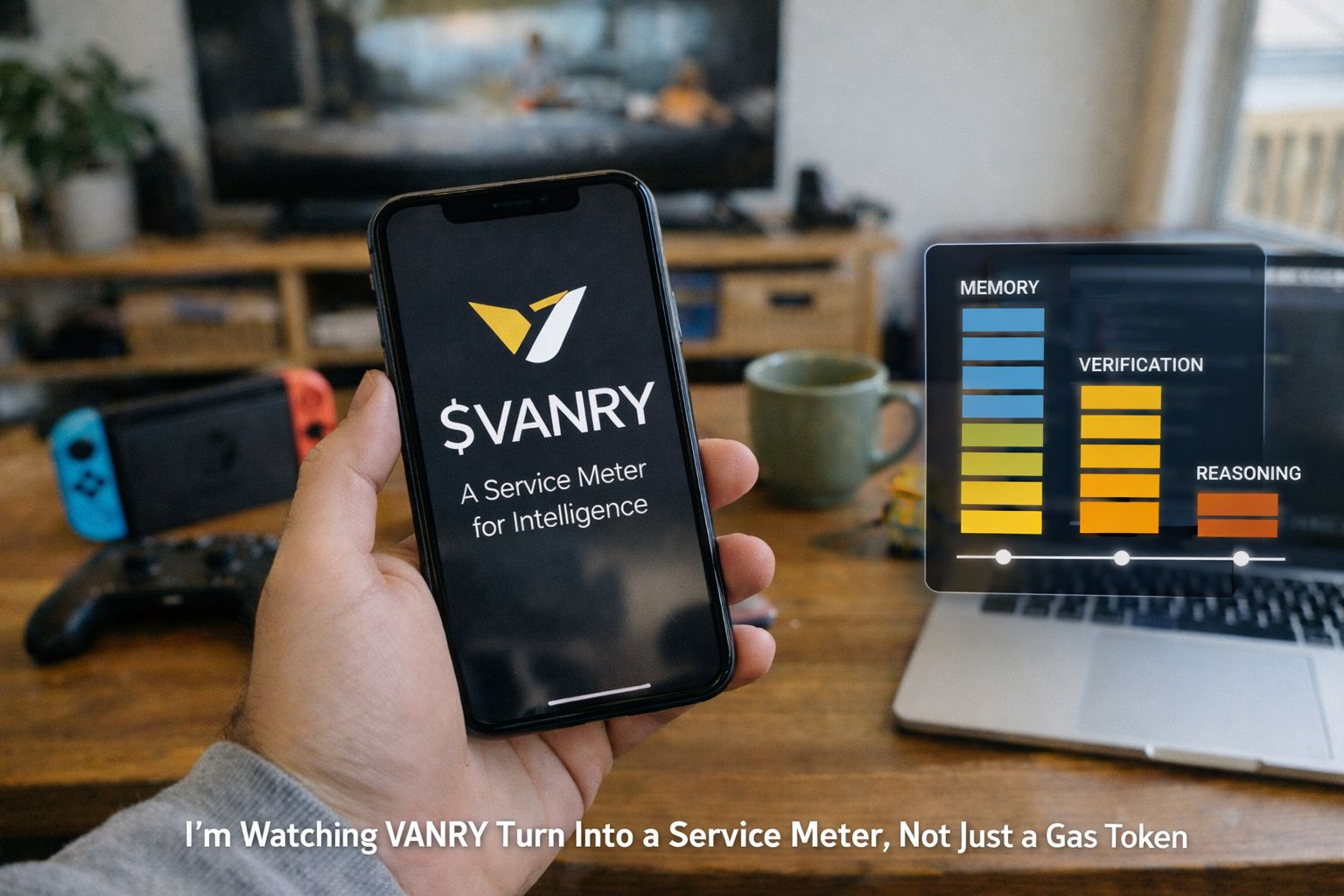
Instead of paying unpredictable fees because the network is crowded, I’m imagining a world where I’m paying for higher-value actions. I’m paying for memory. I’m paying for verification. I’m paying for structured queries. I’m paying for reasoning. These are things I already pay for today when I use cloud platforms and APIs.
When I use traditional cloud services, I don’t think about “gas.” I think about usage. I think about how much compute I’m consuming. I think about how many API calls I’m making. I get a bill based on what I actually use.
Now I’m watching Vanar and wondering: what if blockchain worked like that?
If Neutron, Kayon, and the rest of the Vanar stack become tools that builders actually use every day, then something important shifts. I’m thinking about developers who are building apps that need memory, intelligence, verification layers, structured data access. If they rely on Vanar for those capabilities, then demand for VANRY isn’t coming from traders refreshing charts. It’s coming from workflows running in the background.
That’s a huge difference.
I’m watching this idea closely: trader-driven demand versus workflow-driven demand.
Trader-driven demand is emotional. It spikes. It crashes. It depends on hype, momentum, narratives. I’ve seen that cycle play out too many times across crypto.
Workflow-driven demand feels quieter. It feels boring, almost. But I’m realizing boring is powerful. If businesses are using Vanar’s intelligence layer every single day, then they need VANRY not because they’re speculating, but because their product depends on it working.
That’s where it starts to look less like a meme asset and more like a service meter.
I’m also paying attention to the idea of fixed fees for predictable execution. As someone thinking about real-world applications, I’m asking myself what businesses actually want. They don’t want surprise costs. They don’t want fees spiking because the network is trending on Twitter. They want to forecast expenses. They want reliability.
If Vanar can offer predictable execution costs, that’s good for real apps. That’s good for companies trying to budget. That’s good for long-term planning.
Then I’m looking at VANRY as the key for premium capability. Not just paying to send a transaction, but paying to unlock higher-level features — deeper memory, stronger verification, structured reasoning. That’s where recurring utility starts to form.
I’m thinking about it like this: if intelligence becomes something measurable and billable, then VANRY becomes the meter that tracks usage. The more advanced the function, the more it costs. Not because the network is struggling, but because the value being delivered is higher.
That model feels more aligned with how modern infrastructure works.
Of course, I’m not blindly assuming this will succeed. I’m constantly reminding myself that execution decides everything. It’s easy to describe a clean business model. It’s much harder to build the technology, attract developers, and maintain performance at scale.
I’m watching to see if builders actually adopt Neutron or Kayon in their daily workflows. I’m watching to see if the tools are simple enough to integrate. I’m watching to see if the value is strong enough that teams choose Vanar not because of hype, but because it genuinely solves problems.
If that happens, the narrative around VANRY changes naturally.
I’m imagining a future where usage doesn’t look like chart speculation. It looks like monthly infrastructure spend. It looks like recurring service payments. It looks like companies quietly running processes on-chain because it’s efficient and reliable.
That kind of demand builds differently. It grows slowly. It compounds.
And that’s the shift I’m watching.
I’m not saying it’s guaranteed. I’m not saying it’s risk-free. I’m simply observing that the direction feels more sustainable than a congestion-based fee model. If Vanar really turns “intelligence” into something that can be measured, priced, and integrated into daily workflows, then VANRY stops behaving like a pure trading chip.
It starts behaving like access.
It starts behaving like infrastructure.
And if that transformation actually happens, I think we’ll look back and realize the real story wasn’t about gas at all. It was about turning intelligence into a billable service and using VANRY as the key that unlocks it.
For now, I’m watching.